
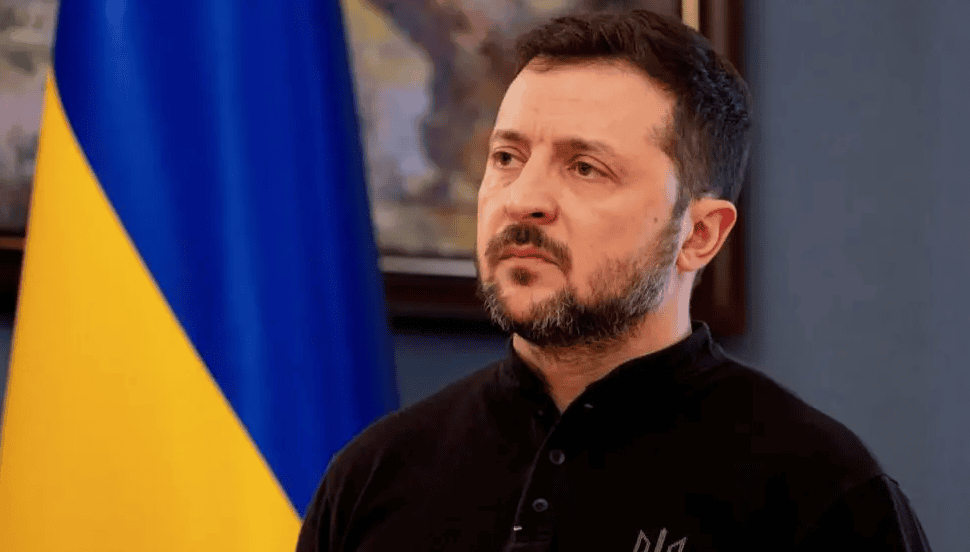
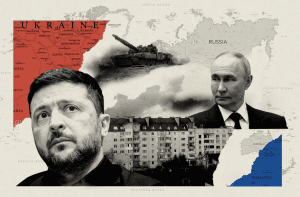
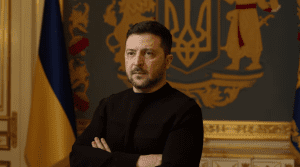
Ukrainian President Volodymyr Zelenskyy has rejected growing calls for presidential elections to be held during the war with Russia, warning that a vote under current conditions could deepen political divisions and threaten the country’s fragile unity.
Speaking to reporters on Saturday, Zelenskyy described wartime elections as a “huge risk”, arguing that the political upheaval surrounding a national vote could become as destabilising as the military pressures Ukraine is already facing.
“Elections right now are a tsunami for the country that will split Ukraine,” Zelenskyy said.
His comments followed an unprecedented call from former Defence Minister Mykhailo Fedorov for Ukraine to hold elections despite the ongoing conflict. Fedorov, who was dismissed by Zelenskyy in July after six months in office, has argued that Ukraine’s democratic institutions cannot remain indefinitely constrained by Russia’s invasion.
Under Ukrainian law, national elections are prohibited while martial law remains in force. The issue had largely remained outside the mainstream political debate until Fedorov’s intervention this week, which has opened a new and potentially consequential fault line within Kyiv’s political establishment.
A political debate unfolding under fire
Fedorov, a prominent and popular figure in Ukrainian politics, said Ukraine’s democracy should not be “held hostage by Russia”. He questioned whether Moscow should effectively determine when Ukrainians can next choose their leaders and warned of what he described as a broader crisis of governance.
Yet the practical obstacles to holding a credible election during an active war are formidable.
Millions of Ukrainians remain displaced, including people living abroad, while large parts of the country continue to face Russian missile and drone attacks. Organising polling, protecting voters and election workers, accommodating displaced citizens and ensuring the participation of soldiers on the front lines would present extraordinary logistical and security challenges.
Zelenskyy argues that these circumstances could transform an election from an expression of democratic choice into a source of national fragmentation.
“If we want to destroy the country, then we can move in the direction of elections during these times of war,” he said.
Military pressure intensifies
The political dispute comes as Ukraine continues to confront relentless Russian attacks.
Overnight strikes in the eastern Donetsk region killed two people and wounded two others, according to Ukrainian emergency services, while another Russian drone attack on Kharkiv injured eight people, including a child, and damaged residential buildings. A Russian drone also struck a passenger train travelling from Zhytomyr to Odesa, although no casualties were reported.
At the same time, Kyiv is attempting to adapt to Russia’s increasing use of ballistic missiles. Zelenskyy said Ukraine is increasingly focusing on locating and striking Russian launch sites as its supply of ballistic-missile interceptors becomes increasingly constrained.
According to figures cited by the president, Ukraine received 264 Patriot missiles in 2026, compared with 364 in 2025 and 675 in 2023.
Kyiv is also pursuing domestic production of Patriot interceptors following political support from US President Donald Trump, while negotiating additional air-defence capabilities with European allies. Zelenskyy said France had agreed to provide at least one SAMP/T system this year, while Germany is expected to supply approximately 600 PAC-2 and PAC-3 interceptors through 2028.
A widening financial challenge
Beyond the battlefield, Ukraine is facing a substantial financial shortfall.
Zelenskyy estimates that the country has a $27bn defence funding gap for 2026, following higher-than-anticipated military spending during the first half of the year. He said Kyiv requires at least another $8bn for what he described as a “normal start” to 2027, alongside roughly $20bn for other expenditures, including military salaries and payments to the families of fallen service members.
Norway, meanwhile, announced that it would provide 85 billion Norwegian kroner — approximately $9.2bn — to Ukraine for the 2027 fiscal year, matching its contribution for 2026.
The scale of Ukraine’s financial needs underscores the extent to which the war has become not only a military contest but also a long-term test of the country’s economic and institutional resilience.
The next battle for control of the skies
Zelenskyy also revealed that the technological competition surrounding the war is expanding beyond conventional weapons.
Both Russia and Ukraine are developing alternatives to Starlink, the satellite communications network controlled by Elon Musk that has become an important component of battlefield communications.
Zelenskyy said Russia’s system was being developed with Chinese assistance and could become operational by December. Ukraine, he added, is pursuing a comparable project with a European partner.
The development reflects the increasingly strategic importance of communications infrastructure in modern warfare — and the growing effort by both sides to reduce their dependence on foreign-controlled systems.
Democracy versus wartime survival
The election dispute places Ukraine before a difficult constitutional and political dilemma.
On one side is the principle that democratic legitimacy must ultimately be renewed through elections, even during periods of profound national crisis. On the other is the reality that a nationwide vote conducted under bombardment, with millions displaced and martial law in force, could prove difficult to administer fairly and could expose existing political divisions to unprecedented pressure.
For now, Zelenskyy has made his position clear: Ukraine’s immediate priority must be preserving its ability to withstand the war rather than opening a political contest that he believes could fracture the country from within.
But Fedorov’s intervention has ensured that the question of Ukraine’s political future can no longer be separated from the question of how, and when, the war itself ends.


Comments are closed.