
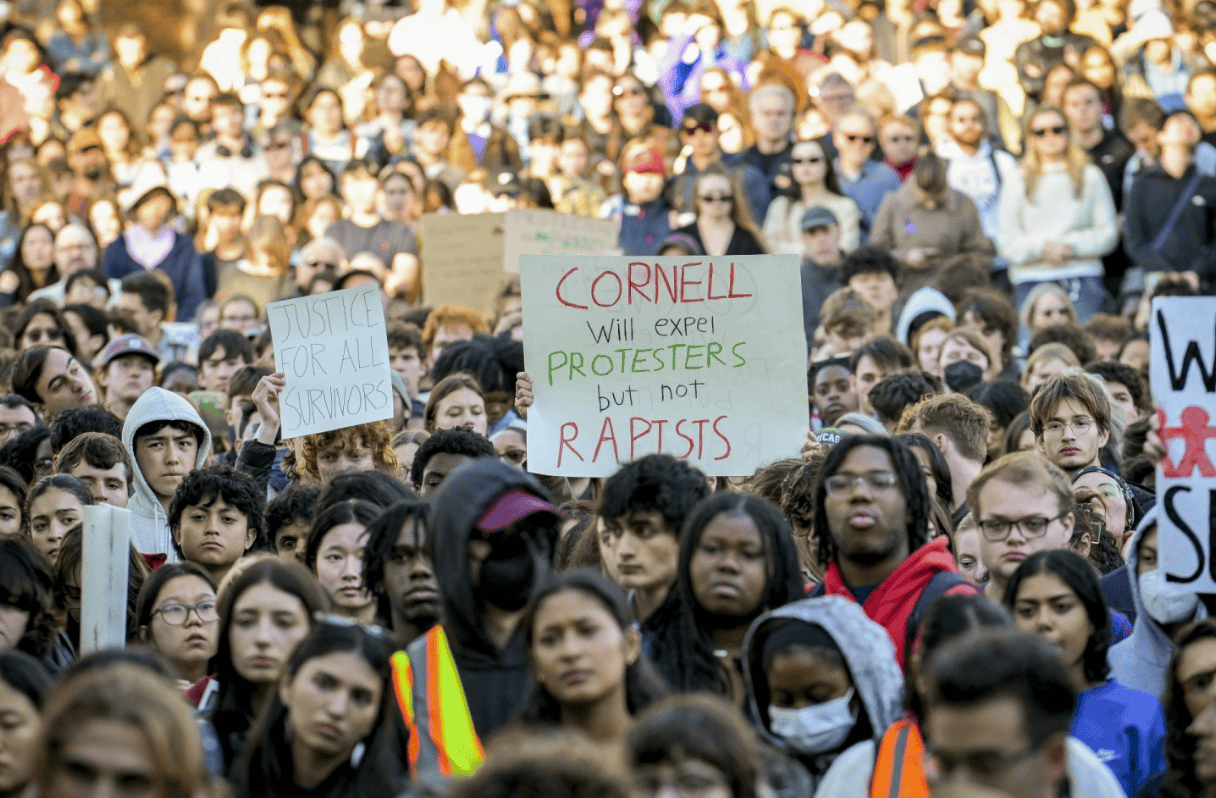
The Cornell sexual assault allegations have reignited a difficult debate in the United States over how the law defines consent when alcohol or drugs are involved. The case has also drawn attention to a significant difference between being intoxicated and being legally incapable of consenting to sexual activity.
A woman identified as Jane Doe in legal documents filed a lawsuit last month alleging that she was drugged and sexually assaulted by several men at a Cornell University fraternity house in 2024. She alleges that she had been drinking earlier in the night before going to the fraternity, where she was pressured to take ketamine and consume more alcohol. She says she became too intoxicated to consent.
The allegations have prompted renewed scrutiny of New York’s sexual assault laws and raised questions about whether existing rules adequately protect people who voluntarily consume alcohol or drugs before an alleged assault.
Cornell Sexual Assault Allegations Put New York Law Under Scrutiny
At the centre of the controversy is what has been described in public discussion as a “voluntary intoxication loophole.”
The phrase can be misleading, however. New York law does not give someone permission to have sex with a person simply because that person voluntarily drank alcohol or took drugs.
Instead, the legal question can turn on the person’s level of incapacitation.
Under New York’s current framework, a person may be unable to legally consent if they are unconscious or physically incapable of communicating their unwillingness to sexual activity. The difficulty arises when someone is extremely intoxicated but not clearly unconscious or physically incapable of communication.
That distinction can create a challenging legal threshold.
A person may be confused, heavily impaired, unable to make sound decisions or unable to understand what is happening without necessarily meeting the legal standard for incapacitation. Prosecutors must then establish enough evidence to demonstrate that the person’s condition prevented meaningful consent.
For advocates seeking changes to the law, that standard can place too much pressure on victims.
What Does Incapacitation Mean Under the Law?
The debate largely comes down to a deceptively difficult question: When is someone too intoxicated to consent?
There is no universal answer across the United States.
Some states use standards that focus on whether a person is incapacitated. Others use broader concepts such as impairment or significant impairment. As a result, conduct that may raise serious consent concerns in one jurisdiction can be treated differently under another state’s criminal law.
Former sex-crimes prosecutors have pointed out that New York law can still allow convictions in cases involving people who voluntarily became intoxicated. The crucial issue is whether the evidence establishes that the person was incapable of consenting at the time of the sexual activity.
However, former prosecutors and legal advocates disagree about whether that threshold is appropriate.
Critics of the existing system argue that a person can be severely impaired without being unconscious. They say requiring prosecutors to prove near-total incapacity can make some cases especially difficult to pursue.
Others warn that changing the standard without clearly defining it could create problems of its own.
Why Voluntary Drinking Does Not Equal Consent
One of the most important points in the debate is that drinking alcohol is not the same thing as consenting to sex.
A person can voluntarily decide to drink and still withdraw consent later. They can also become too impaired to make a meaningful decision.
Consent must relate to the sexual activity itself. Choosing to consume alcohol does not automatically communicate agreement to sexual contact.
This distinction is particularly important because alcohol can affect judgment, coordination, memory and communication. Drugs can produce additional effects, including confusion, sedation and impaired awareness.
The legal challenge is determining when those effects become severe enough that a person can no longer provide legally meaningful consent.
That is where disagreement emerges.
Cornell Uses a Different Standard for Consent
University policies can also differ from criminal law.
Cornell University uses an affirmative-consent approach. Under that standard, sexual activity requires a knowing, voluntary and mutual decision by the participants.
Silence or a lack of resistance does not automatically constitute consent.
This illustrates an important distinction between campus disciplinary procedures and criminal prosecutions. A university can establish its own conduct policies, while criminal cases are governed by state law and require prosecutors to meet the applicable legal standards.
As a result, behavior that violates a university’s sexual misconduct policy does not necessarily meet the elements required for a criminal conviction.
That difference can sometimes create confusion for students and the wider public, particularly when a highly publicised case involves both university investigations and criminal allegations.
New York Lawmakers Are Pushing for Change
The controversy has intensified calls to change New York’s sexual assault laws.
A proposed legislative change would broaden the circumstances under which an intoxicated person could be considered incapable of consenting. The proposed language focuses on whether substances have made someone temporarily incapable of assessing or controlling their conduct and whether that condition was known, or reasonably should have been known, by the other person.
Supporters argue that the change would better reflect the realities of severe intoxication.
They also say the current system can place too much of the burden on victims to demonstrate precisely how impaired they were.
The proposal has received support from lawmakers who believe New York should establish a clearer standard for cases involving intoxication.
Yet the legislation has also faced opposition from criminal defence attorneys and others who argue that the proposed language could be too vague.
Critics Warn Against an Unclear Legal Standard
Opponents of the proposed changes do not necessarily argue that intoxicated people should lose legal protection.
Instead, they question how a broader standard would be interpreted and enforced.
Terms describing someone as incapable of “appraising or controlling” their conduct can be difficult to apply consistently, critics say. Criminal law requires clear standards because defendants face serious consequences, including imprisonment.
There is also a practical question for prosecutors and juries: How should they determine the exact point at which intoxication becomes incapacity?
Someone may appear extremely drunk to one observer while behaving relatively normally to another. Alcohol affects people differently, and the circumstances surrounding an alleged assault can vary significantly.
These complications make the issue considerably more complex than simply establishing whether someone had been drinking.
The Broader Debate Over Consent
The Cornell case has therefore become part of a much wider American conversation about sexual consent.
At its heart is a basic principle: Consent must be voluntary and meaningful.
The disagreement concerns how the criminal justice system should identify situations in which intoxication has undermined a person’s ability to make that decision.
Supporters of reform argue that laws should recognise serious impairment even when a person is not unconscious. They believe a person should not have to reach an extreme level of incapacitation before the law recognises that meaningful consent was impossible.
Opponents counter that criminal statutes must define those circumstances with enough precision to be applied fairly. They warn that vague standards can make it difficult for prosecutors, defendants and juries to understand exactly what conduct falls within the law.
Both sides agree on one fundamental point: sexual activity without consent is unacceptable. The disagreement lies in how the law should identify and prove the absence of consent when alcohol and drugs are involved.
What Happens Next?
The allegations involving the Cornell fraternity have generated significant public attention, but the legal process must still determine what happened and whether any criminal laws were violated.
That distinction matters. Allegations are not findings of fact, and a lawsuit or public accusation does not by itself establish criminal responsibility.
At the same time, cases such as this can expose areas where existing laws leave difficult questions unanswered.
For New York lawmakers, the challenge is to create rules that protect people who are genuinely unable to consent while also providing clear and consistent standards for criminal prosecutions.
The debate is unlikely to end with one case.
Conclusion
The Cornell sexual assault allegations have brought renewed attention to one of the most complicated questions in sexual assault law: how should consent be treated when alcohol or drugs leave someone severely impaired?
New York’s current law does not make voluntary intoxication a defence to sexual assault, but critics argue that the threshold for proving incapacitation can be too demanding in some cases. Supporters of reform want a broader standard, while opponents warn that any new law must remain precise enough to be applied fairly.
Ultimately, the debate is about more than one university or one set of allegations. It concerns how society defines meaningful consent, how the justice system evaluates intoxication and how laws can protect victims while maintaining clear legal standards.
As New York lawmakers consider further changes, the central question remains straightforward but difficult to answer in practice: At what point does intoxication make genuine consent impossible?





















Comments are closed.