
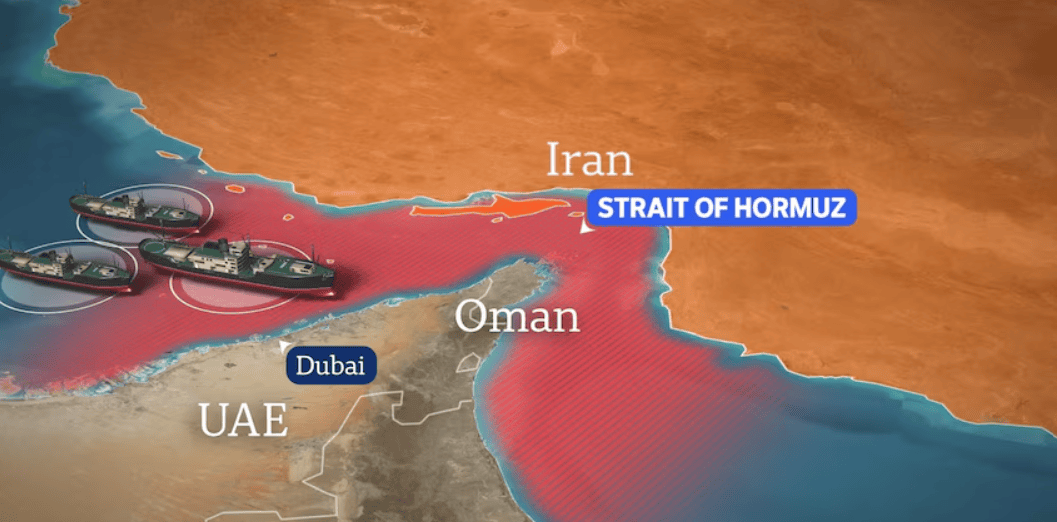
The Strait of Hormuz oil flows have become a major point of dispute as the United States and Iran offer sharply different accounts of how much commercial traffic is moving through the strategic waterway. Washington says US-backed vessels are crossing in significant numbers, while maritime tracking data indicates that traffic remains dramatically below normal levels.
The disagreement matters well beyond the Gulf. Hormuz is one of the world’s most important energy corridors, and uncertainty over whether tankers can safely pass through it has implications for oil markets, shipping companies and countries dependent on Middle Eastern energy supplies.
Why the Strait of Hormuz Matters So Much
The Strait of Hormuz connects the Persian Gulf with the Gulf of Oman and the wider Arabian Sea. During normal conditions, it carries a substantial share of global oil and gas exports.
Before the current conflict, roughly 100 vessels and about 20 million barrels of oil were estimated to pass through the waterway each day. That made Hormuz a critical artery for international energy markets.
The situation has changed dramatically since the US-Israel war on Iran began six months ago. Iran says it controls the strait and has restricted passage to vessels using approved routes. Tehran has also warned that ships attempting to use other routes could face attack.
Washington, by contrast, maintains that the waterway is open and that US forces are helping commercial vessels navigate it.
That fundamental disagreement helps explain why the two sides are presenting such different pictures of activity in Hormuz.
What the US Says About Strait of Hormuz Oil Flows
US officials have recently reported a substantial increase in commercial traffic.
President Donald Trump said the US Navy was helping roughly 30 ships cross the Strait of Hormuz each night. He also described the waterway as being under US control.
US officials cited by CNN said that 40 commercial vessels carrying approximately 18 million barrels of oil passed through on one Tuesday under American military escort. If accurate, that would represent a significant wartime increase in shipping.
US Treasury Secretary Scott Bessent offered another measure of activity, saying at least 10 million barrels of oil were moving through the strait each day. He said the figure reached between 15 million and 17 million barrels on one day.
The US position gained further attention after US Central Command said its forces had cleared transit lanes of sea mines.
Taken together, these statements suggest Washington believes it has substantially restored commercial access to one of the world’s most important shipping routes.
Yet independent maritime data tells a much more limited story.
What Shipping Trackers Show
The latest available tracking figures indicate that traffic remains well below prewar levels.
According to PortWatch data cited in the reporting, the overall average has fallen to about seven vessels per day since March. More recent figures from Kpler showed six vessels crossing on Wednesday, 11 on Tuesday and five on Monday, producing a 10-day average of about 13 vessels per day.
Lloyd’s List Intelligence reported a similar pattern. Between August 26 and September 1, it recorded roughly 12 daily transits. For the previous period, August 17 to 23, the company identified about 14 non-Iranian-linked ships crossing each day.
Those figures are considerably lower than the US claim that 40 commercial ships crossed in a single day.
The Joint Maritime Information Center, which monitors threats to commercial shipping, also said on September 1 that traffic remained far below its normal baseline, although there had been a modest increase from recent lows.
The organization continued to rate the risk to shipping in Hormuz as severe. Among the concerns it identified was the possibility of drifting or uncharted mines.
Why Do the Numbers Differ?
The apparent contradiction may not necessarily mean that one side is simply counting incorrectly. Maritime traffic is difficult to measure during a conflict, particularly when vessels stop broadcasting their positions.
How Ship Tracking Works
Commercial maritime databases often rely heavily on Automatic Identification System, or AIS, signals. Ships use AIS transponders to transmit information such as their identity, position, speed and direction.
However, vessels can switch off or limit those signals. In a conflict zone, that creates what maritime analysts call dark shipping, where a vessel’s movement is not immediately visible through standard tracking systems.
This means publicly available databases can underestimate the number of actual crossings.
Lloyd’s List Intelligence has acknowledged that its latest figures may be incomplete because of delays in identifying such movements. Some previously unrecorded voyages may only become visible after analysts reconstruct a vessel’s route.
The US military, meanwhile, has access to a much broader collection of information.
Different Definitions Can Produce Different Totals
Another explanation is that Washington and commercial tracking companies may not be counting the same kinds of vessels.
Maritime research specialist Eirik Hooper said a US operational tally could include vessels moving under or near naval protection, including tugs, offshore support vessels, coastal craft and other smaller ships.
Commercial databases may apply stricter filters. Kpler, for example, can exclude vessels based on characteristics such as size or whether they are carrying cargo.
That distinction could produce a large numerical gap.
There is also the question of intelligence sources. The US military can combine AIS information with satellite imagery, aircraft surveillance, other sensors and convoy information unavailable to commercial tracking companies.
As a result, the American figure could include movements that have not yet appeared in conventional public datasets.
Still, that does not automatically validate the much higher US figures. Without knowing exactly how Washington defines a “ship crossing” and what vessels are included, outside analysts cannot make a direct comparison with commercial tanker-tracking data.
Iran’s Account Adds Another Layer
Iran also claims control over the Strait of Hormuz, although its officials acknowledge that some vessels have managed to pass.
Iranian Parliament Speaker Mohammad Bagher Ghalibaf said the enemy had succeeded in getting some ships through the waterway but insisted that Iranian forces remained in control.
Iran’s Islamic Revolutionary Guard Corps later claimed that two oil tankers had struck mines while attempting to use an unauthorized route. Saudi Arabia separately accused Iran of attacking a Saudi tanker, with two Filipino sailors reportedly killed.
These competing claims underscore the security risks surrounding every transit.
For shipping companies, the issue is not simply whether a vessel can physically cross Hormuz. It is whether the voyage can be completed with an acceptable level of risk, insurance exposure and operational uncertainty.
What the Dispute Means for Global Oil Markets
The question of Strait of Hormuz oil flows has consequences far beyond the ships visible on tracking maps.
If substantial volumes of crude are genuinely moving through the waterway, pressure on global supply could ease. However, if actual traffic remains close to the levels reported by commercial trackers, the disruption to energy markets could be much more serious.
The difference also illustrates why wartime shipping statistics require caution. A single headline figure can obscure the methodology behind it.
For investors, governments and energy companies, the most useful approach is therefore to compare several indicators rather than rely on one announcement. Tanker movements, AIS data, satellite observations, official statements and port activity can each provide part of the picture.
The Bottom Line
The competing accounts of Strait of Hormuz oil flows reflect both the complexity of wartime maritime tracking and the strategic importance of the waterway. The US says escorted shipping has increased sharply, while commercial tracking services continue to record traffic far below normal levels.
Some of the discrepancy may be explained by different definitions, military intelligence and vessels operating with their tracking systems disabled. But the available evidence still points to a waterway operating at a fraction of its normal capacity.
Until independent observers can reconcile the competing methodologies, the true scale of oil moving through Hormuz will remain difficult to establish. For global energy markets, that uncertainty may be almost as important as the number of barrels actually crossing the strait.












Comments are closed.