
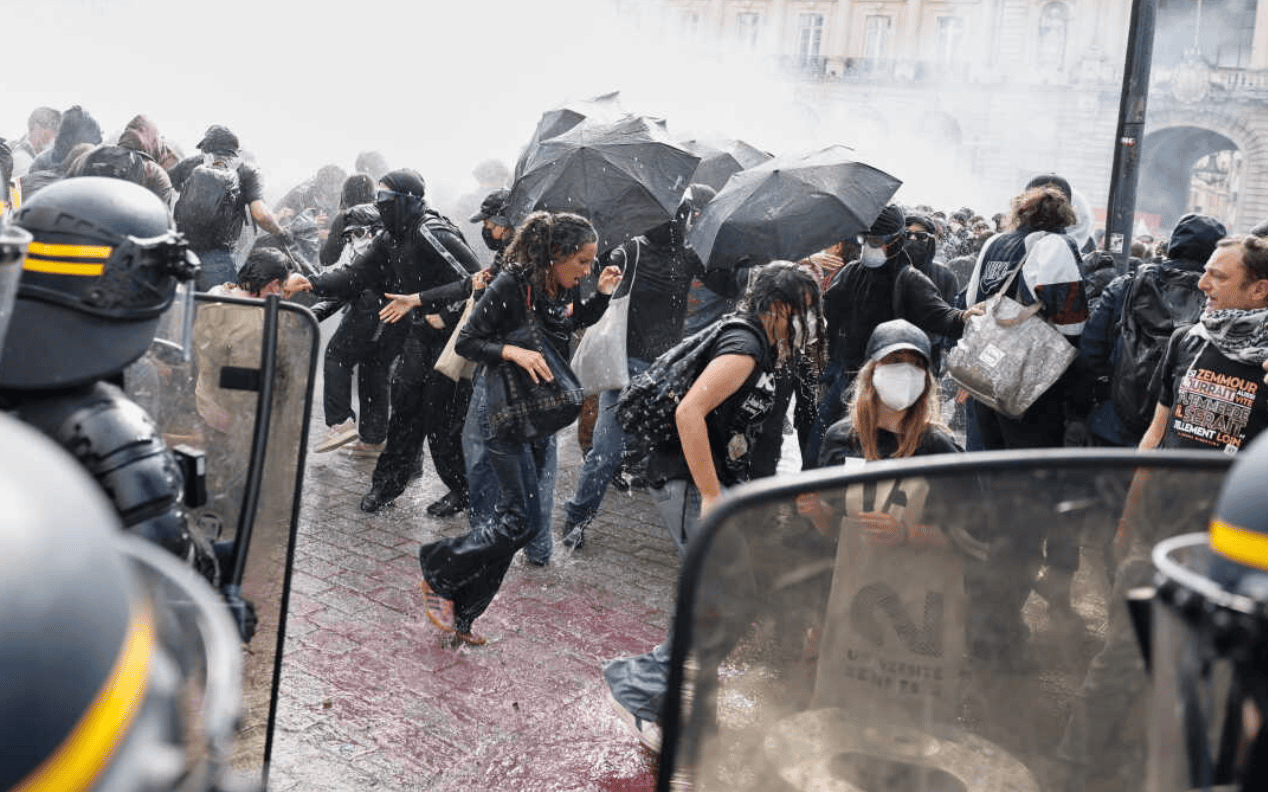
France has suspended the use of stun grenades during student protests after a 15-year-old boy lost his hand in an incident involving police in the northern city of Lens. The decision comes as demonstrations over school conditions continue to spread across the country, intensifying pressure on the government and raising fresh questions about police tactics.
France Halts Stun Grenades Amid Growing Outrage
Interior Minister Laurent Nuñez ordered the temporary suspension while authorities investigate exactly what happened near the Auguste Béhal high school in Lens.
The circumstances remain disputed.
Authorities say the teenager picked up an anti-encirclement grenade before it exploded. Students and other protesters have given a different account, alleging that police fired the device directly at him.
Nuñez said the suspension would remain in place until the facts surrounding the incident were established. France’s police watchdog, IGPN, has opened 18 investigations into whether officers used proportionate force during the demonstrations.
The decision reflects growing concern over the treatment of young protesters, particularly as the unrest has expanded beyond high school students to parents, university students and trade unions.
Teenager’s Injury Raises Questions About Police Tactics
The incident in Lens has become a powerful symbol of the tensions surrounding the protests.
According to local authorities, police were confronted by approximately 200 to 250 students who were throwing stones and fireworks. During the confrontation, the 15-year-old suffered catastrophic injuries when a grenade exploded.
Anti-encirclement grenades are classified as non-lethal weapons, but they can cause serious injuries. The devices are designed to disperse crowds and can release rubber projectiles when they detonate.
That distinction has done little to calm public anger following the teenager’s injury.
Nuñez acknowledged that the circumstances required scrutiny, saying that allegations of disproportionate police action must be investigated through the appropriate judicial process.
The controversy is also not an isolated case.
A 14-year-old boy was reportedly struck in the face by a tear gas grenade during an earlier protest in Saint-Ouen-l’Aumône, northwest of Paris. His lawyer said the teenager lost several teeth and suffered a fractured jaw. A police officer has been charged in connection with that incident.
Another Investigation Adds To Pressure On French Police
Authorities are also investigating a separate allegation involving a 17-year-old protester in Belfort.
Prosecutors said an attempted-murder investigation was opened after the teenager alleged that a police officer held his head underwater while attempting to arrest him near a river.
The investigation does not establish that the allegation is true, but its existence adds another layer to the growing debate over policing methods during the protests.
For the government, maintaining public order while avoiding further injuries has become an increasingly difficult balancing act.
Hundreds Of Thousands Join School Protests
The unrest has now developed into a nationwide movement.
More than 500 schools were fully or partially disrupted on Wednesday, while hundreds of thousands of people took part in demonstrations across France the previous day.
The protests began in mid-September and have focused on school conditions, including overcrowded classrooms, teacher shortages and deteriorating school buildings.
Demonstrators have also raised concerns about what they describe as excessive police repression.
The scale of Tuesday’s protests remains disputed. Government figures estimated that more than 250,000 people participated, while student unions put the figure closer to 450,000.
The interior ministry said 488 people were arrested and 43 members of the security forces were injured during Tuesday’s unrest.
Since the demonstrations began, government figures indicate that 215 students, 85 education staff members and 715 police officers have been injured.
More than 6,500 people have also been stopped or arrested during the wider protest movement.
French Government Faces Growing Political Pressure
The escalating demonstrations are creating a serious challenge for Prime Minister Sébastien Lecornu’s government.
President Emmanuel Macron held an emergency meeting with Lecornu and senior ministers on Tuesday night as officials searched for a way to ease the crisis.
Lecornu has condemned violence during the demonstrations while emphasizing the need to protect students and maintain public order.
The government’s challenge is complicated by the fact that the protests involve large numbers of young people.
When demonstrations involving teenagers lead to confrontations with riot police, the political consequences can extend well beyond the immediate disorder. Images of injured students can quickly become rallying points for wider opposition and further demonstrations.
Student groups have already indicated that another major protest is planned for Thursday in Paris and other cities.
Ryad Rani, head of the USL high school union, called for restraint and urged the interior minister to ensure that police officers exercise greater caution.
Why The Protests Matter
At the heart of the demonstrations is a broader argument about the future of France’s education system.
Students and their supporters say schools need more resources to address overcrowding, staffing shortages and poor infrastructure. The movement has grown because those concerns have increasingly connected with wider frustrations among teachers, parents and university students.
As a result, what began primarily as a high school protest has developed into a national political problem.
For the government, the immediate priority is preventing violence while addressing legitimate concerns about schools. For protesters, however, the police response has itself become a central part of the dispute.
That tension could determine what happens next.
France Stun Grenade Suspension Puts Police Response Under Scrutiny
The decision to suspend stun grenades represents a significant response to the injury in Lens, but it is unlikely to resolve the wider crisis on its own.
Investigators must now establish what happened to the 15-year-old and whether police actions were lawful and proportionate. At the same time, authorities face continued demonstrations, disrupted schools and growing demands for investment in education.
The coming days could prove crucial.
If the protests remain peaceful, pressure may shift toward negotiations over school funding and conditions. If confrontations continue, however, the debate over police tactics is likely to become even more prominent.
For now, France’s suspension of stun grenades is both a response to one teenager’s devastating injury and a sign of how seriously the government is treating the growing anger on the streets.








Comments are closed.