
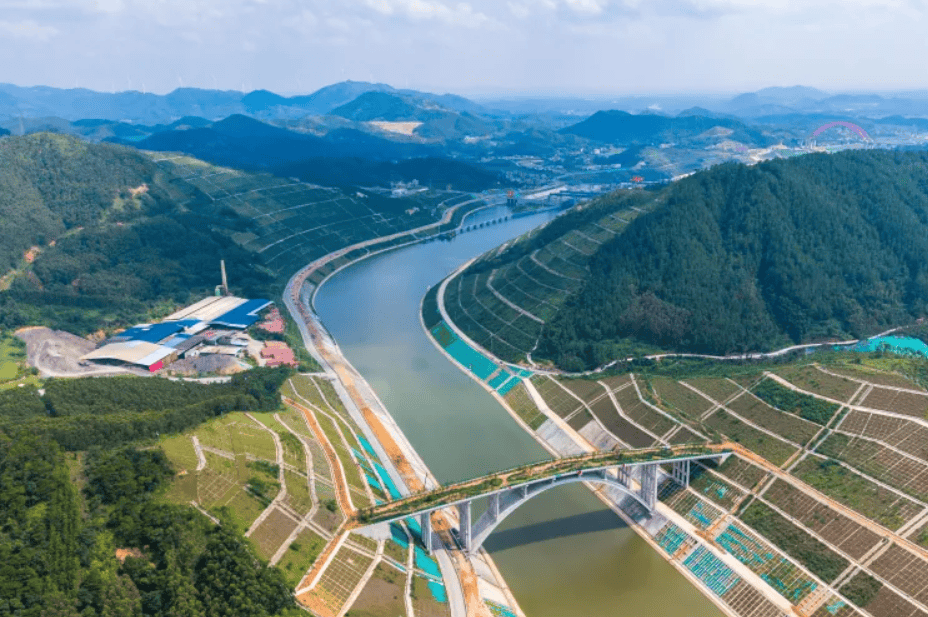
China has opened the Pinglu Canal, a major new waterway designed to give the country’s southwestern interior a shorter route to the sea and Southeast Asian markets. Stretching about 134 kilometers across Guangxi, the canal connects the Xijiang River with the Beibu Gulf and can accommodate vessels of up to 5,000 tonnes.
The project is more than a new shipping route. It is designed to reshape freight movement across southwestern China, strengthen trade connections with Southeast Asia and encourage industrial development along the corridor.
Why the Pinglu Canal Matters for Trade
For decades, geography has made access to international shipping routes more complicated for much of southwestern China. Goods moving from inland provinces toward the coast have often traveled long distances before reaching major seaports.
The Pinglu Canal changes that equation by creating a direct river-to-sea connection through Guangxi. The waterway links the Xijiang River system with the Beibu Gulf, providing inland cities with a new route toward international maritime markets.
Chinese authorities estimate that the canal can shorten shipping distances between parts of southwestern China and Southeast Asia by around 560 kilometers. They also expect logistics costs to decline significantly, with potential annual transportation savings running into billions of yuan.
For manufacturers, farmers and trading companies, those reductions could have a practical impact. Shorter routes can mean lower fuel consumption, reduced handling requirements and faster movement of goods.
How the Pinglu Canal Connects China With Southeast Asia
The canal forms part of the New International Land-Sea Trade Corridor, a transportation network linking western and southwestern China with coastal ports and overseas markets.
Its connection to the Beibu Gulf is particularly important. The port system has expanded rapidly, increasing its ability to handle containers and connect with major destinations across Southeast Asia.
This creates a broader logistics chain in which goods can travel from inland China by river, reach the Beibu Gulf and then continue by sea to international destinations.
Rail and road networks also complement the waterway. Together, these connections give companies multiple options for moving cargo between inland industrial centers and overseas markets.
China and ASEAN Trade Is Growing
The timing of the canal’s opening is significant because trade between China and Southeast Asia has expanded considerably.
China and ASEAN have developed deep commercial ties involving electronics, machinery, agricultural products, raw materials, chemicals and consumer goods. As manufacturing and supply chains become increasingly interconnected, transportation infrastructure has become an important part of the relationship.
The Pinglu Canal gives companies another route through which goods can move between the two regions.
For southwestern China, the potential benefits are particularly significant. Cities and industrial centers such as Chongqing, Chengdu, Guizhou and Yunnan are located far from the country’s traditional eastern coastal gateways.
A more direct connection to the Beibu Gulf could help reduce the geographic disadvantage faced by businesses operating far inland.
From Shipping Route to Industrial Corridor
The Pinglu Canal is also expected to influence development beyond transportation.
Guangxi is promoting an economic belt around the waterway, with the goal of attracting businesses, industrial investment and logistics operations along the new corridor.
Industries being targeted include non-ferrous metals, critical minerals, green chemicals, advanced manufacturing, artificial intelligence and information technology.
The strategy follows a familiar infrastructure model. Better transportation can attract businesses, while new businesses create additional demand for transportation and logistics services.
Industrial parks and commercial facilities near ports could also reduce the distance between factories and shipping terminals. That could make supply chains more efficient and potentially encourage companies to establish new operations in the region.
A Major Engineering Project
Constructing the canal required years of engineering work across Guangxi.
The waterway includes three major ship locks and has been designed to accommodate vessels carrying up to 5,000 tonnes. Its connection between inland rivers and the sea is intended to allow river vessels to reach the port area without repeatedly transferring cargo between different modes of transport.
That feature could be particularly useful for bulk commodities and other cargoes where additional handling increases costs and delays.
The project also includes environmental measures. One unusual feature is a dedicated wildlife crossing designed to allow animals to move safely across the canal corridor.
The crossing uses vegetation and natural materials to create a route for wildlife, reflecting efforts to reduce the impact of large-scale infrastructure on local ecosystems.
Resettlement Brings Another Dimension
Large infrastructure projects can transform communities as well as economies.
Construction of the Pinglu Canal required thousands of residents to relocate from areas affected by the project. Official figures put the number of people involved in resettlement arrangements at more than 11,000 across several counties and county-level cities in Guangxi.
Housing plans were developed to reflect local lifestyles and agricultural needs. Some residents received new homes that included space for businesses, storage and agricultural activities.
However, relocation also means leaving behind established communities and familiar surroundings. For families whose homes or villages were affected, the canal represents both an economic opportunity and a significant personal change.
Some residents reportedly moved mature trees from their former properties to their new homes, preserving a physical connection with places that had existed for generations.
What Happens After the Opening?
The opening of the Pinglu Canal marks the beginning of its most important test.
Building a major waterway creates capacity, but businesses ultimately determine how valuable that capacity becomes. Cargo volumes, shipping schedules, freight prices and connections with ports and inland transport networks will all influence the canal’s long-term performance.
Authorities have also introduced a temporary approach to transit fees as commercial navigation begins. The initial policy is intended to encourage operators to use the new waterway and gradually establish regular traffic.
Another important factor will be how quickly companies adjust their existing supply chains.
Businesses do not automatically change transportation routes simply because a new option becomes available. They need reliable services, competitive costs and predictable delivery times before shifting significant volumes of cargo.
The Pinglu Canal and the Future of Trade
The Pinglu Canal represents a major change in the transportation geography of southwestern China.
By connecting the Xijiang River system directly with the Beibu Gulf, the waterway gives inland regions a shorter path toward international maritime trade. Its role could become increasingly important as commercial ties between China and Southeast Asia continue to develop.
The project also reflects a broader trend in global trade. Countries and companies are increasingly interested in developing alternative transportation routes, strengthening supply-chain resilience and reducing dependence on individual trade corridors.
For Guangxi, the canal could become the foundation of a new economic corridor. For southwestern China, it offers another gateway to the sea. And for Southeast Asian trade, it adds a new connection to one of the world’s largest manufacturing and consumer markets.
The real measure of the Pinglu Canal will come in the years ahead. Its importance will ultimately depend on how much cargo moves through it, how many businesses benefit from the shorter route and how effectively the surrounding infrastructure develops.
For now, however, a long-planned transportation project has become an operating waterway, giving China’s southwest a new route toward the sea and strengthening its physical connection with Southeast Asia.















Comments are closed.