
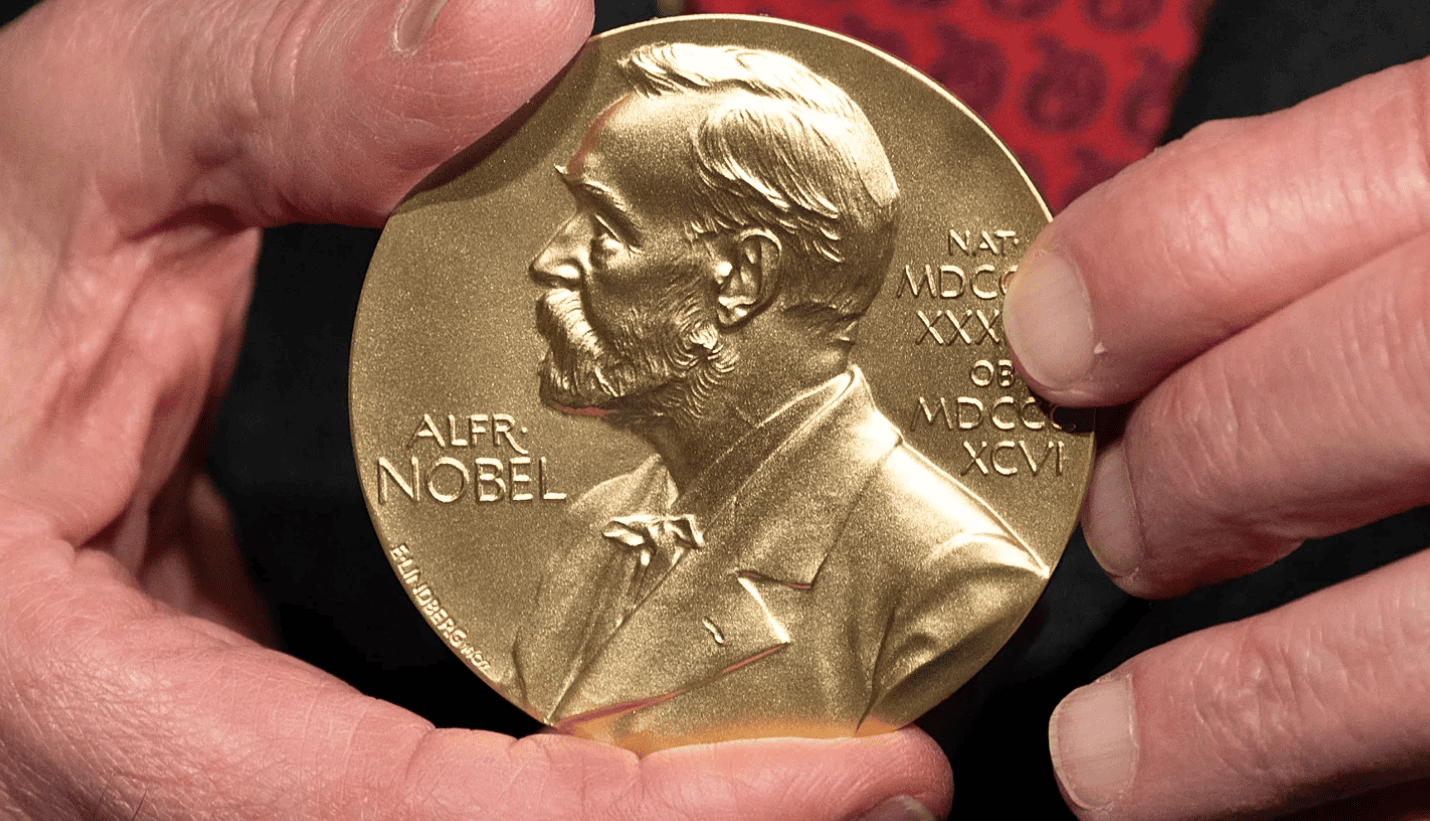
The 2026 Nobel Prize in Chemistry has been awarded to French chemist Henri B. Kagan and Japanese scientist Kenso Soai for work that helped explain one of chemistry’s most intriguing puzzles: why chemical reactions can favour one mirror-image form of a molecule over the other. Their discoveries have important implications for understanding the chemistry of life, developing medicines and exploring how biological “handedness” may have emerged.
At first glance, the problem sounds almost philosophical. Molecules can have two versions that are mirror images of each other, much like a left hand and a right hand. Yet living systems overwhelmingly use one version. Kagan and Soai helped show how chemistry can amplify such molecular differences rather than simply producing an equal mixture of both forms.
2026 Nobel Prize in Chemistry Tackles Molecular “Handedness”
The scientific concept at the centre of this year’s award is chirality, a property of molecules that cannot be perfectly superimposed on their mirror images. The term comes from the Greek word for hand, making the hand analogy particularly useful.
Consider your own hands. They contain the same basic parts, but your left hand cannot be perfectly placed over your right hand so that every feature matches. Certain molecules behave in much the same way.
The two mirror-image versions are known as enantiomers. Chemically, they may appear remarkably similar. However, biological systems can distinguish between them because proteins, enzymes and receptors are themselves three-dimensional structures.
That distinction matters enormously in medicine. Two enantiomers of a compound can interact differently with the human body. One may have the desired therapeutic effect, while the other may be less useful or behave differently altogether.
For pharmaceutical researchers, controlling molecular handedness is therefore far more than a technical detail. It can be central to designing and manufacturing effective medicines.
Why Does Life Choose One Molecular Form?
The bigger mystery goes beyond drug development.
Many of the molecules essential to life are chiral. Amino acids, for example, can exist in two mirror-image forms. Yet proteins in living organisms are built predominantly from one particular handedness of amino acid.
Scientists refer to this phenomenon as homochirality, meaning that biological systems strongly favour one molecular orientation.
The question is deceptively simple: how did that preference arise?
Nature appears to have developed a remarkable ability to select and preserve one molecular form. Ordinary chemical reactions, however, often tend toward mixtures containing both enantiomers.
Understanding how a tiny imbalance can become a strong preference is therefore relevant not only to synthetic chemistry but also to one of the deepest questions surrounding the origins of life.
The work recognised by this year’s Nobel Prize addresses a chemical mystery that has challenged researchers for generations.
How Kagan and Soai Changed the Chemistry of Chirality
Henri B. Kagan made an important contribution in the 1980s through research into asymmetric chemical reactions and the unusual ways in which small differences could influence the outcome of a reaction.
His work demonstrated that the relationship between a chiral catalyst and the handedness of the resulting product does not always behave in a simple, proportional way. Under the right conditions, a relatively small imbalance can produce a much larger difference in the final molecular mixture.
That insight became especially important because it suggested that chemistry could amplify asymmetry.
Kenso Soai subsequently pushed the idea much further. His research into asymmetric autocatalysis showed how a molecule produced during a reaction could help promote the formation of more molecules with the same handedness.
In simple terms, the chemical system could reinforce its own initial preference.
Soai’s research provided a striking demonstration of how molecular asymmetry can become increasingly pronounced through a chemical feedback process. This helped open a new window into the mechanisms that can produce highly selective molecular reactions.
Why This Discovery Matters for Medicine
The practical importance of chirality becomes clearer when chemistry meets biology.
The human body is not simply a container filled with chemicals. It is a highly organised molecular environment. Enzymes and receptors have precise three-dimensional shapes, allowing them to recognise certain molecules while interacting differently with their mirror-image counterparts.
A change in molecular orientation can therefore alter how a compound fits into a biological target.
This is one reason asymmetric synthesis has become such an important area of modern organic chemistry. Instead of producing both enantiomers and separating them afterward, chemists can seek methods that preferentially create the desired form during the reaction itself.
That approach can make the production of complex compounds more precise and potentially more efficient.
The significance extends across pharmaceutical research, where scientists routinely consider the three-dimensional structure of molecules when investigating how potential medicines interact with biological targets.
From Molecules to the Shape of Life
Chirality is not confined to test tubes.
Its influence can be seen throughout biology. The three-dimensional arrangement of molecules contributes to the structure and function of proteins, enzymes and other biological components. Those molecular choices can ultimately be reflected in larger structures found in living organisms.
Researchers studying biological chirality have pointed to striking examples in nature, including the direction in which snail shells coil.
The connection becomes even more fascinating when considering the human body. Biological development produces consistent patterns of left and right, including the position of major organs.
The chemistry behind these patterns is complex, and scientists do not have a complete explanation for every step. However, the relationship between molecular chirality and biological asymmetry provides an important window into how microscopic chemical properties can influence the architecture of living systems.
A Four-Billion-Year-Old Question
Perhaps the most profound aspect of the 2026 Nobel Prize in Chemistry is the connection between laboratory chemistry and the origins of life.
Life on Earth did not merely require molecules. It required systems capable of organising those molecules into increasingly complex structures and processes.
If early chemistry contained even a tiny preference for one molecular orientation, mechanisms capable of amplifying that preference could have played a role in establishing the molecular “handedness” that became characteristic of life.
That does not mean Kagan and Soai have solved the origin-of-life question. Their work addresses something more specific: it demonstrates chemical mechanisms through which asymmetry can be generated and amplified.
That distinction is important. Science rarely answers a vast question with a single discovery. Instead, breakthroughs provide pieces of a much larger puzzle.
A Nobel Prize for Fundamental Chemistry
The award also highlights the value of research whose importance may not be immediately obvious outside specialist laboratories.
Kagan and Soai were not simply searching for a new commercial product. Their research addressed a basic question about how chemical reactions behave and how a small asymmetry can become dramatically amplified.
Those principles have become part of the broader understanding of asymmetric organic chemistry.
The 2026 Nobel Prize in Chemistry therefore carries significance on several levels. It celebrates two scientists, recognises decades of research and draws attention to a fundamental feature of the molecular world.
More importantly, it shows how a seemingly abstract question about mirror-image molecules can connect chemistry with medicine, biology and the origins of life.
Conclusion
The 2026 Nobel Prize in Chemistry awarded to Henri B. Kagan and Kenso Soai shines a spotlight on one of nature’s most intriguing tricks: making molecular systems choose a particular “hand.”
Their work on molecular asymmetry and asymmetric autocatalysis helped demonstrate how small chemical differences can be amplified into a powerful preference for one molecular form. That insight has consequences for synthetic chemistry and pharmaceuticals while also offering a compelling way to investigate the molecular asymmetry found throughout living organisms.
The enduring lesson is that chemistry is not only about what molecules are made of. It is also about shape, orientation and interaction. Sometimes, the difference between a left hand and a right hand is enough to change the course of an entire chemical reaction.














Comments are closed.