
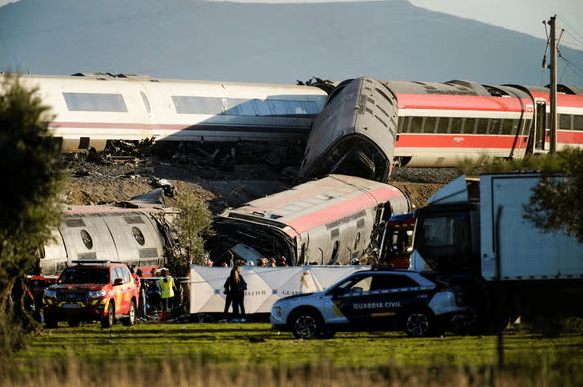
At least 68 people have died after two high-speed trains collided in central Spain, with dozens more injured. Authorities are investigating a possible failure in the railway signalling system and a decision to allow trains to resume normal operations.
At least 68 people have been killed after two high-speed passenger trains collided in Spain’s Toledo province on Wednesday, 28 October, triggering a major emergency response and raising urgent questions about railway safety.
The collision occurred shortly after 09:00 local time between the municipalities of Mora and Orgaz, approximately 140 kilometres south of Madrid. The trains were travelling in the same direction on a route connecting the Spanish capital with southern parts of the country.
According to Spanish authorities, more than 500 passengers were aboard the two trains. Dozens of people were injured, with some reported to be in serious or critical condition. Officials have warned that the death toll could rise as emergency operations and investigations continue.
How the Two Trains Collided
The accident involved a Renfe AVE high-speed train and an Iryo passenger service travelling from Madrid towards Seville.
Initial reports indicated that the Renfe train struck the Iryo train from behind while the latter was stationary on the tracks. The impact caused extensive damage, with several carriages derailing and some falling down an embankment.
Rail infrastructure operator Adif confirmed that the collision had taken place on the high-speed line. Both companies have been cooperating with the authorities as investigators work to establish the precise sequence of events.
The incident led to the suspension of rail traffic along the affected route. Services connecting Madrid with Ciudad Real and Andalusia were also disrupted, leaving passengers facing cancellations and delays.
Investigators Focus on a Signalling-System Failure
Spain’s Transport Minister, Óscar Puente, said a failure involving the railway’s signalling and control system preceded the collision.
According to his preliminary account, a communications problem affected the LZB train-control system across a stretch of approximately 63 kilometres of track at around 08:30. The malfunction automatically brought several trains to a halt.
The central traffic-control centre subsequently took over the management of train movements. At approximately 08:36, the Renfe train was reportedly authorised to resume normal operations, despite a red signal remaining active on the line.
It then travelled approximately 25 kilometres before colliding with the stationary Iryo train at around 08:53.
Puente described the decision to allow the train to continue at normal speed as “inexplicable” and said investigators were examining how the instruction was issued.
Under railway safety procedures, a signalling failure requires trains to operate under strict restrictions. One such procedure, known as marcha a la vista, requires drivers to proceed cautiously at a reduced speed, maintaining the ability to stop if an obstacle or another train is encountered.
The minister indicated that the train should not have been allowed to resume normal running under the circumstances. Authorities are examining communications between drivers and the control centre, along with technical records, to determine how the events unfolded.
The investigation remains ongoing, and the final cause of the collision has not been established.
More Than 500 Passengers Were on Board
Regional authorities said the Iryo train was carrying 146 passengers and a baby, while the Renfe service had 397 passengers on board.
The combined number of people travelling on the two trains exceeded 500, making the scale of the emergency response particularly challenging.
At least 68 deaths had been confirmed in reports from the regional authorities, while dozens of injured passengers were receiving medical treatment. Some casualties were reported to be in critical condition.
Emergency crews deployed firefighters, ambulances and helicopters to reach the crash site and assist survivors. The extensive damage to the carriages complicated rescue operations, while emergency teams worked to identify victims and account for missing passengers.
Spanish media also reported that Fátima Báñez, who heads the foundation of the Spanish Confederation of Business Organizations, was aboard one of the trains. Reports concerning missing individuals continued to emerge as authorities worked to establish the identities and whereabouts of those involved.
Hospitals Appeal for Support as Emergency Response Continues
Hospitals across the affected region faced an influx of patients following the collision. Medical facilities in Toledo, Ciudad Real and Alcázar de San Juan reportedly cancelled planned procedures to accommodate casualties.
A blood transfusion centre in Madrid also appealed for urgent donations, warning of a possible sudden increase in demand for medical care.
Local emergency services established reception areas to support survivors and coordinate assistance for affected families. Authorities continued working to provide medical treatment, information and practical support to those whose relatives were involved in the crash.
The European Union said it was ready to assist Spain if required.
Pedro Sánchez Vows a Full Investigation
Spanish Prime Minister Pedro Sánchez visited the crash site and expressed condolences to the victims and their families.
“The whole of Spain is grieving,” he said, describing the impact of the tragedy on families and communities.
Sánchez pledged that authorities would determine what caused the collision and investigate whether any negligence or failures in safety procedures had contributed to it.
“If there has been any negligence, it will come to light,” he said, adding that any confirmed shortcomings in the safety system would be addressed firmly.
The prime minister and other Spanish political figures cancelled public engagements in response to the disaster, including campaigning activities ahead of next month’s parliamentary elections.
Spain’s royal family also expressed shock and concern, offering condolences to the families of those killed and support to everyone affected.
The government announced three days of national mourning, scheduled to begin on 29 October.
Spain Faces Another Deadly Railway Disaster
The collision is the second deadly high-speed railway accident to strike Spain in 2026.
In January, a separate crash in southern Spain killed 46 people after a train derailed and its carriages entered the path of another service operated by Renfe.
The two accidents have renewed attention on railway safety, although investigators have indicated that the circumstances of the incidents appear to differ.
Spain operates one of Europe’s largest high-speed rail networks, connecting major cities through services run by the state-owned Renfe and private operators such as Iryo. The latest disaster is expected to prompt further scrutiny of signalling systems, operational procedures and the responsibilities of railway traffic controllers.
For now, the immediate priorities remain supporting survivors, informing families, identifying victims and establishing the exact sequence of events that led to Wednesday’s collision.
As investigators examine the technical failure and the decisions made in the minutes before the crash, authorities have pledged that any confirmed safety shortcomings will be addressed. The findings will be central to determining responsibility and assessing what changes may be needed to prevent another tragedy.








Comments are closed.