
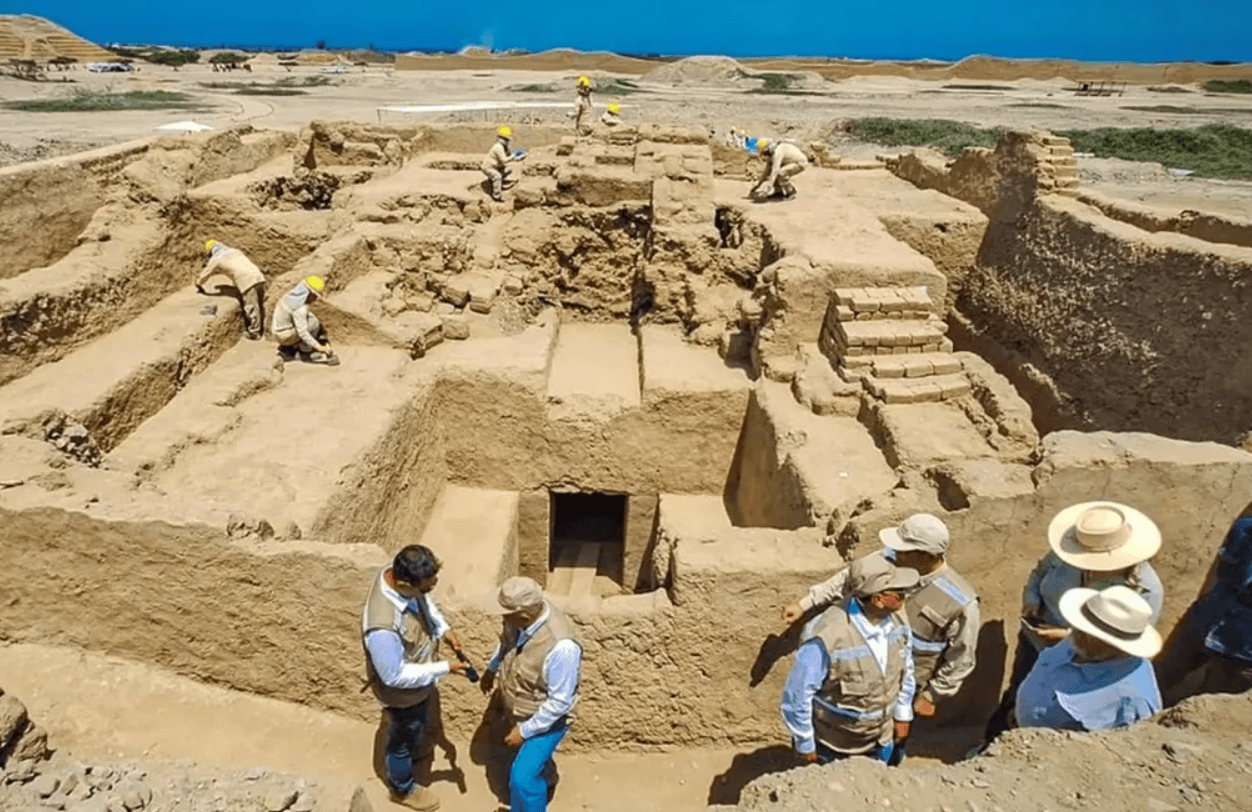
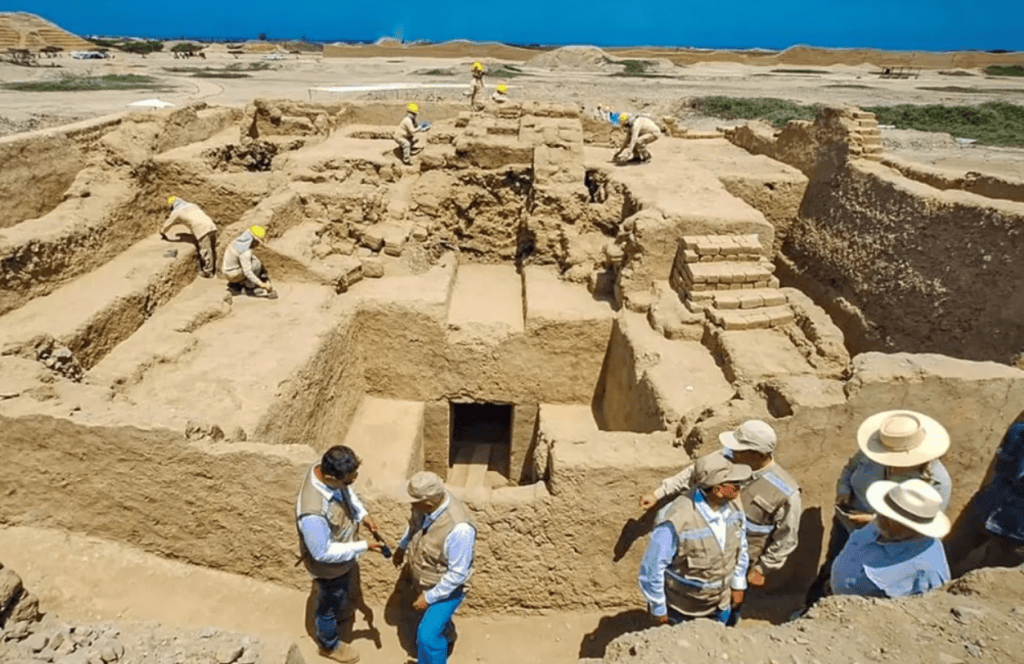
Archaeologists in Peru have uncovered a 600-year-old tomb in Peru that remained sealed for centuries, offering an unusually rare glimpse into the burial traditions and social hierarchy of the ancient Chimú civilization. The remarkably preserved mausoleum contained the skeletal remains of at least 38 people, along with weapons, ornaments, ceramics and other funerary objects.
The discovery was made at Chan Chan, the former capital of the Chimú kingdom near modern-day Trujillo. Because the burial had escaped major disturbance and looting, researchers now have an opportunity to study human remains and artifacts together, potentially revealing details that have remained hidden for more than half a millennium.
A 600-Year-Old Tomb In Peru Preserved Beneath Chan Chan
The newly identified mausoleum is located within the Utzh An complex at Chan Chan, the vast archaeological site that once served as the political center of the Chimú world.
The Chimú civilization flourished along the northern coast of present-day Peru from roughly 900 to 1470 CE. It developed sophisticated irrigation systems, monumental architecture and a highly organized society in one of the driest environments in South America.
Chan Chan eventually became one of the largest urban centers in the pre-Columbian Americas. Its enormous adobe compounds, ceremonial spaces and funerary platforms reflect the wealth and power of Chimú rulers and elites.
The newly discovered tomb adds another important piece to that story.
Unlike many elite burials previously studied by archaeologists, this mausoleum was found with much of its contents still in place. That distinction is critical because looting has affected numerous archaeological sites in Peru, separating artifacts from the human remains and archaeological contexts that give them meaning.
Why The Untouched Tomb Matters
An intact burial can tell researchers far more than an isolated artifact.
The position of the remains, the objects placed beside them, the construction of the chamber and even traces of pigments can help archaeologists reconstruct ancient funerary practices. Researchers can also compare the biological information from the skeletons with the objects associated with them.
According to archaeologists involved in the project, previous knowledge of Chimú elite burials often came from disturbed or looted sites. This discovery therefore provides a rare chance to examine an elite funerary complex in its original archaeological context.
Archaeologists Found 38 Human Remains
The burial complex contains a central chamber flanked by additional spaces. Researchers found one individual in the main chamber, although some of that person’s bones were missing, suggesting the remains may have been moved or reburied at some point.
Another area contained around 20 sets of human remains, while additional skeletons were discovered on the funerary platform.
Together, the excavations revealed the remains of at least 38 people.
The number alone makes the site significant, but archaeologists are particularly interested in what the arrangement of the burials may reveal about Chimú society.
The people buried there appear to have been connected to an elite individual or group. Their precise identities, relationships and roles remain unknown, however. Researchers must conduct further analysis before drawing firm conclusions.
Red Pigment Offers A Clue To Ancient Rituals
One of the most intriguing features of the discovery is the presence of red pigment on several skulls.
Researchers believe the material may be cinnabar, a naturally occurring red mineral composed primarily of mercury sulfide. Cinnabar was used in different parts of the ancient Andes and has been associated with ceremonial, funerary and symbolic practices.
Red pigments could be applied to objects, buildings and human remains. Archaeological evidence from the region indicates that such materials sometimes played an important role in rituals surrounding death and status.
If the pigment at Chan Chan is confirmed as cinnabar, its presence could provide another clue about the beliefs and practices associated with the people buried at the site.
However, researchers are continuing to analyze the material, so its precise composition and purpose should not be assumed before scientific testing is complete.
What The Burial Reveals About Chimú Beliefs
The discovery also highlights a broader feature of ancient Andean culture: death did not necessarily represent a complete separation from the living.
In several Andean societies, ancestors could remain important participants in family, political and religious life. Human remains might be moved, revisited or incorporated into rituals long after the original burial.
The missing bones in the central chamber could therefore be significant. Rather than indicating simple disturbance, they may reflect later treatment of the deceased.
This possibility is especially important when considering elite burials. A powerful individual’s tomb could serve not simply as a final resting place, but as a location where descendants or members of a political community continued to honor and interact with an ancestor.
The Chan Chan mausoleum may consequently provide evidence of a much longer funerary process rather than a single burial event.
Ceramics Could Reveal A Later Chapter
Archaeologists also recovered around 60 ceramic objects from the site.
Some appear to display stylistic characteristics associated with the Inca civilization, which expanded into the region after the Chimú had already established their powerful northern kingdom.
That detail could help researchers understand when the tomb was used and whether it remained significant after political control of the region changed.
The Chimú kingdom was conquered by the Inca during the 15th century. Therefore, objects showing later influences could provide evidence of cultural interaction during a period of major political transformation.
Rather than viewing Chimú and Inca culture as completely separate, the artifacts may help researchers explore how traditions, objects and practices changed as power shifted across the Andes.
Scientists Are Now Studying The Remains
The excavation is only the beginning of the research process.
Bioanthropological analysis of the skeletons could provide information about the individuals’ age, sex, diet and biological relationships. Scientists may also be able to investigate signs of disease, physical activity, injuries or other evidence preserved in the bones.
Those findings could eventually answer questions that archaeology alone cannot resolve.
Were the individuals members of the same family? Were some servants or retainers connected to an elite leader? Did they share similar diets and lifestyles? And why were so many people associated with the same funerary complex?
Researchers may also learn more by studying the artifacts alongside the human remains. Jewelry, weapons, metal ornaments, ceramics and other objects can help establish differences in status and social role.
Chan Chan Still Has More Secrets To Reveal
Perhaps the most striking aspect of the discovery is that it represents only a small part of a much larger archaeological story.
Only a fraction of Chan Chan has been excavated. Much of the ancient city remains buried beneath layers of earth, sand and debris, meaning additional discoveries could still change what researchers know about the Chimú civilization.
The newly uncovered mausoleum demonstrates why undisturbed archaeological sites are so valuable. A single tomb can preserve information about individuals, families, rituals, political authority, technology and beliefs all at once.
For now, the 600-year-old tomb in Peru stands as an extraordinary window into a civilization that disappeared centuries ago but left behind one of South America’s most remarkable archaeological landscapes.
As scientists continue analyzing the 38 sets of remains and the objects found alongside them, the tomb may reveal not only who was buried there, but also how the Chimú understood power, ancestry and death.
Conclusion
The discovery of this 600-year-old tomb in Peru gives archaeologists an exceptionally rare opportunity to study a largely preserved Chimú burial complex in its original context. The 38 human remains, red pigment, ceramics and valuable funerary objects could shed new light on elite status and ancient Andean burial traditions.
More importantly, the discovery shows that Chan Chan is far from an archaeological story that has already been fully told. With much of the ancient city still unexplored, researchers may yet uncover further evidence that changes our understanding of the Chimú world.






Comments are closed.