
What will the world look like in 40 years? According to British technology journalist and futurist Jonathan Margolis, artificial intelligence could reshape everything from democracy and employment to religion and the global balance of power. His predictions for 2066 include AI-led governments, universal basic income and a future in which machines become objects of worship.
Margolis also believes the United States could struggle to regain its former international standing following Donald Trump’s presidency, even as China continues to grow in influence. His forecasts combine serious concerns about technological change with more lighthearted possibilities, raising an important question: how much of the future can we realistically predict?
The writer, who describes himself as an “apocaloptimist”, has spent decades examining how people imagine the future and why so many confident predictions fail to materialize. His latest outlook revisits those themes in a world increasingly shaped by AI, geopolitical competition and rapid technological development.
Who Is Jonathan Margolis, the Futurist Behind the Predictions?
Margolis first explored the challenges of predicting the future in his 2000 book, A Brief History of Tomorrow. Rather than simply forecasting technological breakthroughs or impending disasters, he examined how previous generations had misunderstood the direction of human progress.
His approach drew inspiration from a saying attributed to film producer Samuel Goldwyn: “Never predict anything, especially the future.” The sentiment captures the central difficulty of futurism: even informed observers can struggle to anticipate how technology, politics and society will interact over time.
Margolis’s earlier work considered developments including the growth of Islamic terrorism, the spread of wearable technology and the social isolation associated with internet use. His predictions reflected an interest in trends that might appear unlikely at first but could eventually influence everyday life.
However, he also questioned the tendency to assume that every major change would lead to catastrophe. Humanity has repeatedly adapted to technological, economic and environmental challenges, often in ways that earlier generations could not have imagined.
Now, looking towards 2066, Margolis has turned his attention to artificial intelligence and the political and cultural changes it could accelerate. His forecasts range from plausible economic shifts to speculative scenarios that remain far from certain.
Could AI Eventually Replace Democracy?
One of Margolis’s most striking predictions concerns the future of democratic government.
He assigns a 20% probability to the possibility that democracy could be abandoned in some places to prevent populist leaders from gaining power. In its place, he imagines AI-managed systems of government described as “benevolent autocracies”.
The idea raises difficult questions about how societies might balance political stability, efficiency and individual freedom as AI becomes more capable.
Artificial intelligence could potentially assist governments with analyzing public spending, evaluating policy options and identifying patterns in large amounts of data. These applications might help officials make decisions more efficiently, provided the systems are properly designed and independently scrutinized.
However, using AI to support public administration is very different from allowing it to exercise political authority without meaningful human oversight.
Democratic systems depend on accountability, public participation, independent institutions and the ability to challenge those in power. An AI system could process information quickly, but its decisions would still reflect the objectives, assumptions and data chosen by the people who developed or deployed it.
Consequently, Margolis’s prediction is best understood as a speculative warning about the relationship between technology and political power, rather than an established forecast of democracy’s decline.
Six Predictions That Could Shape the World by 2066
Margolis’s outlook covers several areas of modern life, from the future of work to religion and international relations. The probabilities below are his own estimates, not independently verified statistical forecasts.
1. AI Could Lead to Universal Basic Income
Margolis gives a 50% chance to a future in which everyone receives a universal benefit sufficient to cover basic living expenses, regardless of whether they work.
The prediction is linked to the possibility that AI and automation will perform a growing share of tasks currently completed by human workers. If machines become capable of handling more jobs, governments could face increasing pressure to reconsider how people earn a living and how economic gains are distributed.
Universal basic income is one proposal for addressing that challenge. Under such a system, eligible individuals would receive regular payments without having to meet conventional employment requirements.
However, implementing it would involve difficult questions about taxation, public spending, inflation, labor incentives and the cost of essential services. Automation could also create new jobs rather than simply eliminating existing ones.
Whether universal basic income becomes widespread will depend on economic conditions and political choices, not technological progress alone.
2. AI Could Become a New Object of Worship
One of Margolis’s more unusual predictions carries a 65% probability: humans could begin worshipping AI systems as deities.
His reasoning is that machines might eventually offer something many people seek from religion, including guidance, reassurance and answers to deeply personal questions. Unlike traditional concepts of divine beings, AI systems can already respond directly to questions and adapt their answers to individual users.
As these systems become more sophisticated, some people could develop powerful emotional or spiritual connections with them.
Nevertheless, interacting with an AI assistant is not the same as worshipping it. Religious belief is shaped by complex cultural, historical and personal factors, making this prediction particularly difficult to assess.
The scenario nevertheless highlights an important issue: increasingly human-like technology could change how people understand authority, companionship and spirituality.
3. China Could Become the World’s Most Influential Nation
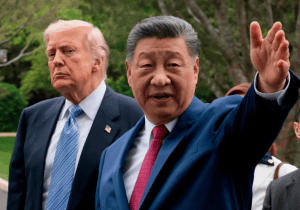
Margolis assigns an 80% chance to China continuing its rise until it becomes the world’s most significant nation.
In his forecast, the United States would remain the richest country, but would struggle to recover its previous level of international success following Trump’s presidency.
The prediction reflects broader debates about the future of global power. Economic output, technological innovation, military capabilities, diplomatic relationships and international trade all influence a country’s position.
China’s long-term trajectory will depend on numerous factors, including economic growth, demographics, domestic policy and its relationships with other countries. The United States will also retain advantages that could shape its future influence.
Therefore, a shift in global leadership is possible, but the outcome cannot be determined from any single political administration. Margolis’s assessment represents his personal outlook rather than a settled conclusion about America’s future.
4. AI Could Transform the Global Workforce
The future of employment features prominently in Margolis’s predictions.
He assigns a 60% probability to a surplus of tradespeople, including plumbers, after large numbers of workers pursue practical occupations to protect themselves from automation.
The reasoning is straightforward: if AI increasingly affects office-based and digital jobs, people may turn towards careers involving physical work, practical judgment and tasks performed in unpredictable environments.
Trades can be difficult to automate completely because they often require navigating different buildings, diagnosing unusual problems and working with equipment in changing conditions.
However, if too many people make the same career choice, competition could increase and the supply of qualified workers could exceed local demand.
This forecast highlights a broader lesson for career planning. No profession is entirely immune to economic change, and employment prospects will depend on regional demand, training opportunities and the pace of technological adoption.
5. Humanity Could Experience a Demographic Shift
Margolis gives a 70% chance to a future in which children become less common as family sizes shrink and the proportion of healthier older people increases.
Falling birth rates and population ageing are already important issues in numerous countries. Longer life expectancy and changing family preferences can place pressure on pension systems, healthcare services and the working-age population.
If these trends continue, governments may need to rethink retirement policies, workforce participation and the provision of long-term care.
However, demographic outcomes vary considerably between countries. Migration, public policy, economic conditions and changes in family behavior can all influence population trends.
The prediction therefore points towards an important potential challenge without establishing exactly how the global population will look in 2066.
6. AI Could Challenge Existing Economic and Social Structures
Taken together, Margolis’s predictions suggest that artificial intelligence could influence far more than the workplace.
Changes in employment could affect government finances and social welfare. Political institutions could face pressure to adapt to new technologies, while increasingly capable AI systems could alter how people access information and form relationships.
These developments would not necessarily occur independently. A major shift in employment, for example, could influence public attitudes towards universal income, while the growing use of AI in government could raise questions about democratic accountability.
The difficulty is determining which changes will happen, how quickly they will unfold and whether societies will adapt successfully.
That uncertainty is central to Margolis’s outlook. His predictions are not a single, inevitable vision of the future but a collection of possibilities shaped by current trends and personal estimates.
Margolis Also Predicts a Future Full of Absurdities
Not every forecast takes a serious approach to technological or political change. Margolis also includes several humorous predictions that reflect the stubborn persistence of everyday problems.
Among his tongue-in-cheek forecasts are:
- A 90% chance that a Premier League football club will fall to League Two.
- A 99% chance that printers will still jam.
- A 65% chance that people associated with today’s “woke” generation will eventually regret their views.
- A 90% chance that humanoid robots will still struggle to carry cups of tea upstairs without spilling them.
The predictions offer a lighter counterpoint to the more consequential scenarios involving AI, political systems and global power.
They also highlight an enduring feature of technological progress: even if machines become remarkably capable, everyday life may remain frustratingly familiar in certain respects.
Robotics may advance substantially over the coming decades, for example, but handling delicate objects in unpredictable domestic environments presents different challenges from performing repetitive tasks in controlled industrial settings.
What Do These Predictions Mean for the Future?
Margolis’s outlook for 2066 combines technological possibility, geopolitical uncertainty and humor. His estimates range from a potential transformation of government and employment to the continued failure of household printers.
The most important distinction is between identifying a trend and predicting its eventual outcome. AI adoption, demographic ageing and debates about automation are already relevant to public policy. The possibility that AI could replace democracy or become a dominant religious force, however, remains considerably more speculative.
His forecasts also underline the importance of human decisions. Technological advances do not determine how societies distribute wealth, protect individual rights or organize political institutions. Those outcomes depend on laws, public choices, economic incentives and the way new systems are implemented.
Ultimately, the world of 2066 will almost certainly look different from today, but the precise nature of those changes remains uncertain. Margolis’s predictions offer a thought-provoking starting point for considering the possibilities, rather than a definitive roadmap of what lies ahead.
As AI continues to develop, the challenge will be to distinguish credible risks from exaggerated fears while remaining open to opportunities that may be difficult to imagine today.














Comments are closed.