
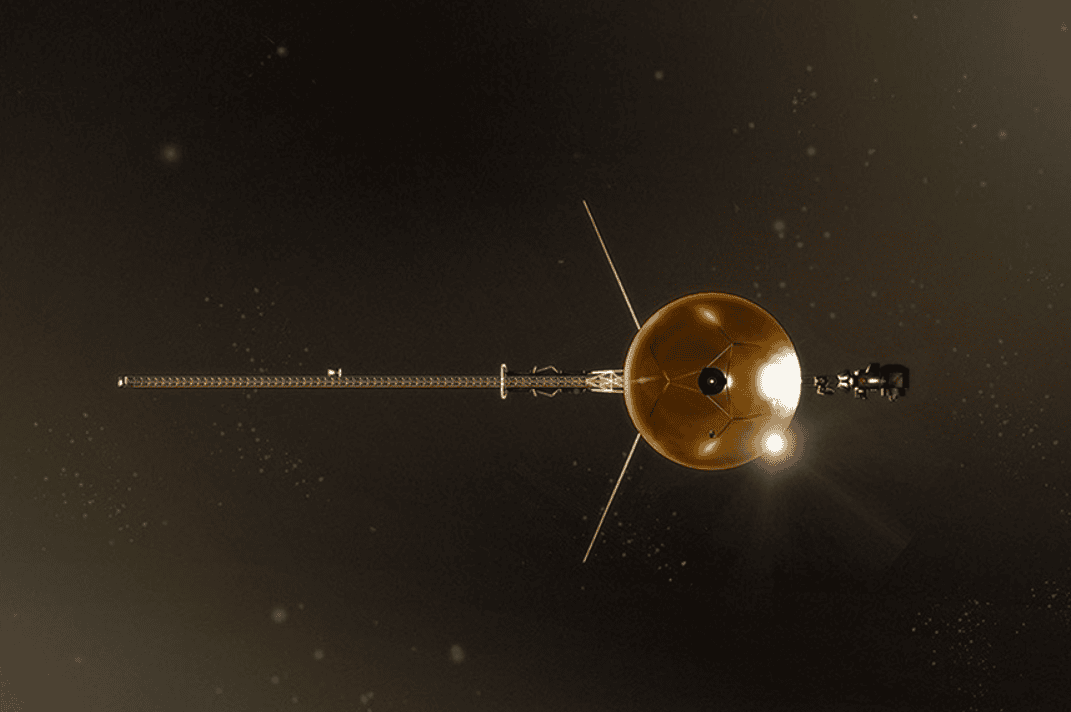
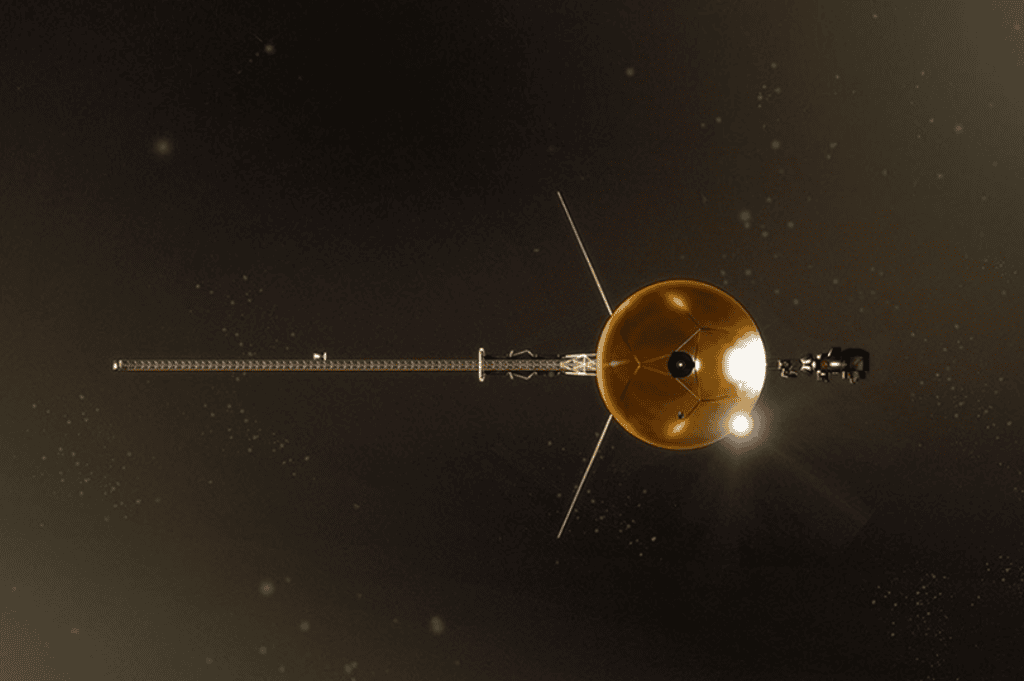
Nearly 50 years after leaving Earth, NASA’s Voyager 1 spacecraft has achieved another extraordinary milestone, travelling so far into space that radio messages now need an entire day to reach it. On November 18, 2026, the historic spacecraft reached a distance of one light-day from our planet, marking a remarkable moment in humanity’s exploration of the universe.
Launched in 1977, Voyager 1 has travelled farther than any other human-made object. Its latest achievement highlights just how enormous the distances between stars really are, even when spacecraft travel continuously for decades. More remarkably, despite moving at approximately 38,000 miles per hour (61,000 kilometres per hour), Voyager 1 remains nowhere near the speed of light.
NASA’s Voyager 1 Reaches the Historic One Light-Day Milestone
According to NASA, Voyager 1 officially reached the one-light-day distance at 5:16:07 a.m. EST on November 18, 2026.
But what exactly does that mean?
A light-day represents the distance light travels through space in 24 hours. Since light moves at approximately 186,000 miles per second (300,000 kilometres per second), one light-day equals roughly 16 billion miles, or 26 billion kilometres.
In other words, Voyager 1 is now so distant that even a signal travelling at the fastest speed known to science requires an entire day to reach the spacecraft.
This is particularly impressive when considering that radio communications travel at approximately the speed of light. Despite the technology involved, NASA cannot simply send a message and expect an immediate response.
Why It Takes 48 Hours to Send and Receive a Message
The enormous distance creates a significant communication delay.
When NASA sends instructions to Voyager 1, the radio signal takes approximately 24 hours to arrive. If the spacecraft responds immediately, its reply requires another 24 hours to travel back to Earth.
That means a complete exchange can take around 48 hours.
For engineers monitoring the spacecraft, this requires careful planning. Commands cannot be sent with the expectation of an immediate reaction, and troubleshooting becomes increasingly challenging as the distance grows.
NASA has developed sophisticated communication systems to maintain contact with Voyager 1, demonstrating the remarkable capabilities of the Deep Space Network.
Voyager 1 Has Been Travelling Through Space Since 1977
Voyager 1 began its extraordinary journey on September 5, 1977, when NASA launched it as part of its ambitious Voyager programme.
Its original mission focused on exploring the outer planets of our solar system, particularly Jupiter and Saturn.
During its planetary encounters, the spacecraft collected valuable scientific information and captured observations that transformed our understanding of these distant worlds.
However, its mission did not end after completing those objectives.
NASA extended Voyager 1’s journey, allowing scientists to investigate the outer boundaries of the Sun’s influence and eventually explore the interstellar environment beyond the heliosphere.
In 2012, Voyager 1 became the first spacecraft confirmed to enter interstellar space, making another historic contribution to space exploration.
Today, it continues travelling away from the Sun, carrying scientific instruments that help researchers study an environment no human has ever physically visited.
Where Is Voyager 1 Heading Next?
Although Voyager 1 is travelling in the direction of the star Gliese 445, located in the constellation Ursa Minor, it is important to understand that the spacecraft is not actively travelling there to explore it.
Gliese 445 is more than 17 light-years away from Earth. NASA estimates that Voyager 1 will pass approximately 1.7 light-years from the star in around 40,000 years.
That is an almost incomprehensible timescale.
Even after travelling through space for nearly five decades, Voyager 1 has covered only a tiny fraction of the distance separating stars.
Its projected passage near Gliese 445 also highlights another fascinating aspect of interstellar travel: reaching another star system remains an enormous challenge, even for a spacecraft that has been continuously moving since the 1970s.
By the time Voyager 1 reaches that region, its scientific mission will almost certainly have ended.
NASA Creates an Interactive Tool to Track Voyager 1
For anyone curious about the spacecraft’s incredible journey, NASA offers an interactive visualisation platform called NASA’s Eyes.
The tool allows users to explore spacecraft positions and better understand the distances involved in missions across the solar system.
One particularly interesting aspect is the ability to visualise communication delays. It demonstrates how even signals travelling at light speed can take hours or days to cross the enormous distances separating Earth from distant spacecraft.
This provides a useful perspective on the challenges facing modern space exploration.
After all, communicating with a spacecraft millions of miles away is already complicated. Maintaining contact with an object billions of miles from Earth requires extraordinary engineering and precision.
People Around the World Celebrate Voyager 1’s Achievement
To mark the historic one-light-day milestone, NASA encouraged people around the world to participate in a symbolic celebration.
The initiative invited participants to create a wave of golden light around Earth after sunset on November 17.
People were encouraged to use mobile phone torches, flashlights and even illuminated buildings to contribute to the collective display.
The symbolic gesture represented humanity’s connection with Voyager 1 and its remarkable journey into the unknown.
Although the lights could not physically reach the spacecraft, the event offered an opportunity for people to celebrate a mission that has inspired generations of scientists, engineers and space enthusiasts.
It also served as a reminder that Voyager 1 represents something much bigger than a technological achievement: humanity’s curiosity and determination to explore beyond our own planet.
Voyager 1 Continues to Push the Boundaries of Space Exploration
Voyager 1 reaching one light-day from Earth is a powerful reminder of how vast our universe really is.
Nearly five decades after launch, the spacecraft continues its journey into interstellar space, carrying instruments and technology developed in an entirely different era of computing.
Its communication delay now illustrates the extraordinary distances involved in exploring beyond our solar system. A simple exchange of messages requires roughly two days, even though radio signals travel at light speed.
And yet, Voyager 1’s story is far from over. Its journey will continue long after the original planetary mission has become a distant chapter in space exploration history.
For now, this latest milestone offers another reason to celebrate one of NASA’s most remarkable achievements and the human ambition that made it possible.















Comments are closed.