
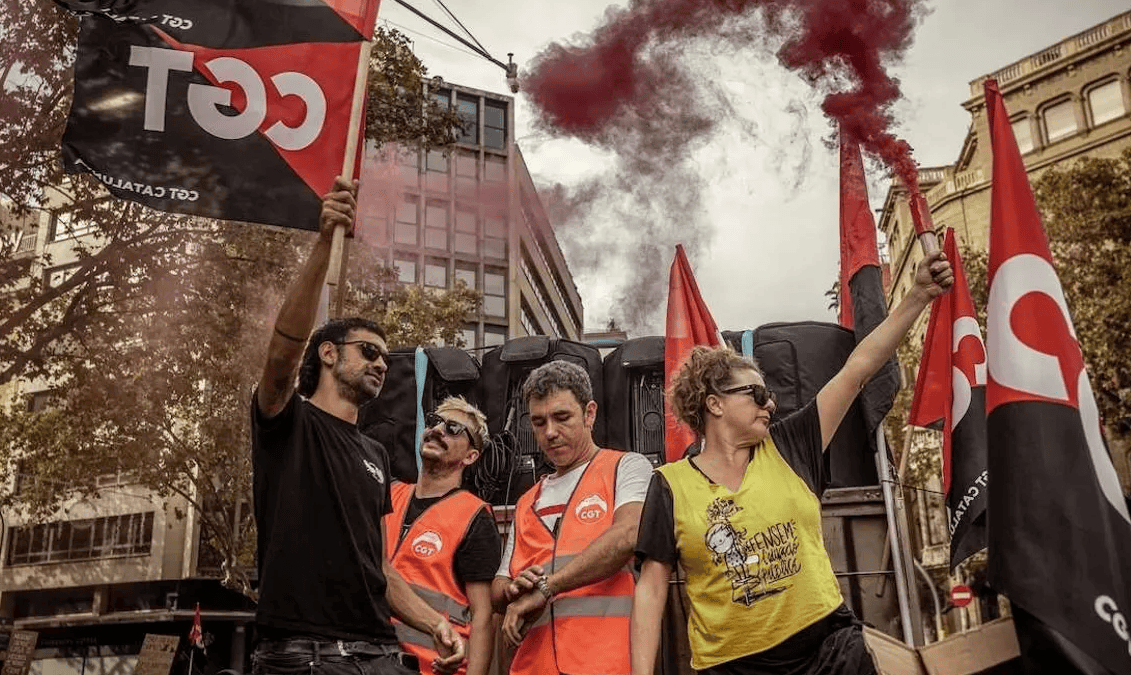
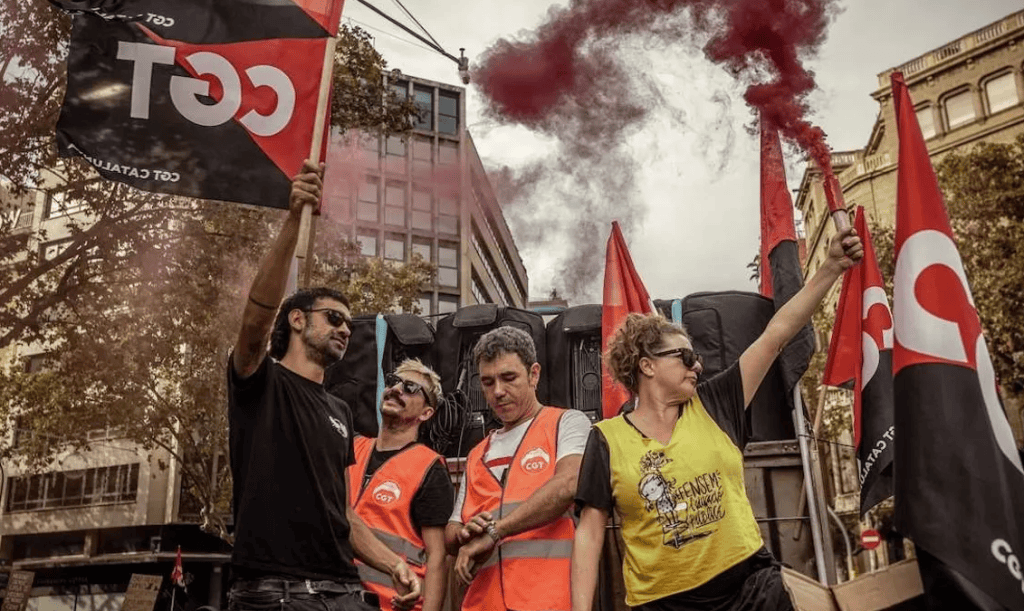
Violent clashes broke out between protesters and police in Barcelona after tens of thousands of people across Spain joined the country’s first general strike in 14 years, protesting rising housing costs and the growing pressure of the cost-of-living crisis.
The nationwide action, organised by Spain’s major trade unions, caused significant disruption to public transport, traffic and other public services. Demonstrations took place in several major cities, with approximately 120,000 people gathering in Madrid and more than 50,000 taking to the streets of Barcelona.
While much of the protest activity was peaceful, tensions escalated in central Barcelona on Wednesday evening. Groups of masked individuals set fire to rubbish bins, damaged shop windows and confronted police officers, who responded with tear gas.
Police and Protesters Clash in Central Barcelona
A heavy police presence was deployed across Barcelona as demonstrations continued into the evening. Some of the most serious disturbances were reported around Passeig de Gràcia, close to the city’s central Plaça de Catalunya.
Footage from the area showed fires burning in the streets and smoke rising from rubbish bins set alight during the unrest. Local media also reported that fireworks were directed towards police officers and that several shops were targeted, including a Lego store. Some protesters reportedly attempted to enter an Apple Store.
Spain’s Interior Ministry said dozens of people had been arrested in connection with various incidents. Reports also indicated that estate agency offices had been attacked during the demonstrations.
Despite the violence in parts of the city, people who attended the protests described much of the demonstration as peaceful. One woman who spoke to the BBC said the atmosphere had initially been joyful, with families, children and older people participating to demand more affordable housing.
However, she described seeing fires across the streets later in the evening, as the situation became increasingly intense.
Housing Crisis and Rising Living Costs Fuel Strike
The general strike was driven by growing frustration over Spain’s housing shortage, rising rental prices and the widening gap between wages and everyday expenses.
One event that helped intensify public anger was the eviction of 87-year-old Maricarmen Abascal from her Madrid apartment, where she had lived for approximately seven decades. She was reportedly forced to leave after her rent tripled under new landlords and died in hospital several weeks later.
Her case became a focal point for housing campaigners and helped bring renewed attention to the difficulties faced by tenants across the country.
According to property portal Idealista, the average monthly rent for a 50-square-metre apartment in Madrid reached €1,170 in October. Spain’s average gross monthly salary stands at approximately €2,460, meaning rent for such a property would consume nearly half of that amount before taxes and other living expenses.
Housing experts and public institutions often recommend that households spend no more than 30% of their income on housing, highlighting the financial pressure facing many Spanish residents.
For younger workers in particular, the combination of expensive rentals, high property prices and everyday costs has made saving for home ownership increasingly difficult.
Workers Describe Growing Financial Pressure
Among those participating in the Madrid demonstrations was 27-year-old Gonzalo Álvarez, who volunteers with a housing union while working in sales.
Álvarez said the eviction of Abascal had become a turning point for many people concerned about housing affordability. He had known the elderly woman and described being deeply affected by her situation.
He also shared his own experience of the rental market. Álvarez and his girlfriend, who works as a dental hygienist, rent a small one-bedroom apartment in Madrid’s Arganzuela district for €1,000 a month.
The couple each spend approximately half their salaries on rent, before accounting for electricity, water, food and other essential expenses.
He told the BBC that buying a property appeared increasingly unrealistic given current salaries and the amount of money required for a deposit.
His experience reflects broader concerns among younger Spaniards who feel that stable housing and home ownership are becoming less accessible despite working full-time.
Spain’s Political Parties Divided Over the Strike
The demonstrations have also become part of a wider political debate ahead of Spain’s parliamentary elections scheduled for 29 November.
Prime Minister Pedro Sánchez, whose Socialist government called early elections after parliament failed to approve its proposed housing reforms, has expressed support for workers exercising their right to strike.
Sánchez has pointed to previous labour movements as important moments in securing rights such as the eight-hour working day, pensions and public healthcare. He has also defended the legitimacy of the latest demonstrations against criticism from political opponents.
The conservative People’s Party (PP), however, has accused the government of using the strike for political purposes ahead of the election.
Party leader Alberto Núñez Feijóo dismissed the action, while PP spokesman Miguel Tellado accused the government of attempting to influence voters by presenting the demonstrations as a warning against a potential right-wing administration.
The business community has also criticised the strike. Miguel Garrido, vice-president of Spain’s largest business association, the CEOE, argued that housing prices were not primarily an employment issue and described the action as politically motivated.
The disagreement highlights how housing affordability has become a central issue in Spain’s political landscape, with different groups debating responsibility for the crisis and the appropriate response.
First General Strike Since 2012 Disrupts Services Nationwide
Spain has not experienced a general strike on this scale since 2012, when the country was governed by the conservative administration of Mariano Rajoy.
The latest action affected transport networks, major roads and public services, with demonstrations and picket lines reported across the country.
One measure of the strike’s impact was electricity demand. Data from Spain’s electricity system operator, Red Eléctrica, showed that power consumption in the industrial sector fell by 7.5% during the early hours of Wednesday.
During the previous general strike in 2012, comparable electricity consumption dropped by more than 15%.
The level of participation is expected to be closely examined as an indication of public dissatisfaction ahead of the November election.
With housing costs continuing to place pressure on household budgets, the demonstrations have brought one of Spain’s most pressing social and economic challenges into sharper political focus. The clashes in Barcelona have also highlighted the tensions surrounding a movement that began with demands for affordable housing and better living conditions but escalated into unrest in parts of the country.













Comments are closed.