
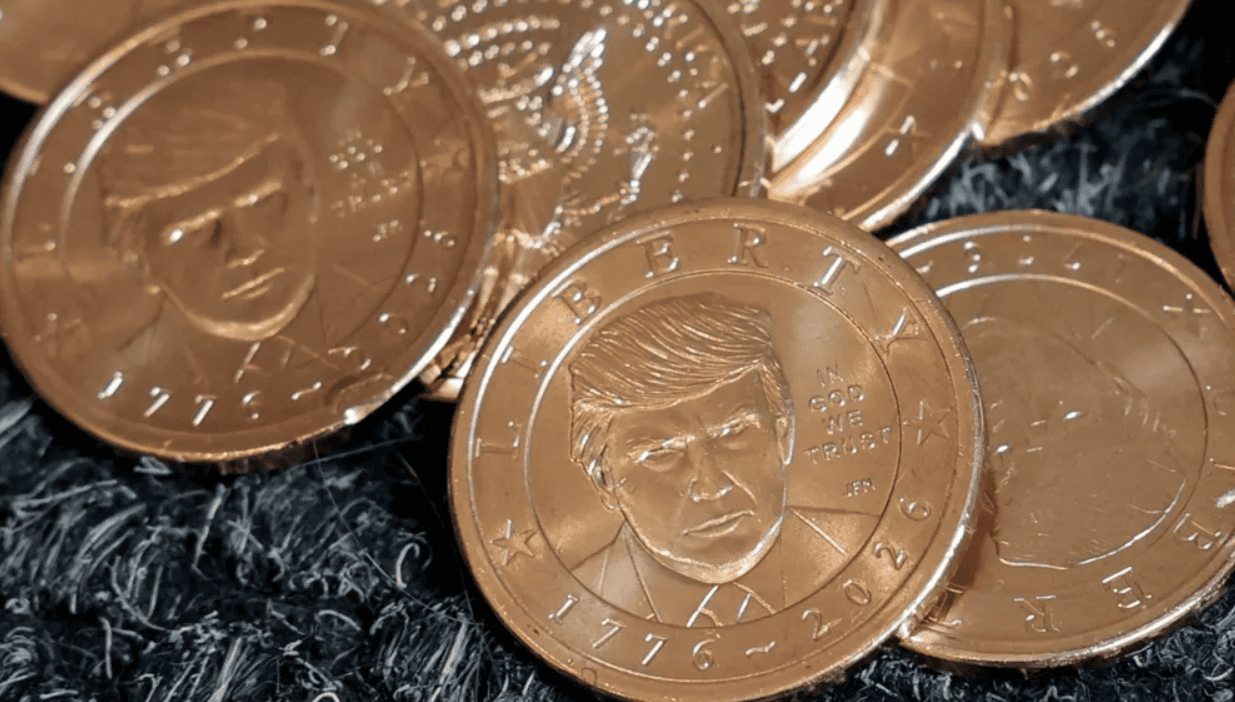
Donald Trump’s portrait has appeared on a new Trump $1 coin, creating a rare moment in US currency history. Released by the US Mint to mark America’s upcoming 250th anniversary, the special-edition coin has already attracted significant attention from collectors and the public.
Trump $1 Coin Marks a Rare Moment in US History
The US Mint launched the Trump $1 coin on Wednesday as part of the celebrations surrounding the United States’ 250th anniversary of independence.
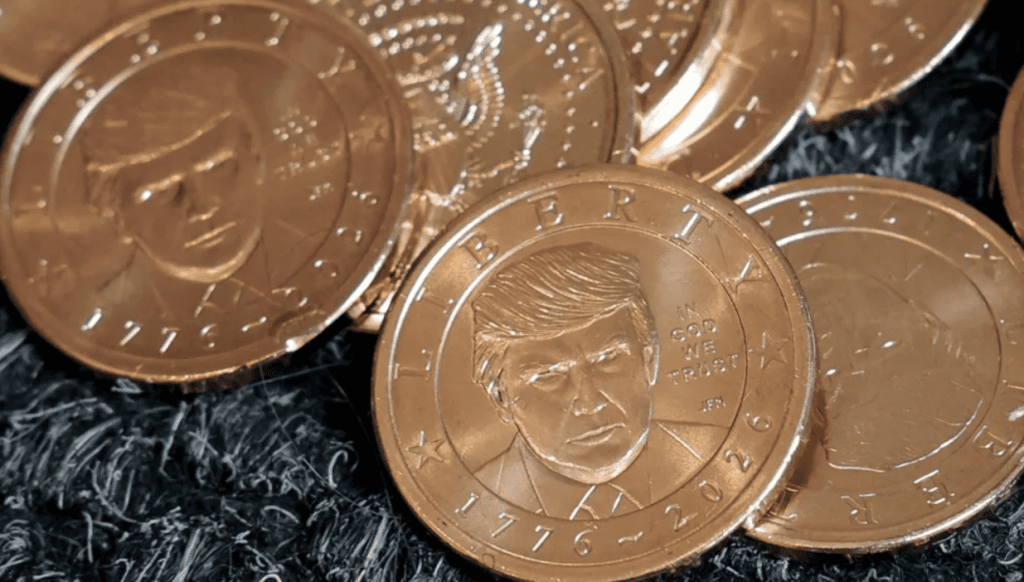
The coin features Trump’s portrait alongside the words “LIBERTY” and “IN GOD WE TRUST.” Its release places the current president’s likeness on American currency at a time when the country is preparing for one of its most significant national anniversaries.
According to the US Mint, the design was created to reflect the “spirit, pride, and legacy” of the United States as it approaches the milestone.
The release is notable because portraits of living presidents are unusual on US currency. While the rules governing coins differ from those covering banknotes, the appearance of Trump’s image has nevertheless drawn attention because of the long-standing traditions surrounding presidential portraits.
Why the Trump $1 Coin Is Historically Significant
The United States has traditionally reserved prominent currency portraits for historical figures who have died. That tradition is particularly strict when it comes to paper money.
Federal law prohibits the depiction of living people on US notes. That restriction has become relevant to a separate proposal from Treasury Secretary Scott Bessent, who said earlier this year that the administration was considering a new $250 bill featuring Trump.
Legislation has reportedly been introduced by Trump allies in Congress to create an exception to the restriction. However, that proposal has not advanced.
Coins operate under somewhat different rules.
The Circulating Collectible Coin Redesign Act of 2020, signed during Trump’s first presidential term, restricts portraits of living people on the reverse, or tails side, of coins. The legislation does not explicitly impose the same restriction on the obverse, or heads side.
That distinction provides the legal basis cited by the administration for the new design.
Has a Living President Appeared on US Currency Before?
Trump is not the first living president to appear on an American commemorative coin.
In 1926, President Calvin Coolidge appeared on a commemorative half-dollar issued to mark the 150th anniversary of American independence.
That historical example is important because it shows that the idea of depicting a sitting president on a coin is not entirely unprecedented. However, such instances remain exceptionally uncommon.
The Trump $1 coin therefore represents both a continuation of a limited tradition and a striking departure from what Americans normally expect from presidential currency.
What the New $1 Coin Is Made Of
Despite its golden appearance, the Trump $1 coin does not contain actual gold.
The US Mint says the coin is composed primarily of copper, which makes up 88.5% of its composition. The remainder consists of zinc, manganese and nickel.
Its gold-colored appearance is therefore the result of its metal composition and finish rather than precious-metal content.
That distinction matters for collectors and buyers. A coin that looks like gold is not necessarily a gold investment, and the Trump $1 coin should not be confused with a precious-metal bullion product.
Trump $1 Coin Sells Out Quickly Online
Demand for the commemorative coin appeared strong from the moment it went on sale.
The US Mint initially offered the coins at $61 for a roll of 25 and $154.50 for a bag containing 100 coins. Within hours, the Mint’s website listed the products as unavailable.
The rapid online demand highlights the interest surrounding presidential memorabilia, particularly when a release combines a major political figure with a major national anniversary.
The coins were also made available through vending machines at the US Mint store in Washington, DC.
For collectors, limited availability can make a commemorative issue especially appealing. However, scarcity at the point of release does not automatically mean that a coin will become highly valuable on the secondary market.
Future collector demand, production numbers, condition and broader interest in the design will all influence its long-term market value.
The Coin Is Part of a Bigger 250th Anniversary Celebration
The release comes as the United States prepares to commemorate 250 years since the Declaration of Independence in 1776.
The anniversary has created an opportunity for the federal government to introduce special products and programs highlighting American history and national identity.
The US Mint’s decision to create a commemorative design featuring Trump places the president directly within those celebrations.
It also demonstrates how currency can serve a purpose beyond everyday transactions. Coins can become historical objects, political symbols and collectibles, depending on how they are designed and received.
In this case, the coin has generated attention not simply because it carries a $1 denomination, but because of the person depicted on it and the unusual circumstances surrounding its release.
Why the Trump Coin Could Interest Collectors
Collectors often look beyond a coin’s face value when deciding whether an issue is worth keeping.
The Trump $1 coin has several characteristics that could attract attention, including:
- Its association with a sitting US president.
- Its connection to the nation’s 250th anniversary.
- Its unusual place in modern American currency history.
- Its commemorative rather than ordinary circulating character.
- Strong initial public interest.
However, collectors should distinguish between historical significance and guaranteed financial value.
A coin can be historically interesting without becoming a valuable investment. The condition of individual pieces, the number produced and future collector demand will all matter.
For that reason, anyone buying the Trump $1 coin purely as an investment should approach claims about future prices with caution.
A Currency Release With Political And Historical Weight
The Trump $1 coin arrives at the intersection of politics, history and collecting.
Its release has renewed discussion about the rules governing presidential portraits on American currency, while its connection to the 250th anniversary gives it a broader historical context.
The controversy surrounding presidential imagery also reflects a larger question about how national symbols are created and who gets represented on them.
Currency is among the most visible forms of government-issued imagery. A portrait on a coin can therefore carry symbolic significance far beyond its monetary value.
For Trump supporters, collectors and observers of American political history, the new coin offers a particularly unusual artifact from the current era.
What Happens Next for the Trump $1 Coin?
The immediate sellout suggests that interest is substantial, but the coin’s long-term legacy will take much longer to determine.
Collectors will likely watch production figures, availability and resale prices closely. Historians may also view the issue as part of the evolving relationship between American presidents and national symbols.
For now, the Trump $1 coin stands out as one of the most unusual US currency releases of the modern era. Its $1 face value may be modest, but its historical and political significance could make it a memorable piece of the country’s 250th anniversary celebrations.
Conclusion
The Trump $1 coin has become noteworthy for far more than its denomination. Featuring a sitting president and issued during America’s 250th anniversary celebrations, it occupies a rare place in the history of US commemorative currency.
While its future collector value remains uncertain, its historical importance is already clear. Whether viewed as a collectible, a political symbol or a snapshot of modern America, the coin is likely to remain a closely watched piece of US currency history.












Comments are closed.