
Artificial intelligence is transforming nearly every aspect of modern life. From chatbots and search engines to healthcare research and business automation, AI is driving a new technological revolution. Yet behind every AI-powered interaction lies a vast network of data centres consuming enormous amounts of energy, water, and computing power.
Now, researchers are warning about another environmental consequence that has received far less attention: heat.
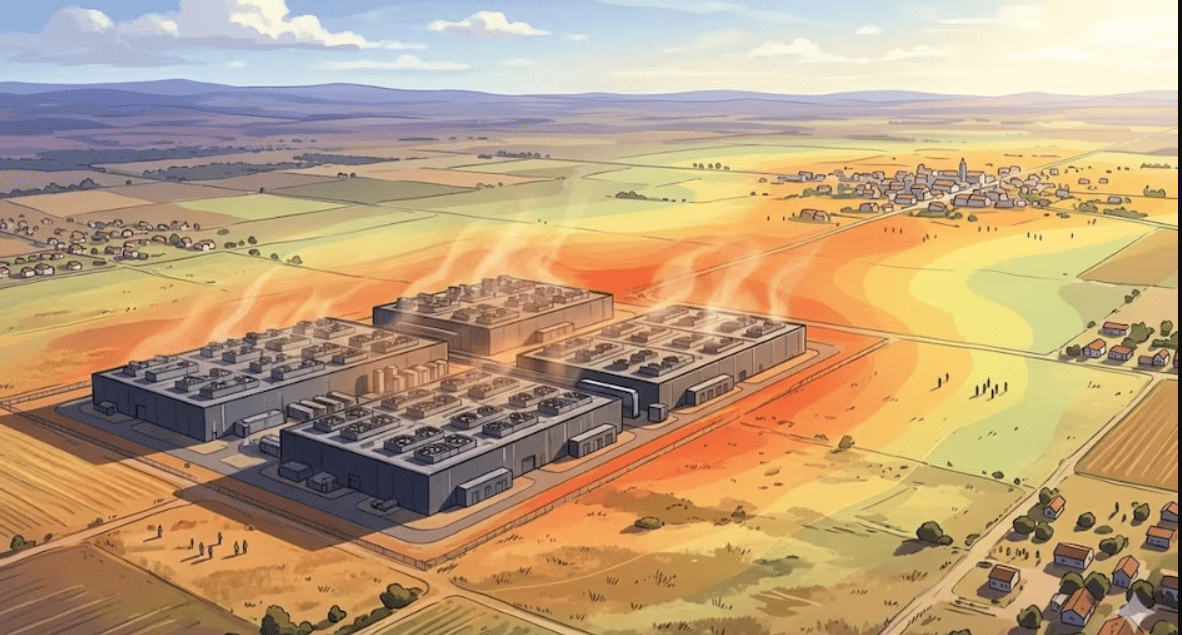
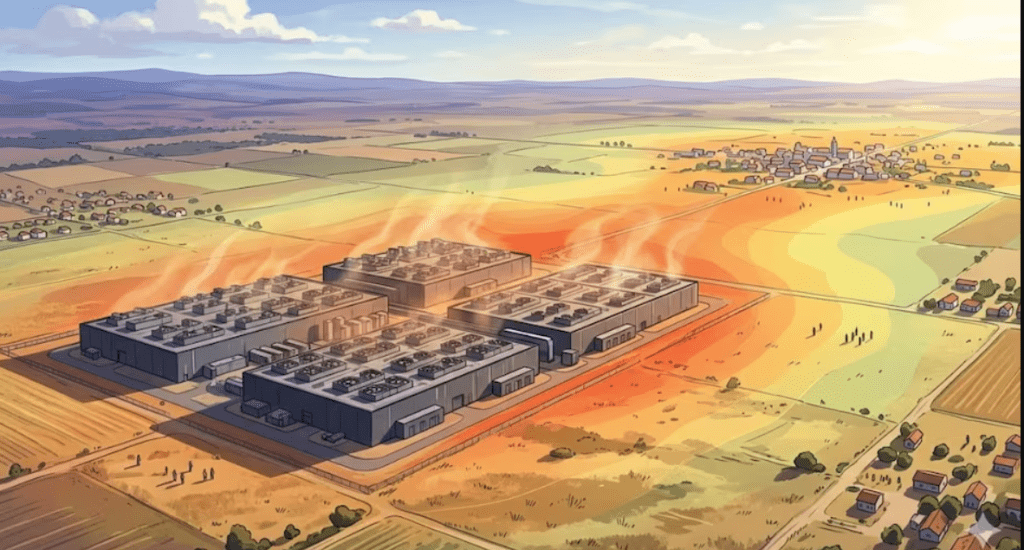
A growing body of research suggests that AI data centres are not only placing increasing demands on electricity grids and water supplies but are also raising temperatures in surrounding areas. Scientists have even coined a new term for the phenomenon: the data heat island effect.
As global technology companies race to expand AI infrastructure, questions are emerging about how these facilities may affect nearby communities, local ecosystems, and future sustainability goals.
What Is the Data Heat Island Effect?
The data heat island effect refers to localized warming caused by large-scale data centres.
Much like cities experience the well-known urban heat island effect, where buildings, roads, and human activity increase temperatures compared to surrounding rural areas, data centres can create their own concentrated zones of heat.
AI systems require vast amounts of computing power. Every request made to platforms such as ChatGPT, Gemini, Claude, and other AI tools is processed by powerful servers operating around the clock.
These servers generate significant amounts of heat while performing billions of calculations every second. Although cooling systems help manage temperatures inside the facilities, much of that heat ultimately enters the surrounding environment.
Recent research has revealed that the impact may be much greater than previously understood.
New Research Reveals Rising Temperatures Around AI Data Centres
A major study led by researchers from the University of Cambridge and Nanyang Technological University examined the environmental impact of thousands of AI data centres worldwide.
Using two decades of NASA satellite temperature data and more than 11,000 global data centre locations, researchers analyzed how temperatures changed after facilities became operational.
The results were striking.
The study found that land surface temperatures around AI data centres increased by an average of 2 degrees Celsius. In some locations, temperature rises reached as high as 9 degrees Celsius.
Researchers also discovered that warming effects could extend up to 10 kilometers from the facilities, affecting nearby neighborhoods and surrounding landscapes.
Perhaps most significantly, the study estimated that more than 340 million people worldwide live within this potential impact zone.
The findings suggest that AI infrastructure may have broader environmental consequences than many policymakers and technology companies have previously acknowledged.
Why AI Data Centres Use So Much Energy
The rapid rise of artificial intelligence has dramatically increased global demand for computing power.
Traditional internet services such as email, websites, and cloud storage require substantial resources. However, AI applications consume far more energy because they rely on advanced processors designed to handle massive volumes of calculations simultaneously.
According to estimates from energy experts, global data centres consumed approximately 415 terawatt-hours of electricity in 2024. That represented roughly 1.5 percent of the world’s electricity supply.
Demand continues to grow rapidly.
Industry projections indicate that electricity consumption from data centres could more than double by 2030, reaching nearly 945 terawatt-hours annually.
A large portion of this growth is directly tied to AI development.
The Rise of Hyperscale Data Centres
At the center of the AI boom are hyperscale data centres.
These facilities represent the largest category of data centres and are typically operated by major technology companies including Google, Amazon, Microsoft, Meta, and Oracle.
A hyperscale facility can contain thousands of servers operating continuously. Many require between 100 and 300 megawatts of electricity at any given moment, enough energy to power hundreds of thousands of homes.
As AI adoption accelerates, hyperscale data centres are becoming larger and more numerous.
Industry analysts report that the number of hyperscale facilities worldwide has nearly doubled since 2021. This expansion reflects the growing competition among technology companies seeking to dominate the next generation of AI services.
Where Are Most AI Data Centres Located?
The United States remains the global leader in data centre infrastructure.
With more than 4,300 facilities, the country hosts a significant share of the world’s digital backbone. Major clusters exist in states such as Virginia, Texas, California, and Arizona.
Europe ranks as the second-largest market, with the United Kingdom, Germany, and France leading regional development.
Meanwhile, Asia continues to experience rapid expansion. China and India have emerged as major hubs for new AI infrastructure, while Southeast Asia is becoming one of the fastest-growing regions for cloud computing and data centre investment.
Globally, more than 11,600 data centres are currently active, and that number continues to rise.
Water Consumption Adds Another Environmental Challenge
Heat is not the only environmental concern associated with AI infrastructure.
Data centres require sophisticated cooling systems to prevent servers from overheating. Many of these systems rely heavily on water.
According to sustainability researchers, a single 100-megawatt hyperscale data centre can consume billions of liters of water each year.
To put that into perspective, the annual water use of one large facility can equal the needs of tens of thousands of people.
As climate change intensifies drought conditions in many regions, concerns are growing about the long-term sustainability of large-scale AI infrastructure.
Communities located near major data centre developments are increasingly asking whether the economic benefits justify the environmental costs.
A Multi-Trillion-Dollar AI Infrastructure Boom
Despite environmental concerns, investment in AI infrastructure shows no signs of slowing down.
Financial analysts estimate that major technology companies could collectively spend more than $5 trillion on AI-related infrastructure between 2025 and 2030.
Several massive projects are already underway, including:
Meta’s Hyperion Campus
Meta is developing a multi-billion-dollar AI campus in Louisiana designed to support future AI services and cloud computing operations.
Microsoft’s Wisconsin Expansion
Microsoft continues expanding its large-scale data centre footprint through a multi-phase investment program worth tens of billions of dollars.
Amazon’s Mississippi Development
Amazon is investing heavily in next-generation AI infrastructure as part of its long-term cloud computing strategy.
Oracle’s Stargate Project
One of the world’s most ambitious AI infrastructure developments is Project Stargate in Texas, a massive AI supercluster designed to support advanced AI workloads at unprecedented scale.
These projects highlight the extraordinary pace at which AI infrastructure is expanding globally.
What the Future of AI Sustainability Looks Like
As artificial intelligence becomes increasingly embedded in everyday life, balancing innovation with environmental responsibility will become a critical challenge.
Technology companies are already exploring solutions such as renewable energy integration, advanced cooling technologies, heat recycling systems, and more efficient AI chips.
However, the latest research suggests that sustainability discussions must extend beyond electricity consumption alone.
The effects of heat generation, water use, and local environmental impacts are likely to become increasingly important as AI infrastructure grows.
Conclusion
The data heat island effect is emerging as one of the most overlooked consequences of the global AI boom. While AI data centres power the technologies shaping the future, they also generate significant amounts of heat that can influence surrounding communities and ecosystems.
As investment in AI infrastructure reaches unprecedented levels, understanding the environmental impact of these facilities will be essential. The challenge moving forward is clear: ensuring that the future of artificial intelligence remains both technologically advanced and environmentally sustainable.

















Comments are closed.