

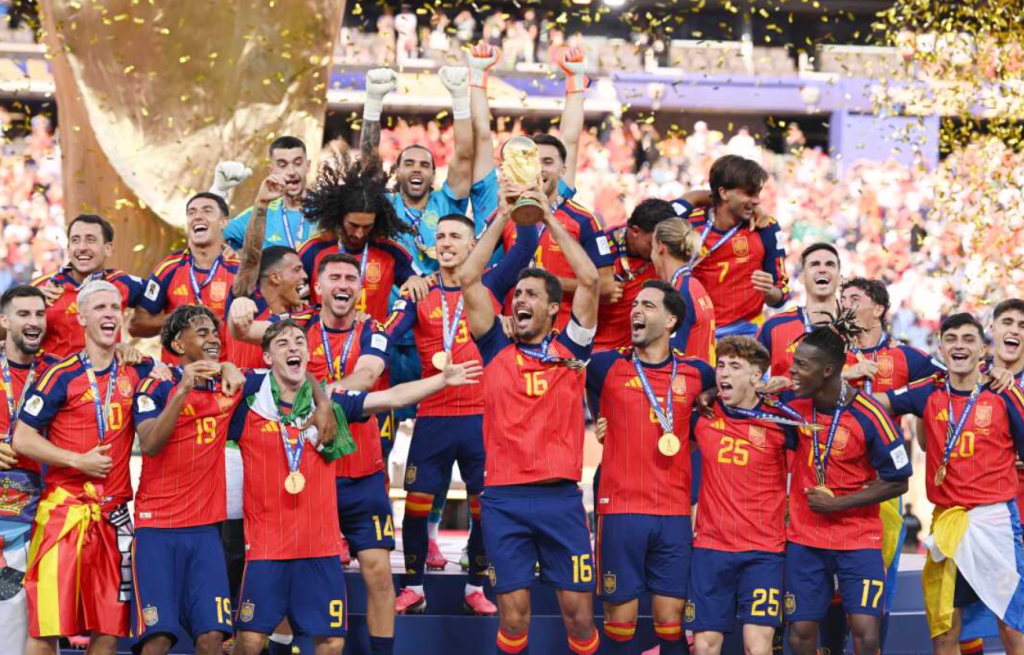
European Champions Secure Second World Cup Title After Extra-Time Victory
Spain have been crowned champions of the 2026 FIFA World Cup after defeating defending champions Argentina 1-0 after extra time in the final, completing a tournament defined by disciplined teamwork, tactical consistency and defensive resilience.
Ferran Torres scored the decisive goal in the 106th minute, ending a tightly contested final and delivering Spain’s second men’s World Cup title. The victory also extends Spain’s recent success in international football after winning the UEFA European Championship and reinforces the country’s reputation as one of the sport’s leading footballing nations.

Spain’s Long-Term Development Strategy Delivers Results
Spain’s triumph reflects years of investment in player development and a consistent footballing philosophy that has shaped multiple generations of international success.
After a period of dominance between 2008 and 2012, Spain rebuilt its national team around a new generation while maintaining an emphasis on technical quality, structured possession and collective play.
Head coach Luis de la Fuente, who previously guided Spain’s youth national teams, brought many players through the country’s development system before leading them at senior level. That continuity has become a defining feature of Spain’s current success.
A Final Defined by Tactical Control
The World Cup final remained scoreless throughout regulation time as Spain controlled possession and limited Argentina’s attacking opportunities.
Spain dictated much of the play, creating the majority of scoring chances while maintaining defensive discipline against a team led by Lionel Messi.
The breakthrough finally arrived early in extra time when Pedro Porro delivered a cross into the penalty area, Nico Williams headed the ball across goal, and substitute Ferran Torres converted from close range to give Spain the lead.
Argentina pushed forward in the closing stages but were unable to find an equaliser.
Collective Strength Proves Decisive
Rather than relying on individual brilliance, Spain’s tournament success was built on contributions across the squad.
Captain Rodri was awarded the FIFA Golden Ball as the tournament’s best player after consistently controlling matches from midfield. Goalkeeper Unai Simón received the Golden Glove following an impressive defensive campaign, while defender Pau Cubarsí earned recognition as the tournament’s top young player.
Spain also benefited from strong performances throughout the competition from players including Pedri, Fabián Ruiz, Nico Williams, Marc Cucurella, Pedro Porro, Mikel Merino and Lamine Yamal.
The team conceded only one goal during the tournament, highlighting the balance between attacking control and defensive organization.
Argentina’s Title Defence Comes to an End
Argentina entered the final seeking to become the first nation since Brazil in 1962 to successfully defend the FIFA World Cup.
Despite another influential tournament from captain Lionel Messi, Argentina struggled to generate attacking opportunities in the final as Spain controlled possession for extended periods.
The defeat also marked the conclusion of another remarkable World Cup campaign for Messi, whose leadership helped guide Argentina back to the final four years after lifting the trophy in Qatar.
Global Significance for International Football
Spain’s victory strengthens its position among international football’s most successful nations and demonstrates the value of long-term investment in youth development and coaching continuity.
The achievement also makes Spain the first country to simultaneously hold both the men’s and women’s FIFA World Cup titles, reflecting the strength of its football development system across all levels.
For world football, the tournament highlighted the contrast between teams built around collective tactical identity and those relying more heavily on individual star performances.
Conclusion
Spain’s World Cup victory represents the culmination of years of planning, player development and tactical consistency. By defeating defending champions Argentina, the European champions completed an impressive tournament and confirmed their return to the summit of international football.
With a young squad featuring emerging stars alongside experienced leaders, Spain appears well positioned to remain a major force in global football for years to come.











Comments are closed.