
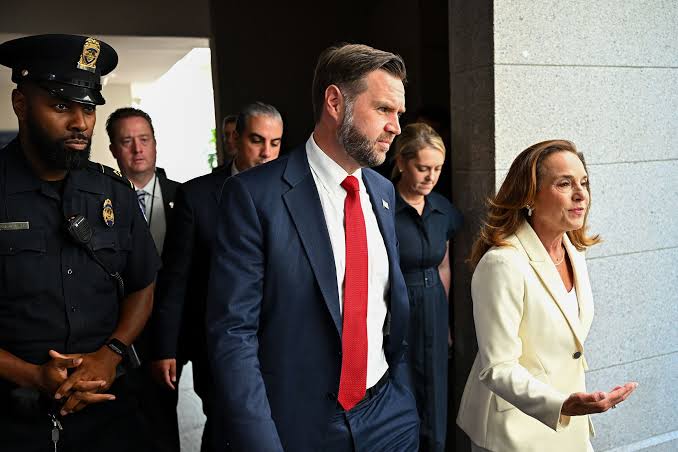
United States Vice President JD Vance has discussed allegations surrounding Jeffrey Epstein’s connections to political and intelligence circles, saying Epstein appeared to have links to powerful networks in the United States and Israel while acknowledging that there is no publicly available evidence proving he worked for any intelligence agency.
During a lengthy podcast interview with Joe Rogan, Vance also addressed criticism of the Trump administration’s handling of the release of documents related to Epstein, saying officials had mishandled communication surrounding the files and contributed to public mistrust.
The discussion comes amid renewed attention over Epstein’s relationships with influential figures, the release of millions of pages of documents, and wider debates about government transparency and accountability.
Background: The Epstein Case and Public Scrutiny
Jeffrey Epstein was a financier and social figure who developed relationships with numerous wealthy and influential individuals before being convicted in 2008 in Florida on charges related to soliciting prostitution involving a minor.
He was later arrested in 2019 on federal sex trafficking charges and died in a New York City jail while awaiting trial. His death, officially ruled a suicide, intensified public interest and speculation surrounding his connections to powerful individuals.
Survivors of Epstein’s abuse have accused him of operating a wider exploitation network involving victims over many years. The case has continued to generate political and legal controversy, particularly over questions about how Epstein gained access to elite circles.
Vance’s Comments on Intelligence Connections
In the interview, Vance responded to questions about claims that Epstein had ties to intelligence organizations. He said Epstein appeared to have connections with senior figures in American and Israeli intelligence circles but emphasized that no documents publicly prove he was an intelligence asset.
Vance referenced speculation involving agencies such as the CIA and Mossad but did not provide evidence confirming those claims. He also said that if documentation proving intelligence links existed, such material would likely not be publicly available.
The vice president’s comments have renewed debate over long-running theories surrounding Epstein’s relationships with international figures. Intelligence experts and officials have repeatedly noted that public associations or contacts do not by themselves establish operational links with intelligence services.
Documents Reveal Contacts With Israeli and US Figures
A large collection of documents related to Epstein was released by the US Department of Justice in 2026 as part of ongoing transparency efforts. The files contained extensive records of Epstein’s communications and relationships but did not publicly establish that he worked for an intelligence agency.
Some documents referenced interactions between Epstein and prominent Israeli figures, including former Israeli Defence Minister Ehud Barak and Yoni Koren, who has been described as having previous ties to Israeli intelligence circles.
The documents also showed Epstein’s financial contributions to several organizations connected to Israel, including donations through his foundation. However, the existence of these relationships has not been presented as proof of intelligence cooperation.
Israeli officials have rejected claims that Epstein represented Israeli interests. Prime Minister Benjamin Netanyahu previously addressed speculation surrounding Epstein’s relationship with Israeli figures, arguing that such associations did not demonstrate state involvement.
Trump Administration Faces Criticism Over Document Release
Beyond intelligence-related claims, Vance addressed criticism over the Trump administration’s handling of the Epstein files.
The controversy intensified after former US Attorney General Pam Bondi faced scrutiny over statements regarding the existence of an alleged Epstein “client list.” Officials later faced criticism from lawmakers and members of the public who argued that the administration had not provided sufficient transparency.
Vance defended Bondi, saying he did not believe there had been malicious intent by the Justice Department. However, he acknowledged that officials had made communication mistakes that damaged public confidence.
“We absolutely screwed up the comms of the Epstein files,” Vance said during the interview, while denying that the errors were connected to an effort to conceal information.
Political and Institutional Implications
The controversy highlights broader challenges facing governments dealing with high-profile investigations involving influential individuals. The Epstein case has become part of wider debates in US politics about transparency, accountability, and public trust in institutions.
For the Trump administration, the issue presents a political challenge as officials attempt to balance demands for disclosure with legal restrictions surrounding investigations, privacy protections, and unverified allegations.
The discussion also intersects with broader US foreign policy debates, including questions about US-Israel relations, intelligence oversight, and how governments respond to claims involving national security institutions.
Conclusion
JD Vance’s comments have reignited public discussion over Jeffrey Epstein’s connections, the release of government documents, and questions surrounding intelligence allegations. While the interview brought renewed attention to the issue, publicly available records have not established that Epstein worked for any intelligence agency.
The controversy is likely to continue shaping debates over government transparency, political accountability, and public confidence in institutions as additional legal and investigative processes move forward.














Comments are closed.