
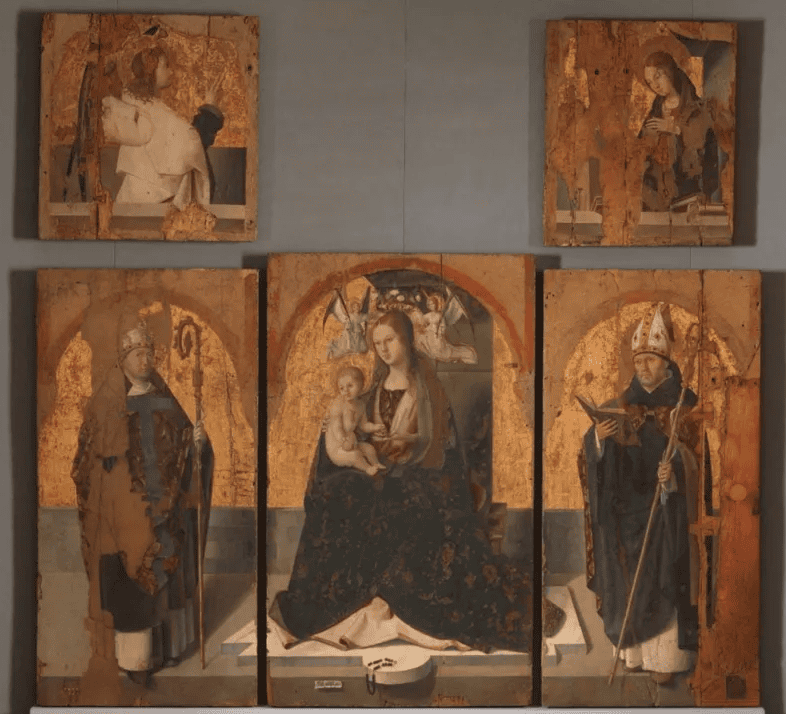
Antonello da Messina Works Taken From Messina Museum as Italian Authorities Investigate Security Breach
Four Renaissance paintings attributed to the celebrated Sicilian artist Antonello da Messina have been stolen from a museum in Messina, Sicily, prompting an investigation into how the thieves entered the building and removed works of exceptional cultural value.
The stolen works include three surviving panels from the Polyptych of San Gregorio and a double-sided panel depicting the Madonna with Child and Christ in Pietà. Italy’s culture minister, Alessandro Giuli, described the paintings as being of “extraordinary value”, while local authorities said investigators are examining whether the theft was carried out as part of an organised art-trafficking operation.
The incident has renewed concerns about the protection of major European cultural collections, following several high-profile art thefts across the continent.
What Was Stolen?
The theft occurred at the Regional Interdisciplinary Museum of Messina, where the works had been part of the institution’s collection.
Three of the five surviving panels of Antonello’s Polyptych of San Gregorio were taken. The 1473 work was commissioned for the monastery of Santa Maria and depicts the Virgin Mary with the infant Jesus, accompanied by saints and angels.
The fourth stolen work is a smaller, double-sided panel showing the Madonna holding the infant Christ on one side and Christ in Pietà on the other. Art historians believe the object’s compact format indicates that it may originally have been intended for private religious devotion.
Unlike paintings executed on canvas, the stolen works were painted on wooden panels, making them considerably more difficult to conceal or transport discreetly.
According to Italian news agency Ansa, the double-sided panel was removed directly from a secured display case.
Investigation Focuses on Museum Security
Museum director Marisa Mercurio said the theft is believed to have occurred at approximately 9:50pm local time on Saturday.
Police are investigating how the perpetrators entered the museum without activating its alarm systems and whether the operation involved individuals familiar with the building or its security arrangements.
One working theory is that the paintings may have been stolen to order for criminal networks operating in the international art market. Investigators have not publicly established the identity or motive of the perpetrators.
Authorities are expected to examine surveillance footage, alarm records and access points as part of the investigation.
Who Was Antonello da Messina?
Antonello da Messina was one of the most important painters of the Italian Renaissance and a central figure in the artistic history of Sicily.
Born in Messina in the 15th century, Antonello became known for combining Italian Renaissance traditions with techniques associated with northern European painting. His work is particularly noted for its detailed treatment of faces, light and three-dimensional form.
His influence extended beyond Sicily, and he is widely regarded as an important figure in the development of Renaissance portraiture and oil painting in Italy.
Because of the limited number of surviving works attributed to him, the disappearance of four paintings from a single museum represents a significant loss for researchers, cultural institutions and the public.
A Wider European Problem
The Messina theft comes amid renewed scrutiny of security at museums and cultural institutions across Europe.
Italy has one of the world’s largest concentrations of historically significant artworks and operates specialised law-enforcement units dedicated to protecting cultural heritage. The country’s art-crime investigators have recovered stolen works in numerous international operations.
Only days before the Messina theft became public, Italian authorities announced the recovery of three paintings by Paul Cézanne, Pierre-Auguste Renoir and Henri Matisse that had been stolen from a museum near Parma. The works were collectively valued at approximately €9 million.
The recovery demonstrated the capacity of specialist investigators to trace stolen cultural property, but also highlighted the continuing vulnerability of museums to organised theft.
The International Art Market
Stolen works by historically important artists can present criminals with a complicated challenge: their fame makes them difficult to sell openly, while their cultural significance can make them extremely valuable to private collectors and criminal intermediaries.
Major works are often impossible to place legitimately on the mainstream art market because dealers, auction houses and museums conduct provenance checks. This can create incentives for criminals to conceal artworks, move them across borders or seek buyers through illicit networks.
For authorities, recovering stolen works can therefore depend on international cooperation, detailed provenance records and monitoring of the movement of cultural property.
Cultural Loss Beyond Financial Value
The significance of the Messina theft extends beyond the monetary value of the paintings.
The works form part of Sicily’s artistic heritage and provide a direct connection to one of the region’s most important Renaissance artists. Their removal from public view also affects researchers, students and visitors who would otherwise have access to the paintings.
Messina Mayor Federico Basile condemned the theft, describing it as an attack on the city’s cultural heritage and stressing the importance of recovering the works.
Conclusion
The theft of four paintings attributed to Antonello da Messina has prompted a major investigation in Sicily and raised fresh questions about museum security across Europe.
Authorities now face the difficult task of determining how the works were removed, identifying those responsible and preventing the paintings from entering the international black market. Their recovery would not simply restore valuable museum property but return an important part of Sicily’s Renaissance heritage to public view.












Comments are closed.