
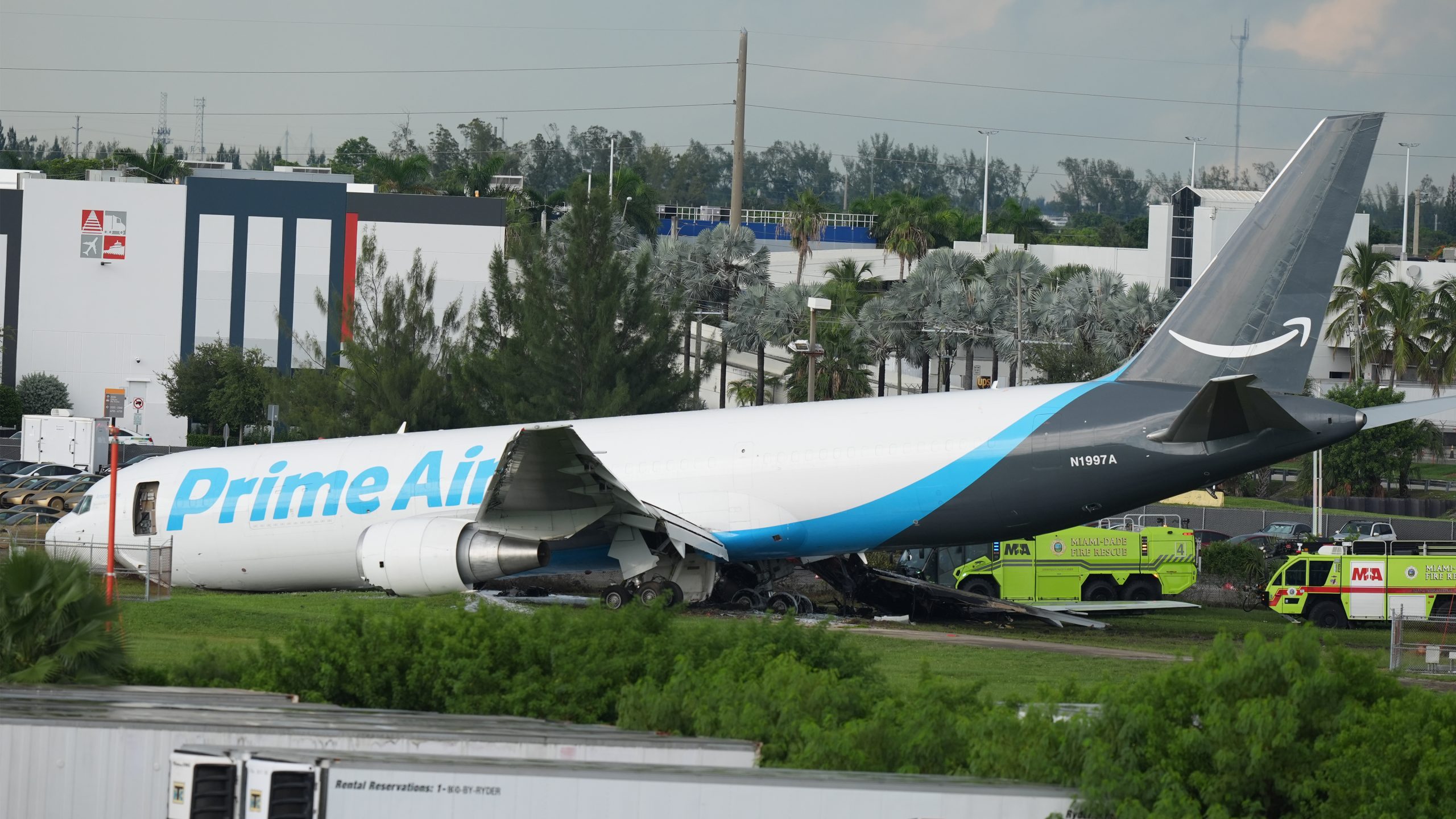
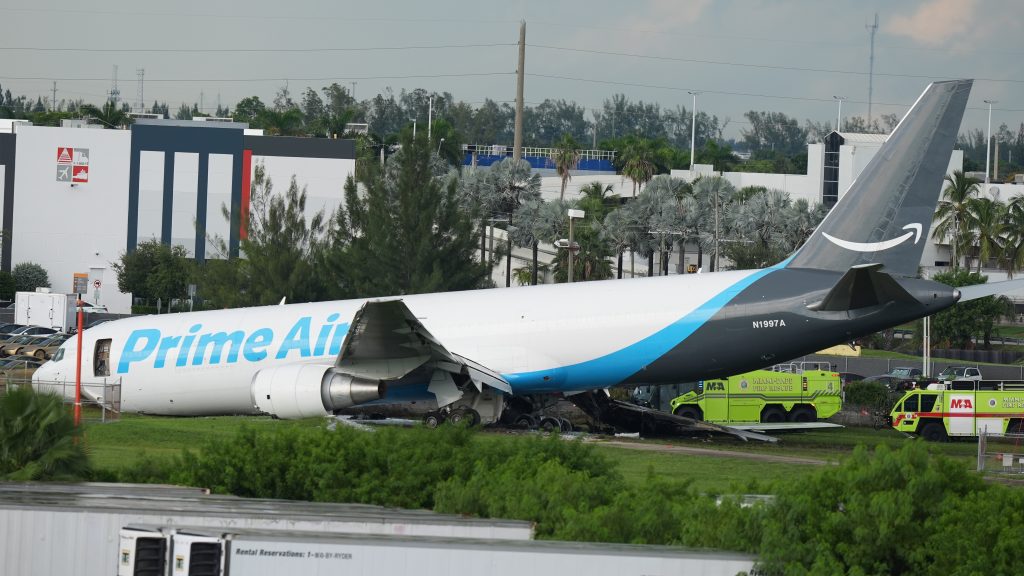
Investigators have recovered the flight data and cockpit voice recorders as they begin examining why an Amazon cargo aircraft overran the runway at Miami International Airport, killing five people.
Investigators have recovered the flight recorders from the Amazon cargo aircraft that crashed at Miami International Airport, as authorities begin the painstaking process of determining what caused the deadly accident.
Five people were killed and five others seriously injured when the Boeing 767-300, operated by 21 Air, overshot the runway shortly before 14:00 local time on Sunday.
The aircraft, carrying two crew members, had been arriving from San Juan, Puerto Rico, on its third flight of the day when it ran beyond the runway and struck airport equipment, vehicles and a perimeter fence.
The National Transportation Safety Board (NTSB) has stressed that it is far too early to determine what caused the crash.
NTSB Chair Jennifer Homendy said investigators remain in the initial fact-finding stage, with teams collecting evidence from the aircraft and the surrounding crash site.
A Devastating Crash Scene
After overrunning the runway, the aircraft struck navigational equipment before colliding with a white Ford van operated by a contract cleaning company.
The van was carrying seven people at the time.
The aircraft then broke through the airport’s perimeter fence and hit a Toyota Corolla carrying three passengers. It eventually came to rest approximately 1,300 feet, or 394 metres, beyond the runway.
The scale of the destruction left investigators and first responders facing a difficult recovery operation.
Homendy described the scene as “devastating”, with aircraft debris, damaged vehicles and sections of airport fencing scattered across the area.
Authorities said the recovery of victims remained the immediate priority, while the examination of the aircraft and other evidence would follow.
“The investigation and access to the aircraft, as well as evidence, can wait,” Homendy said, emphasizing the importance of recovering those who died.
Flight Recorders to Provide Critical Evidence
Both the flight data recorder and cockpit voice recorder have now been recovered and will be transported to NTSB headquarters for detailed examination.
The devices could provide investigators with crucial information about the aircraft’s final moments, including cockpit communications, aircraft performance and operational data.
However, investigators have warned against drawing conclusions before the evidence has been fully examined.
The investigation will cover several areas, including the aircraft’s flight history, the crew’s experience and training, radar information and the aircraft’s performance during the approach and landing.
Separate investigative teams will examine the aircraft’s engines and systems.
Meteorological specialists will also study the weather conditions at the time of the crash.
Weather and Runway Safety Under Investigation
Weather conditions are expected to form another important part of the investigation.
Earlier analysis indicated that an active thunderstorm was near Miami International Airport shortly before the crash, with winds reportedly gusting to around 26 knots.
Investigators will determine whether those conditions affected the aircraft’s approach, landing or ability to stop after touching down.
The NTSB will also examine the runway itself and whether it should have been equipped with an Engineered Materials Arresting System, known as EMAS.
The system is designed to slow and ultimately stop aircraft that overrun a runway by using specially engineered material capable of absorbing the aircraft’s energy.
Homendy described the question of whether EMAS should have been installed as a key part of the investigation.
Airport Disruption Continues
The crash has also caused significant disruption at one of the United States’ busiest airports.
Two of Miami International Airport’s four runways remained closed following the accident, while passengers were warned to expect further delays.
Sunday’s crash occurred during the Labor Day holiday weekend, traditionally one of the busiest travel periods in the United States.
The accident affected not only arriving and departing passengers but also the positioning of aircraft and flight crews, adding to the disruption.
Airport officials and airlines have been working to manage the consequences while investigators continue examining the crash site.
Airlines and Amazon Respond
Amazon expressed its grief following the deaths, saying it was heartbroken by the loss of life and was working closely with authorities.
21 Air, which operated the aircraft, also expressed condolences to those affected and said it was cooperating fully with investigators.
The NTSB has appealed to members of the public who may have witnessed the crash or captured photographs or videos around the time of the accident to provide that material to investigators.
Such footage can help reconstruct the aircraft’s final approach and movements, particularly when combined with radar, flight recorder and airport data.
Searching for the Cause
For investigators, the immediate task is to reconstruct the final minutes of the flight piece by piece.
The flight recorders may provide some of the most important evidence, but they will be examined alongside weather information, radar data, aircraft maintenance records, crew histories and physical evidence recovered from the runway and crash site.
The NTSB has emphasized that the investigation is not simply about determining what went wrong.
Its broader purpose is to establish whether changes are needed to prevent a similar accident from happening again.
Homendy said the agency would issue safety recommendations once the investigation is complete.
“That’s why we’re here — to prevent the next tragedy,” she said.
The investigation could take months, and investigators are likely to examine every stage of the aircraft’s final approach before reaching conclusions.
For the families of those who died, however, the search for answers comes after an immeasurable loss.
As investigators begin analyzing the recorders and reconstructing the crash, the priority remains clear: understand what happened, determine why it happened and ensure that lessons from the tragedy lead to safer skies.











Comments are closed.