
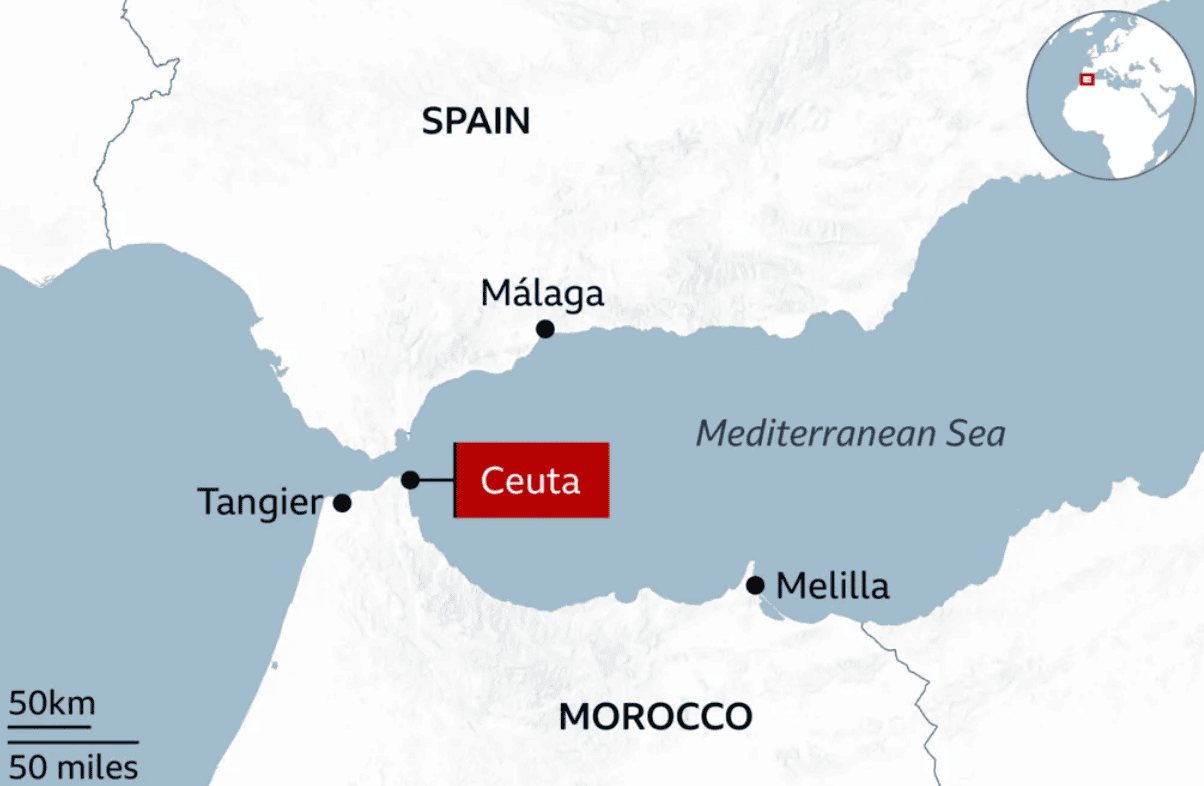
Spain’s North African enclaves have long been a source of geopolitical debate, diplomatic friction, and international attention. While the autonomous cities of Ceuta and Melilla are officially part of Spain and the European Union, Morocco continues to claim sovereignty over both territories, making them one of Europe’s longest-running territorial disputes.
Recent migration pressures at the border have once again placed these enclaves in the global spotlight. Beyond the headlines, however, their history stretches back centuries, shaped by colonial expansion, strategic geography, and modern international politics. Understanding why Spain still controls territories on the African continent helps explain not only Spain-Morocco relations but also broader questions surrounding borders, sovereignty, and migration.
What Are Spain’s Enclaves in North Africa?
Spain maintains several territories on Morocco’s Mediterranean coastline, the most prominent being the autonomous cities of Ceuta and Melilla. Together with a small collection of rocky islands known as the Plazas de Soberanía, these territories represent the last remaining pieces of Spain’s former colonial presence in North Africa.
Today, Ceuta and Melilla are unique because they are:
- Located geographically in Africa
- Politically part of Spain
- Included within the European Union
- Situated along one of the EU’s external borders
Their strategic location has made them important gateways between Europe and Africa for centuries.
The Historical Origins of Ceuta and Melilla
Ceuta’s Early History
Ceuta first came under Portuguese rule in 1415, when Portugal captured the city during its period of maritime expansion. In 1580, following the Iberian Union, the city became associated with the Spanish Crown.
When Portugal regained independence in 1640, Ceuta chose to remain under Spanish sovereignty, a decision later formalized through international treaties.
As a result, Spain argues that its claim predates the creation of the modern Moroccan state.
Melilla’s Spanish Connection
Melilla entered Spanish control even earlier, in 1497, when it was captured by forces serving the Spanish Crown.
Unlike many colonial possessions established centuries later, Spain maintains that Melilla has been continuously administered as Spanish territory for more than five centuries.
How Colonial History Shaped the Enclaves
Spain’s influence once stretched across large parts of the Americas and later into Africa. After losing major overseas colonies, including Cuba and the Philippines in 1898, Spain increasingly focused its remaining imperial ambitions on North Africa.
During the twentieth century, most European colonial powers withdrew from Africa through decolonization. However, Ceuta and Melilla remained under Spanish administration.
Today, they stand as the only European-controlled territories located on mainland Africa, making them historically and politically unique.
Why Morocco Claims Ceuta and Melilla
When Morocco gained independence from France in 1956, it accepted Spain’s continued administration of the enclaves only in practical terms, not as recognition of Spanish sovereignty.
Since independence, Morocco has consistently argued that:
- The territories lie on Moroccan soil.
- They represent unfinished decolonization.
- Historical geography supports Moroccan sovereignty.
Moroccan governments have repeatedly called for negotiations over the future of Ceuta, Melilla, and the nearby Spanish-controlled islands.
Although the issue occasionally fades from international headlines, it remains an important part of Morocco’s foreign policy.
Why Spain Rejects Morocco’s Claims
Spain maintains that Ceuta and Melilla are not colonies but integral parts of the Spanish state.
Spanish officials point to several arguments:
- Spanish administration has existed for centuries.
- The territories predate modern Morocco.
- Residents overwhelmingly identify as Spanish.
- Both cities possess autonomous status similar to Spain’s other autonomous communities.
Madrid also argues that international law does not support changing sovereignty simply because of geographic proximity.
As a result, successive Spanish governments have consistently ruled out negotiations over sovereignty.
Does International Law Favor Either Side?
Most international legal experts believe Spain currently holds the stronger legal position.
Unlike many former colonies, Ceuta and Melilla have never been classified by the United Nations as Non-Self-Governing Territories awaiting decolonization.
Morocco previously sought UN recognition for this position, but those efforts did not succeed.
Instead, the dispute is generally viewed as a political disagreement rather than one with a clear legal mechanism requiring Spain to transfer control.
The situation is often compared to Spain’s own claim over Gibraltar, a British Overseas Territory located across the Strait of Gibraltar.
Life Inside Ceuta and Melilla
Despite ongoing political disagreements, everyday life in the enclaves reflects a remarkable cultural mix.
A Diverse Population
Ceuta has approximately 84,000 residents, while Melilla is home to around 86,000 people.
Their populations include:
- Christian Spaniards
- Muslim communities
- Residents of Moroccan heritage
- Jewish communities
- Small Hindu and Sindhi communities, particularly in Melilla
For decades, these communities have largely coexisted peacefully while maintaining close commercial and family ties across the Moroccan border.
Economic Links With Morocco
Although sovereignty remains disputed, daily interaction between the enclaves and neighboring Moroccan communities has historically been significant.
Cross-border workers, trade, tourism, and family connections have all contributed to a close economic relationship.
Border restrictions introduced during periods of diplomatic tension, however, have had noticeable economic consequences for both sides.
Migration Has Increased International Attention
Why the Border Matters
The land borders surrounding Ceuta and Melilla represent one of the few places where Africa directly borders European Union territory.
Consequently, they have become important migration routes for people seeking entry into Europe.
Large-scale attempts to cross the border have periodically strained relations between Spain and Morocco.
Migration has therefore become closely linked to wider discussions involving:
- Border security
- Humanitarian responsibilities
- European immigration policy
- Bilateral cooperation between Madrid and Rabat
Whenever migration surges occur, diplomatic tensions often intensify as both countries debate responsibility for border management.
What Do Local Residents Want?
Public opinion has consistently indicated that most residents of Ceuta and Melilla prefer remaining part of Spain.
Several factors contribute to this position:
- Access to Spain’s public services
- European Union membership
- Higher living standards
- Economic stability
- Spanish citizenship
Even many residents with Moroccan family backgrounds support remaining under Spanish sovereignty while maintaining strong cultural and economic ties with neighboring Morocco.
Could Spain Ever Give Up Ceuta and Melilla?
The future of Spain’s North African enclaves remains uncertain but stable.
Some analysts argue that changing regional politics or future negotiations could eventually reopen discussions about sovereignty. Others believe the dispute will remain unresolved for decades because neither side appears willing to alter its core position.
Spain has shown flexibility in cooperating with Morocco on issues such as migration, security, and trade. However, that cooperation has not translated into any indication that Madrid is prepared to relinquish control of Ceuta or Melilla.
For Morocco, reclaiming the territories continues to carry symbolic importance. For Spain, retaining them represents both historical continuity and national sovereignty.
Conclusion
The question of why Spain has enclaves in North Africa cannot be answered by history alone. Ceuta and Melilla reflect centuries of imperial expansion, evolving borders, and competing national narratives. While Spain considers the cities an integral part of its territory, Morocco views them as the last remnants of colonial rule on the African mainland.
For now, sovereignty is unlikely to change. Instead, the focus is expected to remain on managing migration, strengthening cross-border cooperation, and maintaining diplomatic dialogue. As regional politics continue to evolve, Spain’s North African enclaves will remain central to discussions about Europe, Africa, and the future of international borders.






Comments are closed.