
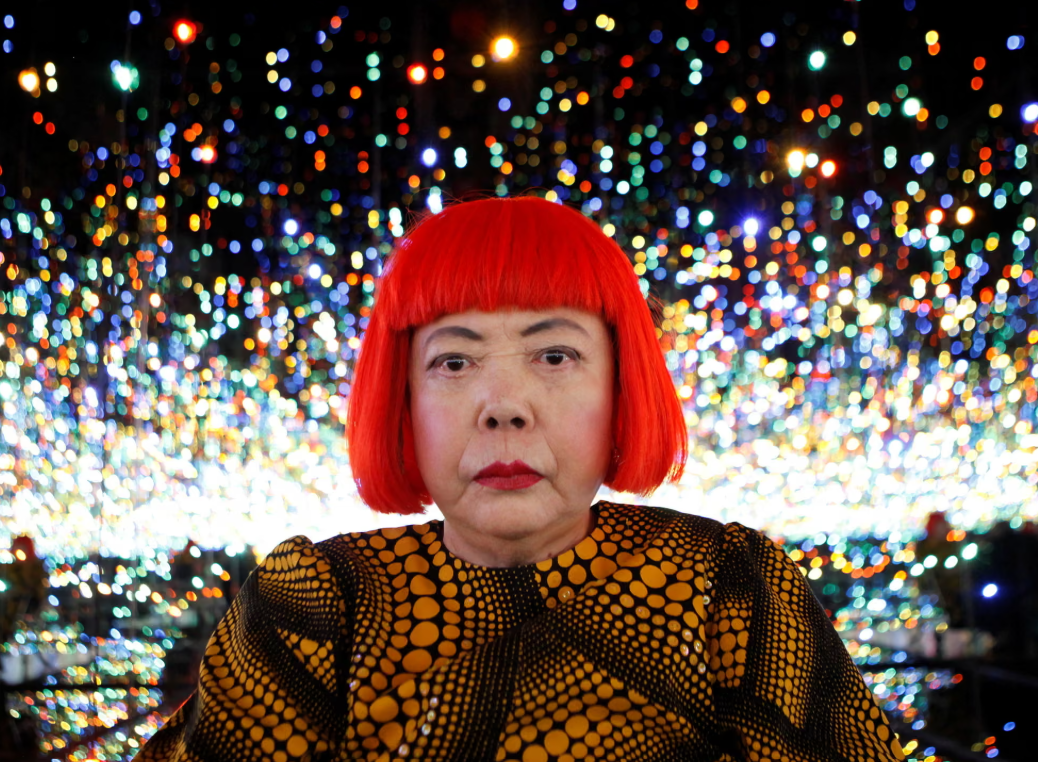
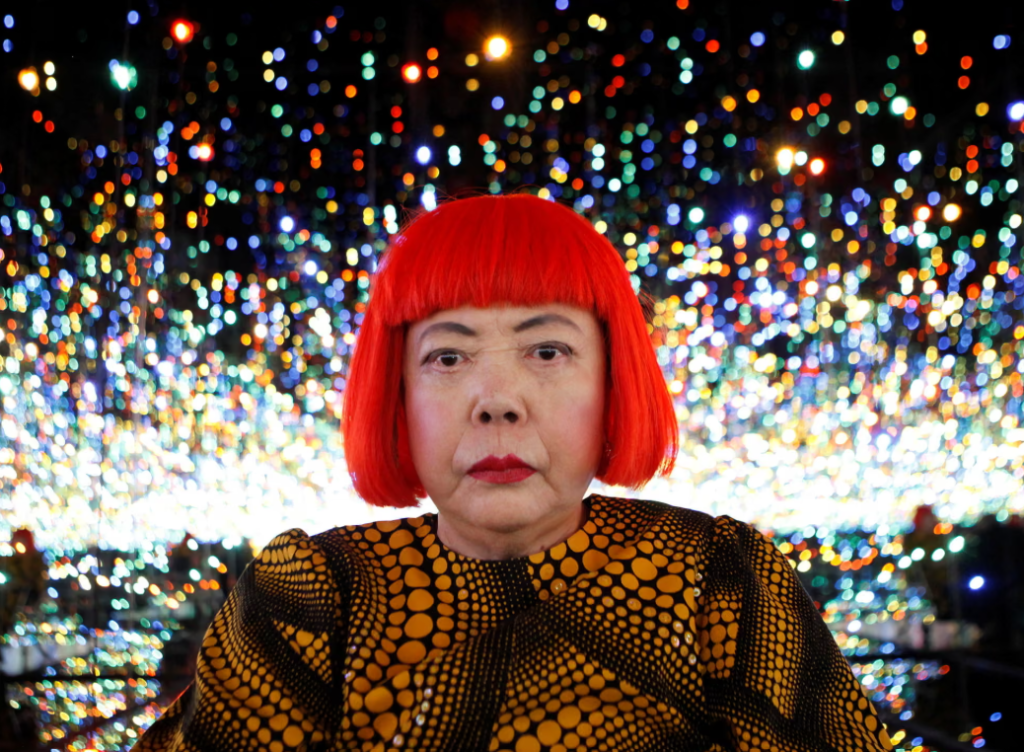
Yayoi Kusama, the Japanese artist whose polka dots, mirrored installations and immersive environments made her one of the most recognizable figures in contemporary art, has died aged 97. Kusama died in a Tokyo hospital on August 14, 2026, according to a statement released by her company, Yayoi Kusama Inc, on August 27.
Her death marks the end of an extraordinary career spanning more than seven decades. From her early experiments in Japan and groundbreaking work in New York during the 1960s to her later emergence as a global cultural phenomenon, Kusama developed an artistic language centered on repetition, infinity, psychological experience and the dissolution of the individual.
Yayoi Kusama Built An Artistic Language Around Infinity
Few contemporary artists created a visual vocabulary as immediately identifiable as Kusama’s.
Bright colors, repetitive dots, mirrored spaces, pumpkins and densely patterned surfaces became recurring elements throughout her work. Yet behind the visual accessibility was a deeply personal practice shaped by experiences she had described as hallucinations from childhood.
Kusama was born in Matsumoto, Japan, in 1929. As a child, she experienced visions in which flowers appeared to swarm around her and speak to her. Drawing became a way to process those experiences, eventually providing the foundation for an artistic career that would transform those private visions into large-scale public works.
The ideas of infinity and self-obliteration became central to her practice. Repetition allowed Kusama to explore the boundaries between the individual, the surrounding environment and the larger universe.
That concept would eventually become synonymous with her most famous installations.
From Japan To New York
Kusama moved to New York in 1958, leaving behind Japan and a future she did not want to follow. She had studied traditional Japanese painting in Kyoto but increasingly felt constrained by its conventions.
In New York, she entered an experimental art scene populated by figures associated with emerging movements such as minimalism and pop art.
Her breakthrough came with the Infinity Net paintings. These large canvases consisted of repeated marks and patterns extending across the surface, creating an almost limitless visual field.
The work attracted the attention of artists including Donald Judd and Frank Stella. In 1962, Kusama sold one of her Infinity Net paintings to Judd and Stella for $75.
Decades later, her market position had changed dramatically. Her painting White No. 28 sold for $7.1 million in 2014, setting a record at the time for a work by a living female artist.
The contrast between those two figures illustrates just how dramatically Kusama’s reputation evolved.
Yayoi Kusama Challenged The Art Establishment
Kusama’s New York period was marked by experimentation and controversy.
In 1963, she began creating her celebrated soft sculptures, covering furniture and everyday objects with fabric forms. The works confronted themes surrounding sexuality, repetition and psychological discomfort.
She also developed performance pieces and public “happenings” during the 1960s. Some incorporated nudity and body painting, while others directly addressed political and social issues.
At the same time, Kusama argued that elements of her work were appropriated by better-known male artists while her own contribution was overlooked by the established art world.
That marginalization became an important part of her later legacy. Kusama had worked alongside major figures in the New York avant-garde, yet recognition on the scale she eventually achieved would not come until much later.
Narcissus Garden And The Pursuit Of Infinity
One of Kusama’s most memorable early works was Narcissus Garden, first presented at the 1966 Venice Biennale.
The installation consisted of 1,500 mirrored balls arranged to create a field of reflections. Kusama used the work to explore narcissism, commercialization and the relationship between art and its audience.
She famously offered the reflective spheres for sale individually, turning the artwork into a provocative commentary on the art market.
The intervention was eventually stopped by Biennale authorities, but the work became an important example of Kusama’s ability to combine spectacle with conceptual ideas.
That combination would later become one of the defining features of her international appeal.
Kusama Found Stability In Tokyo
After years in New York, Kusama returned to Japan in the early 1970s.
The death of artist Joseph Cornell in 1972 had a profound impact on her. Kusama had shared a close, platonic relationship with Cornell, and his death coincided with a serious deterioration in her mental health.
In 1977, she voluntarily entered a psychiatric hospital in Tokyo. She continued making art from a nearby studio, establishing a routine that allowed her to work consistently while living at the hospital.
Rather than ending her artistic career, the arrangement provided a stable environment in which she could continue developing her practice.
She also wrote novels and poetry during this period, demonstrating that her creative work extended beyond painting and sculpture.
The Infinity Rooms Made Kusama A Global Phenomenon
Kusama’s international reputation grew substantially from the 1990s onward.
Her participation in the 1993 Venice Biennale, where she represented Japan, helped bring renewed attention to her work. Her mirrored rooms and pumpkin sculptures became increasingly central to her exhibitions.
The Infinity Mirror Rooms eventually became her signature installations.
Visitors entered rooms covered with mirrors, lights and repeated objects, creating the illusion of an endless environment. The experience was immersive rather than simply observational, allowing audiences to become part of the artwork.
That format proved particularly powerful in the age of social media.
Kusama’s installations offered highly distinctive visual experiences that translated naturally into photographs and videos. Exhibitions began attracting enormous crowds, with visitors often waiting for hours for brief periods inside the installations.
Her popularity reached an unusual level for a contemporary artist. Major institutions including the Museum of Modern Art in New York, Tate Modern in London and the Hirshhorn Museum in Washington, DC presented major retrospectives of her work.
From Outsider To One Of The World’s Best-Known Artists
Kusama’s transformation from an overlooked avant-garde artist into a global cultural icon is one of the most remarkable stories in modern art.
Her work eventually reached audiences far beyond traditional museum visitors. The distinctive visual language she had developed decades earlier became instantly recognizable around the world.
Her polka dots and mirrored rooms were no longer simply elements of an experimental artistic practice. They had become part of global popular culture.
That success did not erase the difficult experiences behind the work. Instead, Kusama continued to incorporate ideas of repetition, infinity and self-obliteration throughout her career.
The popularity of her installations also raised questions about the relationship between contemporary art, spectacle and social media. Yet the extraordinary public response demonstrated that her work could operate simultaneously as serious conceptual art and a mass cultural experience.
Yayoi Kusama Leaves A Lasting Legacy
Yayoi Kusama’s death closes one of the longest and most distinctive careers in contemporary art.
Across paintings, sculptures, performances, writing and immersive installations, she developed a body of work that remained remarkably consistent in its central concerns while continually finding new forms.
Her journey from Matsumoto to New York and eventually back to Tokyo was marked by periods of obscurity, controversy, personal difficulty and eventual international recognition.
Perhaps most significantly, Kusama demonstrated that an artist could remain committed to an intensely personal vision while reaching an enormous global audience.
Her work changed the way audiences experience contemporary art. The mirrored rooms, endless reflections and fields of dots turned abstract ideas about infinity and identity into physical experiences that millions of people could enter.
Kusama once expressed uncertainty about how future generations would classify her, adding that she was comfortable being considered an outsider.
History ultimately gave her a much larger place.
Yayoi Kusama leaves behind a legacy that extends far beyond her instantly recognizable imagery. She changed the possibilities of immersive art, challenged established ideas about artistic recognition and built a visual language that continues to connect with audiences across generations.
Her work may have explored infinity, but her influence on contemporary culture is already unmistakably enduring.











Comments are closed.