
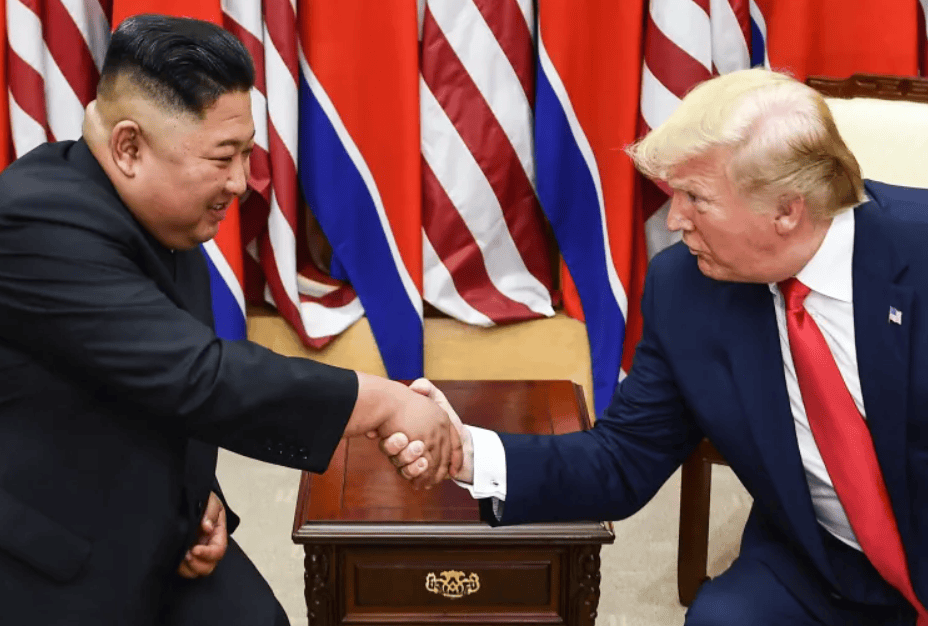
President Donald Trump is once again signaling an interest in renewing direct engagement with North Korean leader Kim Jong Un, reviving a diplomatic relationship that became one of the defining foreign-policy stories of Trump’s first term.
Trump has recently praised Kim and suggested that their relationship helped make the Korean Peninsula safer. At the same time, his administration has moved to scale back major US-South Korean military exercises and publicly criticized Seoul over its refusal to support Washington in its conflict with Iran.
The combination has raised an important question: Is Trump genuinely preparing for another diplomatic opening with North Korea, or is he using Pyongyang as leverage in his increasingly transactional relationship with South Korea?
Analysts say the answer may involve both.
Trump Signals A Return To Kim Jong Un Diplomacy
Trump said this week that Kim had responded positively to his recent overtures, describing their latest exchange as “very positive.” The comments came shortly after Washington ordered changes to military exercises with South Korea.
Trump has also argued that his relationship with Kim has contributed to greater stability on the Korean Peninsula.
The prospect of another Trump-Kim meeting is particularly notable because the two leaders have already established an unusual diplomatic history. During Trump’s first presidency, they moved from exchanging threats over North Korea’s nuclear weapons program to holding three unprecedented face-to-face meetings.
Reports that Trump could seek another summit as early as this autumn have added to speculation that a new phase of US-North Korea diplomacy could be emerging.
However, there are substantial obstacles.
North Korea has expanded its nuclear and missile capabilities since Trump’s first term and has strengthened its strategic relationship with Russia. Pyongyang’s position has also evolved, making the diplomatic landscape considerably different from 2018.
From “Fire And Fury” To Historic Summits
Trump’s First Attempt To Negotiate With Kim
Trump’s relationship with Kim initially developed under extremely tense circumstances.
In 2017, Trump threatened North Korea with “fire and fury” as Pyongyang advanced its nuclear weapons and missile programs. The rhetoric raised fears that the confrontation could escalate into open conflict.
A dramatic reversal followed.
In 2018, Trump met Kim in Singapore for the first-ever summit between a sitting US president and a North Korean leader. The two sides issued a declaration expressing a commitment to work toward the denuclearization of the Korean Peninsula.
The breakthrough, however, did not produce a lasting agreement.
A second summit in Hanoi in 2019 ended without a deal. The central disagreement involved sanctions relief and the extent of North Korea’s willingness to dismantle its nuclear capabilities.
Later that year, Trump met Kim again in the Korean Demilitarized Zone. Trump briefly crossed into North Korea, becoming the first sitting US president to do so.
Despite the historic symbolism, negotiations ultimately stalled.
Why Trump May Be Looking Toward North Korea Again
A renewed summit could offer Trump a significant foreign-policy opportunity at a politically sensitive moment.
His administration is dealing with major international challenges, including the conflict involving Iran, while his campaign promise to help end the war in Ukraine remains unresolved.
A meeting with Kim would allow Trump to present himself as a leader capable of reopening diplomatic channels with one of the world’s most isolated governments.
The political value could be substantial even if a major nuclear agreement were not reached.
Trump has historically placed considerable emphasis on personal diplomacy and direct relationships with foreign leaders. His previous meetings with Kim demonstrated his willingness to bypass traditional diplomatic processes in favor of high-level negotiations.
For Pyongyang, another summit could also provide an opportunity to seek recognition, sanctions relief and greater acceptance of its position as a nuclear-armed state.
That creates a complicated negotiating environment.
South Korea Is At The Center Of The Strategy
Trump’s renewed interest in North Korea cannot easily be separated from his increasingly demanding relationship with South Korea.
The president has criticized Seoul over its reluctance to support Washington’s military efforts involving Iran. He has also questioned whether the United States should continue carrying such a large share of the security burden for its allies.
That approach is consistent with Trump’s broader view that military alliances should involve greater financial and strategic contributions from partner countries.
The United States maintains roughly 28,500 troops in South Korea, where they serve as a major component of the deterrence strategy against North Korea.
For Seoul, the US military presence remains central to national security.
That makes any decision to reduce joint military exercises politically sensitive.
The annual Ulchi Freedom Shield exercises are designed to prepare US and South Korean forces for a potential conflict with North Korea. Pyongyang, however, has long condemned the drills as preparations for an invasion.
Reducing their scale could therefore send two different messages at once: reassurance to North Korea and pressure on South Korea.
A Possible “Tit For Tat” Strategy
Some analysts believe Trump’s approach reflects a transactional form of diplomacy.
By reducing military exercises with Seoul while simultaneously signaling greater openness toward Pyongyang, Washington can remind South Korea that its security relationship with the United States is not necessarily unconditional.
The strategy could also be connected to economic negotiations.
Trump has repeatedly pushed South Korea to increase investment in the United States and contribute more toward the costs associated with American troops stationed on the peninsula.
Trade has added another layer of tension.
During Trump’s first administration, Washington renegotiated its trade relationship with Seoul and imposed tariffs on South Korean steel. More recently, discussions over tariffs and investment commitments have again placed economic pressure on the alliance.
From this perspective, North Korea becomes more than a security issue.
The possibility of improved relations with Pyongyang can also function as diplomatic leverage against Seoul.
North Korea Has Little Reason To Trust Washington
Despite Trump’s enthusiasm for renewed talks, North Korea’s position presents a major challenge.
Pyongyang has spent years expanding its nuclear weapons capabilities and increasingly portrays itself as a permanent nuclear power.
That creates a fundamental problem for any future Trump-Kim negotiation.
During Trump’s first term, Washington insisted that North Korea move toward denuclearization. North Korea now appears far less willing to discuss abandoning its nuclear arsenal.
Kim has also demanded greater recognition of North Korea’s status and sovereignty.
For Pyongyang, accepting another summit with Washington could make sense if the United States is prepared to acknowledge the reality of North Korea’s nuclear capabilities.
For Washington, however, formally accepting North Korea as a nuclear-armed state would represent a major departure from long-standing US policy.
That gap could make a comprehensive agreement difficult.
Russia And Iran Have Changed The Geopolitical Picture
The international environment surrounding North Korea is also very different from 2018.
North Korea has developed closer military and political ties with Russia, while the United States remains deeply engaged in conflicts and security challenges elsewhere.
The war involving Iran has further complicated Washington’s strategic priorities.
American military resources are already under pressure, while policymakers must consider the possibility of additional crises emerging in other regions.
From Washington’s perspective, preventing a new confrontation on the Korean Peninsula could therefore have practical value.
For North Korea, closer ties with Russia may reduce its dependence on the United States and provide Kim with greater diplomatic room to maneuver.
That could make Pyongyang less inclined to accept the concessions Washington sought during Trump’s first presidency.
Does This Mean A New US-North Korea Deal Is Coming?
Not necessarily.
The current signals indicate renewed diplomatic interest, but they do not yet amount to a breakthrough.
A successful Trump-Kim summit would require both sides to overcome fundamental disagreements over nuclear weapons, sanctions, military exercises and North Korea’s international status.
There is also the question of South Korea.
Any major shift in US policy toward North Korea would have direct consequences for Seoul, which remains America’s treaty ally and depends heavily on US military support for deterrence.
Trump’s willingness to use alliance commitments as leverage could therefore create tensions with Seoul even as Washington attempts to improve relations with Pyongyang.
What Trump’s North Korea Strategy Could Mean
Trump’s renewed outreach to Kim Jong Un appears to serve several objectives simultaneously.
It could provide Trump with a major diplomatic opportunity, reduce the risk of another crisis in East Asia and demonstrate that his personal relationship with Kim remains useful.
At the same time, scaling back military exercises could pressure South Korea to contribute more financially and strategically to the alliance.
That combination illustrates the transactional nature of Trump’s foreign-policy approach.
For North Korea, however, the calculation is different. Kim has more nuclear capabilities, stronger ties with Russia and less incentive than before to accept an agreement centered on denuclearization.
The Road Ahead For Trump And Kim Jong Un
A new Trump-Kim summit would undoubtedly attract global attention, but the symbolism may be easier to achieve than a lasting agreement.
Trump has already demonstrated that personal diplomacy can produce dramatic moments. The harder task is converting those moments into concrete commitments that survive beyond a single meeting.
The next few months will show whether Trump’s latest outreach develops into formal negotiations or remains a strategic signal aimed at both Pyongyang and Seoul.
For now, the message from Washington is clear: Trump is once again willing to engage Kim Jong Un.
The more difficult question is whether either side is prepared to make the concessions necessary to turn that renewed interest into a meaningful diplomatic breakthrough.











Comments are closed.