
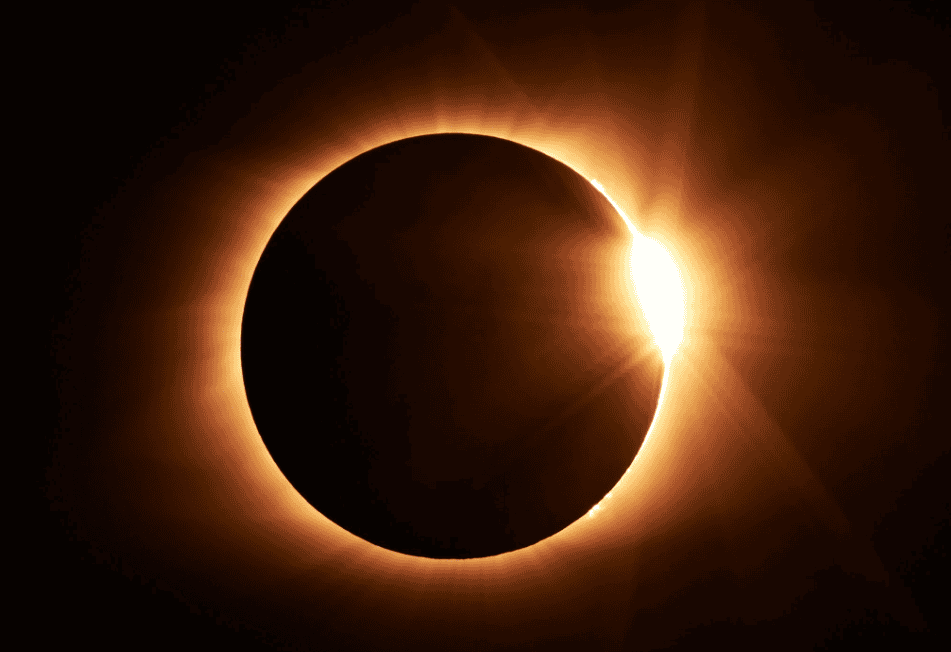
The total solar eclipse August 12, 2026 is set to become one of the year’s most spectacular astronomical events, with the Moon’s shadow crossing Greenland, Iceland, northern Russia, the Atlantic Ocean, Spain and a small part of Portugal. Millions more people across Europe, North America and parts of Africa will see a partial eclipse.
For observers lucky enough to be inside the path of totality, daylight will briefly fade as the Moon completely covers the Sun. The event will last only minutes, but the unusual combination of darkness, the solar corona and a low evening Sun in parts of Europe makes this eclipse particularly memorable.
Total Solar Eclipse August 12, 2026: What Time Does It Happen?
The total solar eclipse August 12, 2026 will unfold at different times depending on location because the Moon’s shadow will travel across Earth’s surface.
NASA’s eclipse data shows that totality will occur in the late afternoon in Iceland and during the evening in Spain. In several Spanish locations, the eclipse will happen shortly before sunset, creating the possibility of an especially dramatic sunset eclipse.
Some useful local timings include:
- Reykjavík, Iceland: Totality begins at about 5:48 p.m. local time and ends at 5:49 p.m.
- León, Spain: Totality begins at about 8:28 p.m. and ends at 8:30 p.m.
- Zaragoza, Spain: Totality begins at about 8:29 p.m. and ends at 8:30 p.m.
- Valencia, Spain: Totality begins at about 8:32 p.m. and ends at about 8:33 p.m.
The exact experience varies considerably by location. Weather, the Sun’s position above the horizon and how close an observer is to the centerline all affect what can be seen.
Where Will The August 12 Solar Eclipse Be Visible?
The path of totality is relatively narrow compared with the much larger region that will experience a partial eclipse.
Countries In The Path Of Totality
The Moon’s central shadow will cross northern Russia, Greenland, Iceland, Spain and a small area of Portugal. The Atlantic Ocean also lies along a significant portion of the eclipse track.
Inside this narrow band, observers can experience totality, when the Moon completely covers the Sun’s bright disk.
For many people outside that band, however, the eclipse will still be impressive. A partial solar eclipse will be visible across much of Europe, parts of northwestern Africa, most of Canada and portions of the northern United States.
That distinction matters. Seeing a very high percentage of the Sun covered is not the same as experiencing totality. Even a tiny visible portion of the Sun’s bright surface means observers must continue using proper eye protection.
Best Places To Watch The Eclipse In Europe
Spain is expected to be one of the major viewing destinations because several cities fall within the path of totality.
León, Valladolid, Zaragoza, Teruel and Valencia are among the Spanish locations positioned to experience totality. NASA’s published timings show that totality in Spain occurs in the evening, with the Sun relatively low in the sky.
That creates both an opportunity and a challenge.
A low Sun can produce striking photographs and atmospheric views, but buildings, hills, trees or clouds near the western horizon can obstruct the eclipse. Anyone planning to watch from Spain should therefore choose a location with a clear view toward the setting Sun.
Reykjavík is another prominent viewing location. There, totality begins at approximately 5:48 p.m. local time and lasts for roughly a minute.
How Long Will Totality Last?
Totality will be brief.
For most observers along the path, the period when the Moon completely blocks the Sun will last less than two minutes. Near portions of the central path, totality will last somewhat longer but remains under two and a half minutes.
That short window is one reason eclipse planning matters so much. Arriving early, checking the weather forecast and identifying an unobstructed viewing position can make a major difference.
Once totality begins, the transformation can be dramatic. The sky darkens, temperatures can change and the Sun’s outer atmosphere, or corona, becomes visible around the Moon’s silhouette.
NASA notes that total solar eclipses provide scientists with valuable opportunities to study the solar corona, which is difficult to observe under normal daylight conditions.
What Happens During A Total Solar Eclipse?
A solar eclipse occurs when the Moon passes between Earth and the Sun and blocks some or all of the Sun’s light.
During a total solar eclipse, observers inside the Moon’s umbra see the entire bright solar disk disappear. The remaining visible glow comes from the Sun’s outer atmosphere, producing the familiar corona around the dark Moon.
Outside the path of totality, the Moon covers only part of the Sun. That produces a partial eclipse, which can still be spectacular but does not create the same period of complete darkness.
The difference is important for both the viewing experience and eye safety.
How To Watch The August 12 Eclipse Safely
Looking directly at the uneclipsed or partially eclipsed Sun can cause serious eye injury. NASA recommends using proper solar viewing protection during all partial phases of a total eclipse.
Use Certified Eclipse Glasses
For direct viewing, use eclipse glasses or a handheld solar viewer designed for solar observation. Ordinary sunglasses are not a substitute, regardless of how dark they appear.
NASA says safe solar viewers should comply with the ISO 12312-2 international standard. Before using eclipse glasses, inspect them for damage and follow the manufacturer’s instructions.
During totality, there is one important exception: once the Moon completely covers the Sun’s bright face, observers inside the path of totality can look directly at the eclipse without solar viewing glasses.
However, that safe period ends immediately when sunlight begins to return. Eye protection must go back on before any portion of the bright solar surface becomes visible.
Can You Photograph The Solar Eclipse?
Yes, but cameras require the same careful planning as direct observation.
Looking at the Sun through a camera, telescope or binoculars without an appropriate solar filter can cause severe eye injury. NASA recommends using a special-purpose solar filter secured over the front of optical equipment, rather than relying on ordinary eclipse glasses placed behind the lens.
Photographers should also check their equipment instructions before attempting solar photography. During totality, when the Sun’s bright surface is completely hidden, specialized solar filtering requirements change, but the filter must be restored before the Sun reappears.
For casual observers, an indirect method such as a simple pinhole projector provides another way to watch the partial phases without looking directly at the Sun.
NASA Will Stream The Eclipse Online
People who cannot travel to the path of totality will still have an opportunity to follow the event.
NASA has announced live eclipse coverage featuring views from locations along the path as well as interviews with experts. Its official coverage is scheduled to begin on August 12, with totality coverage from Iceland and Spain during the broadcast.
This is particularly useful for viewers in places where clouds, sunset timing or geography prevent a clear view.
Why The 2026 Eclipse Matters Beyond The Spectacle
A total solar eclipse is more than a dramatic sky show. The temporary disappearance of direct sunlight creates a natural laboratory for researchers studying both the Sun and Earth’s atmosphere.
NASA-funded teams are conducting experiments during the August eclipse, including high-altitude observations of the solar corona and balloon-based atmospheric research in Iceland and Spain. Researchers are using the unusual conditions to investigate changes associated with the temporary loss of sunlight.
The event therefore offers two experiences at once: a rare visual phenomenon for the public and a valuable scientific opportunity for researchers.
What Comes After The August 12 Eclipse?
The August 12 event is part of a continuing series of solar eclipses.
The next total solar eclipse will occur on August 2, 2027, with the path of totality crossing southern Spain, parts of North Africa, Saudi Arabia and Yemen. Before that, an annular solar eclipse will take place on February 6, 2027.
For eclipse enthusiasts, the 2026 event is therefore not the end of the story. It is another milestone in a sequence of rare celestial events that can be planned for years in advance.
Conclusion
The total solar eclipse August 12, 2026 offers a rare chance to see the Moon completely cover the Sun, with totality crossing Greenland, Iceland, northern Russia, Spain and a small part of Portugal. Millions of additional observers will see a partial eclipse across much of Europe, North America and northwestern Africa.
For the best experience, viewers should choose a location with a clear sky and unobstructed horizon, arrive early and use proper solar protection throughout the partial phases. If you are inside the path of totality, the brief moment when the Sun’s bright face disappears is the only time during the eclipse when direct viewing without solar glasses is safe.
Whether watched from Spain, Iceland, another location across the eclipse zone or through NASA’s live coverage, this August 12 event promises a spectacular reminder of the precise celestial movements that shape our skies.






Comments are closed.