
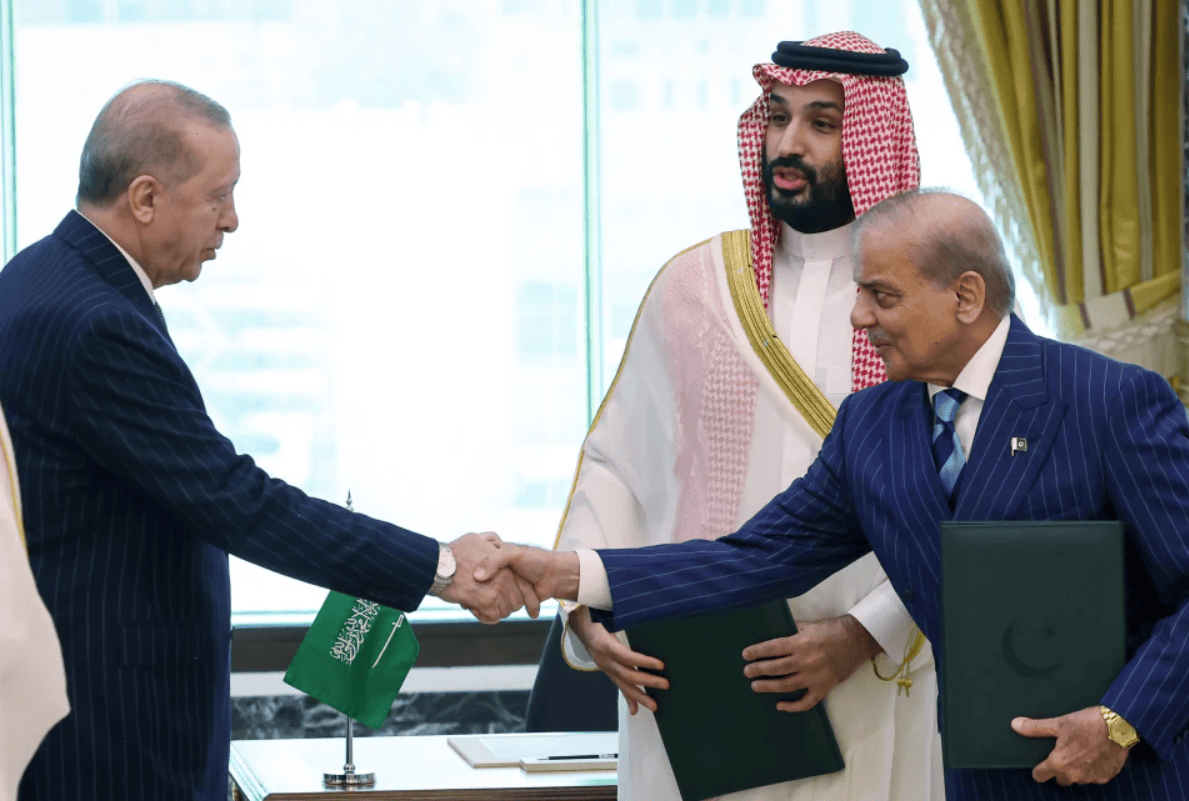
The Saudi Arabia, Türkiye and Pakistan defence agreement marks a significant shift in the strategic landscape of the Middle East and surrounding region. Signed in Mecca as regional tensions remain high, the pact brings together three influential Muslim-majority countries with different but complementary military, economic and geopolitical strengths.
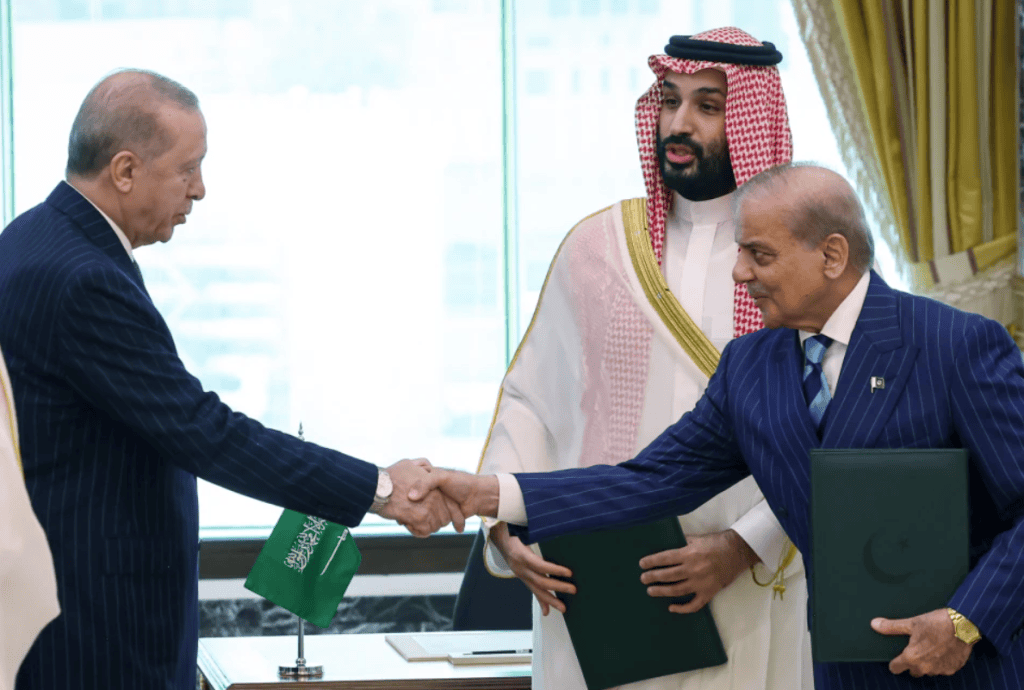
Known as the Mecca Joint Deterrence Agreement, the deal was signed on August 7, 2026, by Turkish President Recep Tayyip Erdoğan, Saudi Crown Prince and Prime Minister Mohammed bin Salman, and Pakistani Prime Minister Shehbaz Sharif. Its central principle is straightforward: an armed attack against one of the three countries would be treated as an attack against all three.
Yet the agreement is about more than mutual defence. It reflects growing concerns about regional instability, changing alliances and the reliability of the security arrangements that have shaped the Middle East for decades.
What Is The Saudi Arabia, Türkiye And Pakistan Defence Agreement?
The Saudi Arabia, Türkiye and Pakistan defence agreement is designed to strengthen collective deterrence and security cooperation among the three countries.
According to statements issued after the signing, the agreement builds on longstanding political, religious and defence ties. It also aims to promote peace, stability and security in the region.
The pact does not appear to create a military alliance equivalent to NATO. Instead, analysts describe it as a framework for closer strategic coordination, military cooperation and defence-industry development.
That distinction matters. While the agreement establishes an important political commitment, the precise mechanisms for responding to a future attack will depend on how the three governments implement the pact.
A Partnership Built On Different Strengths
Each country brings something different to the table.
Türkiye has a large and experienced military as well as an increasingly important domestic defence industry. Its companies have expanded their production of drones, naval systems, missiles and other military technologies.
Saudi Arabia, meanwhile, brings substantial financial resources, energy influence and an ambition to develop its own defence manufacturing capabilities. The kingdom has traditionally relied heavily on foreign suppliers, particularly the United States, but has increasingly sought greater strategic autonomy.
Pakistan contributes extensive military experience and a strategic deterrent. It is also the only Muslim-majority nuclear-armed state.
Together, these capabilities create the potential for deeper cooperation in defence production, intelligence, military training and strategic planning.
Why Was The Pact Signed Now?
The timing of the agreement is particularly important.
The three countries have discussed closer security cooperation for years, but regional developments have accelerated those efforts. The war involving Israel, the United States and Iran has increased concerns about missile attacks, drone warfare, disruption of trade routes and the possibility of a wider regional conflict.
Saudi Arabia has particular reason to be concerned. The kingdom hosts US military infrastructure and has faced security threats connected to the broader confrontation involving Iran and armed groups in the region.
The Strait of Hormuz has also become a major strategic concern. Any prolonged disruption to the waterway could have serious consequences for global energy markets and international trade.
Türkiye and Pakistan have not faced the same direct exposure, but both have strong interests in preventing a wider regional war.
For Ankara, instability in neighbouring regions can affect security, trade and its broader diplomatic ambitions. Pakistan, meanwhile, has sought to position itself as a mediator in regional crises while protecting its own economic and security interests.
The result is a convergence of interests that has encouraged the three governments to move beyond informal cooperation.
A Changing Middle East Security Architecture
The Saudi Arabia, Türkiye and Pakistan defence agreement also reflects a broader question: who should provide security in the Middle East?
For decades, the United States has played a central role in the region’s security system. Washington maintains military relationships and facilities across the Gulf, while countries such as Saudi Arabia have depended heavily on American weapons and defence technology.
At the same time, Iran has developed its own regional network of allies and armed groups.
The latest pact suggests that some regional powers increasingly want greater control over their own security arrangements rather than relying entirely on competition between larger powers.
Analysts have pointed to the complementary nature of the three countries’ capabilities as one reason the partnership could become important.
Türkiye offers defence-industrial expertise and military capacity. Saudi Arabia provides financial strength and considerable regional influence. Pakistan adds military experience and nuclear deterrence.
The combination could therefore encourage a more regionally driven security model.
What Could The Agreement Cover?
The pact’s broad language leaves room for cooperation in several areas.
Potential areas of collaboration include:
- Military coordination and training
- Intelligence and information sharing
- Defence-industry cooperation
- Weapons and equipment development
- Capacity building
- Strategic planning
- Energy and broader economic cooperation
Saudi Arabia’s interest in developing domestic defence manufacturing could make cooperation with Türkiye particularly valuable. Turkish defence companies have expanded rapidly in recent years, while Riyadh has been seeking to increase domestic production and reduce its dependence on imported equipment.
Pakistan could also contribute through military expertise and established defence relationships.
However, turning political commitments into an integrated security system will take time. Differences in foreign-policy priorities, military structures and relationships with other major powers could create challenges.
What Does The Agreement Mean For Iran?
Iran’s response will be closely watched.
At the time of the pact’s signing, there had been no official statement from Iran’s leadership. However, Iranian parliamentarian Ebrahim Rezaei criticised the agreement, arguing that Saudi Arabia should not expect external security partnerships to solve its strategic concerns.
The absence of an official government response does not necessarily mean Tehran will ignore the development.
Saudi Arabia and Iran have spent years balancing competition with diplomatic engagement. A stronger Saudi defence relationship with Türkiye and Pakistan could alter that calculation, particularly if the three countries begin coordinating more closely on regional security.
At the same time, the agreement’s stated defensive character could give all three governments room to avoid presenting the pact as an explicitly anti-Iran alliance.
What Does It Mean For Israel?
The agreement could also affect Israel’s strategic calculations, although its immediate impact remains uncertain.
Türkiye has repeatedly criticised Israeli military operations in Gaza and has opposed Israeli actions that Ankara believes could expand instability across the region. Pakistan has also strongly criticised Israel’s policies toward the Palestinians and has not established diplomatic relations with Israel.
Saudi Arabia occupies a different position. Riyadh has maintained diplomatic contacts with Washington and has faced pressure to normalise relations with Israel, but Saudi officials have continued to link normalisation to meaningful progress toward Palestinian statehood.
That makes the new defence arrangement particularly significant.
The three countries have said the agreement is defensive and is not directed against any specific state. Nevertheless, their shared concerns about regional instability, Israeli military actions and the broader confrontation involving Iran could influence how the partnership develops.
Could This Become A New Regional Alliance?
It is too early to describe the agreement as a new military bloc.
The pact is significant, but its long-term importance will depend on what happens next. Joint exercises, intelligence arrangements, defence-production projects and formal mechanisms for responding to attacks would provide stronger evidence that the agreement is developing into a durable security partnership.
There are also important differences among the three countries.
Türkiye is a NATO member with extensive ties to Western institutions. Saudi Arabia remains closely connected to the United States while simultaneously pursuing greater strategic independence. Pakistan maintains its own complex relationships with China, the Gulf states and other international powers.
Managing those differences will be essential.
A Potential Turning Point For Regional Security
The Saudi Arabia, Türkiye and Pakistan defence agreement arrives at a moment when the Middle East’s traditional security assumptions are under intense pressure.
Rather than depending exclusively on outside powers, the three countries are signalling a willingness to develop stronger regional capabilities and closer strategic coordination. Their combined military, financial and technological resources give the partnership considerable potential.
Still, the agreement’s significance should not be overstated. It is not yet a NATO-style alliance, and its practical military commitments remain to be tested.
What happens next will determine whether the Mecca agreement becomes primarily a political statement or the foundation of a deeper regional security architecture. Either way, the Saudi Arabia, Türkiye and Pakistan defence agreement is an important development that could influence diplomacy, defence cooperation and strategic calculations across the Middle East for years to come.




Comments are closed.