
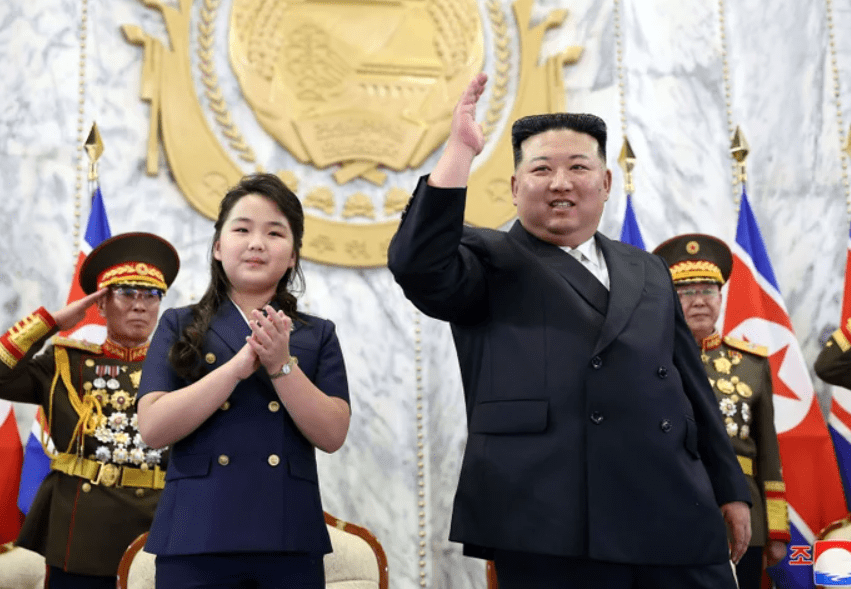
North Korea may be preparing for a historic shift in power. According to South Korea’s intelligence agency, Kim Jong Un has selected his teenage daughter, Kim Ju Ae, as his successor. The announcement has sparked global attention and raised serious questions about the future of the secretive regime.
The move is remarkable for several reasons. Kim Ju Ae is believed to be just 13 years old. Moreover, North Korea remains a deeply patriarchal society where male leadership has long been the norm. Yet her increasingly prominent public presence suggests that the succession plan is no longer speculation but a carefully staged political reality.
As Kim Jong Un chooses teen daughter as heir, analysts are closely watching what this means for the stability, direction, and symbolism of North Korea’s leadership.
Kim Jong Un Chooses Teen Daughter as Heir
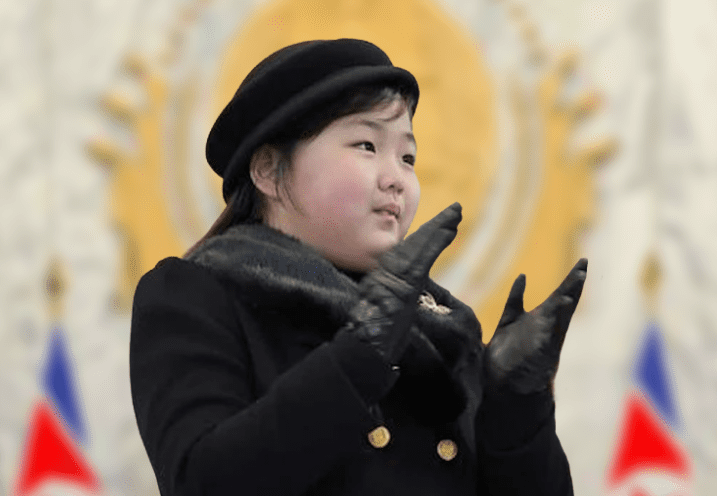
South Korea’s National Intelligence Service recently informed lawmakers that Kim Ju Ae has entered what they describe as the “successor designation” stage. This assessment is based on a range of developments, including her growing visibility at major state events and indications that she may already be offering input on policy matters.
In recent months, Kim Ju Ae has appeared alongside her father at key national ceremonies. She attended the founding anniversary of the Korean People’s Army and visited the Kumsusan Palace of the Sun, where North Korea’s former leaders lie in state. These appearances are not ceremonial footnotes. In North Korea, symbolism carries immense political weight.
Observers have noted that state media photographs often position her prominently next to Kim Jong Un. In some images, she stands level with him rather than behind him. In a country where visual hierarchy reflects power, such positioning is significant.
A Public Role That Signals Authority
Kim Ju Ae first appeared on state television in 2022. She was seen holding her father’s hand while inspecting an intercontinental ballistic missile. That image alone sent a powerful message. It connected her directly to North Korea’s nuclear ambitions, which remain central to the regime’s identity and foreign policy.
Since then, her appearances have increased in both frequency and importance. She has accompanied her father to military inspections and high profile national events. In September, she traveled abroad for the first time, visiting Beijing. This marked a major step in presenting her not only as a domestic figure but as someone who could represent North Korea on the international stage.
South Korean lawmakers have suggested that her current role resembles that of a de facto second highest leader. While she holds no formal title, her proximity to power speaks volumes.
Breaking Tradition in a Patriarchal State
The Kim dynasty has ruled North Korea for three generations. Leadership passed from Kim Il Sung to Kim Jong Il and then to Kim Jong Un. Each transition reinforced the image of a male revolutionary lineage.
Therefore, the decision to elevate a daughter rather than a son challenges long held assumptions. Intelligence officials believe Kim Jong Un has an older son. However, this son has never appeared in public and has not been acknowledged by state media.
North Korea’s society remains rooted in traditional gender roles. Many analysts previously dismissed the possibility of a woman leading the country. However, Kim Yo Jong, Kim Jong Un’s sister, offers an important precedent. She holds a senior position within the ruling Workers’ Party and is widely considered influential in state affairs.
Her prominence has already normalized the presence of women in high level political roles, at least within the ruling family. In that context, Kim Ju Ae’s designation may appear less radical than it once would have.
Why Now
Another key question concerns timing. Kim Jong Un is still relatively young and appears to be in stable health. Why designate a successor at such an early stage?
One possible explanation lies in regime stability. North Korea’s leadership system depends heavily on clear lines of succession. By publicly introducing and elevating Kim Ju Ae, the regime reduces uncertainty in the event of a sudden crisis.
Additionally, early designation allows years of political grooming. Kim Ju Ae can gradually become a familiar figure to the North Korean public. Over time, her authority may feel inevitable rather than abrupt.
Image Crafting and Political Messaging
Kim Ju Ae’s public image appears carefully curated. She is often seen wearing elegant clothing that contrasts sharply with the modest attire of ordinary North Koreans. Her long hairstyle also stands out, as such styles are generally restricted for her peers.
These details are not accidental. They reinforce her elite status and distinguish her as part of the ruling bloodline. At the same time, her youthful presence softens Kim Jong Un’s global image. Instead of appearing solely as a nuclear armed strongman, he is shown as a father guiding his daughter.
This dual messaging serves both domestic and international audiences. Domestically, it strengthens the myth of the Kim family as a permanent and sacred leadership line. Internationally, it introduces a new and somewhat unexpected face to the regime.
The Role of the Workers’ Party Congress
Attention now turns to the upcoming Workers’ Party congress, North Korea’s largest political gathering held every five years. The event typically outlines national priorities, including foreign policy, economic planning, and military strategy.
If Kim Ju Ae plays a visible role at the congress, it would further confirm her elevated status. Such an appearance could mark a decisive moment in formalizing her position as heir.
Given the highly choreographed nature of North Korean political events, even small gestures at the congress would carry outsized meaning. Observers will analyze seating arrangements, speaking opportunities, and visual framing for clues.
What Could a Kim Ju Ae Era Mean
It remains unclear what changes Kim Ju Ae’s succession might bring. When Kim Jong Un assumed power, some hoped his Western education would lead to reform and greater openness. Those expectations largely went unmet.
As Kim Jong Un chooses teen daughter as heir, similar speculation arises. Will a new generation alter North Korea’s direction? Or will the regime maintain its established course of centralized control and nuclear deterrence?
Given the system’s structure, any successor must rely on the military and party elite. Therefore, continuity may prove more likely than transformation. However, generational shifts can introduce subtle changes over time.
One thing is certain. If Kim Ju Ae eventually takes power, she will hold immense authority. North Korea’s leader commands not only the government but also the military and the ruling party. Few positions in the world concentrate power so completely.
A Historic and Uncertain Transition
The emergence of Kim Ju Ae marks a pivotal moment in North Korean politics. Her steady rise from a previously unknown child to a publicly designated heir underscores how carefully the regime manages its narrative.
While many questions remain unanswered, the symbolism is unmistakable. The Kim dynasty appears determined to secure its legacy through a fourth generation. This time, that legacy may rest in the hands of a teenage girl.
Whether this decision signals continuity or gradual evolution, it has already reshaped global perceptions of North Korea’s future. As the world watches closely, Kim Ju Ae stands at the center of a succession story that could define the next era of one of the world’s most secretive states.
















Comments are closed.