
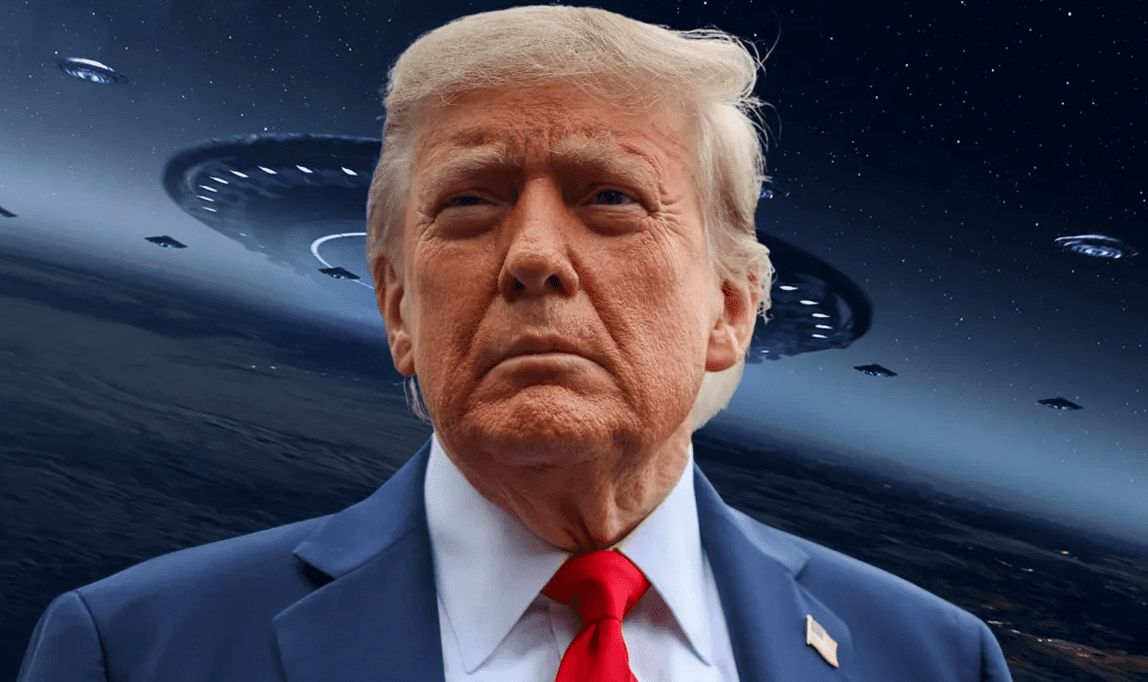

In a development that has reignited global debate over government secrecy and extraterrestrial life, US President Donald Trump has instructed the Pentagon and other federal agencies to begin identifying and releasing government files on aliens and unidentified aerial phenomena (UAP) — also known as UFOs (unidentified flying objects). The announcement comes amid renewed public interest, political pressure, and high-profile comments from former President Barack Obama about the statistical likelihood of life beyond Earth.
Trump made the declaration on February 19, 2026, through a post on his social media platform, directing the Department of Defense and other agencies to “begin the process of identifying and releasing Government files related to alien and extraterrestrial life, unidentified aerial phenomena (UAP), and unidentified flying objects (UFOs), and any and all other information connected to these highly complex, but extremely interesting and important, matters.” While officials have not shared a precise timeline for the release, sources confirm that teams are actively reviewing thousands of reports, radar data, sensor logs, and other relevant documentation.
What Sparked the Directive
The directive follows Obama’s recent podcast comments in which he said he believes extraterrestrial life could exist elsewhere in the universe, though he clarified that he has seen no evidence of alien contact during his presidency. Trump accused Obama of revealing “classified information” in making these remarks, framing his own move as both a corrective measure and a response to public curiosity. While Trump stated he personally “doesn’t have an opinion” on the existence of aliens, he described the matter as “extremely interesting and important” and pledged transparency to the American people.
The announcement taps into a resurgence of interest in UFOs sparked by the release of Navy videos in 2017 showing unidentified objects in U.S. airspace. These events led Congress to hold hearings on UFOs for the first time in 50 years, resulting in the Pentagon establishing the All-domain Anomaly Resolution Office (AARO) in 2022 to collect and analyze reports from military personnel, pilots, and other government sources.
What Files Might Be Released
The Pentagon review is expected to cover decades of military and intelligence records, including radar and satellite data, pilot testimonies, and internal analyses of UAP encounters. Previous unclassified reports suggest that most sightings have mundane explanations, ranging from drones and balloons to atmospheric phenomena. However, thousands of cases remain unresolved, fueling speculation about possible extraterrestrial technologies.
Experts argue that even if no evidence of alien life is found, these files could still offer valuable insights into aerospace phenomena, sensor technology limitations, and flight patterns — contributing to both scientific research and public understanding.
Public Reaction and Political Implications

Trump’s move has sparked a mix of excitement and skepticism. UFO enthusiasts and disclosure advocates like Luis Elizondo, a former intelligence official involved in past government UAP investigations, have urged officials to release information promptly, warning that bureaucratic hurdles could delay full transparency. Meanwhile, scientists and space agencies, including NASA, stress that public fascination does not equate to confirmation of alien contact. They continue to support rigorous scientific inquiry without prematurely attributing unexplained phenomena to extraterrestrial activity.
Politically, the announcement highlights the intersection of public curiosity, media sensationalism, and national security. The issue of UFO disclosure has become a unique point of bipartisan discussion, with proponents emphasizing transparency and skeptics cautioning against misinformation and hysteria.
The Broader Context of UFO Disclosure
This directive marks one of the most high-profile acknowledgments of UFO investigation by a U.S. president in decades. Since the leaked Pentagon videos in 2017, there has been a growing push for declassification of UAP files, culminating in hearings, reports, and the establishment of dedicated offices like AARO. Trump’s announcement is likely to further energize public debate and media coverage, both in the United States and globally, placing pressure on other nations to address their own unidentified phenomena records.
Whether the files will reveal anything groundbreaking remains uncertain, but the move underscores the enduring public fascination with the unknown, the role of government transparency, and the broader implications for science, security, and cultural discourse. As the world watches, the release of these files could redefine the conversation around extraterrestrial life for years to come.












Comments are closed.