


The Artemis II mission concluded with a successful splashdown in the Pacific Ocean on April 10, marking the first crewed journey around the Moon in more than five decades. The four-member crew returned after a 10-day mission that tested critical systems for future lunar landings, underscoring renewed momentum in U.S. space policy and international collaboration in space exploration.
Background & Context
The Artemis program, led by NASA, represents the United States’ long-term strategy to re-establish a human presence on the Moon and eventually support missions to Mars. It follows the historic Apollo program, which last sent astronauts to the lunar surface in 1972.
Unlike Apollo, Artemis is designed as a sustained effort, combining government-led missions with increasing participation from private companies and international partners. The program reflects broader shifts in U.S. foreign policy priorities, where technological leadership and strategic competition—particularly with China—extend into space.
Key Developments
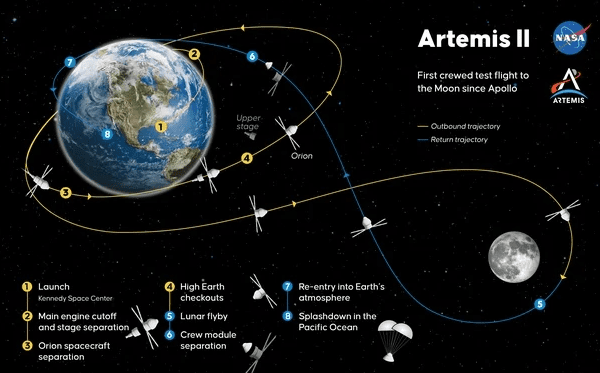
The Artemis II crew—commander Reid Wiseman, pilot Victor Glover, and mission specialists Christina Koch and Jeremy Hansen—traveled approximately 406,000 kilometers from Earth, the farthest distance reached by humans to date.
Launched on April 1 aboard NASA’s Space Launch System, the Orion spacecraft conducted a lunar flyby without landing, orbiting the Moon’s far side before returning to Earth. During re-entry, the capsule endured extreme temperatures and a planned communications blackout before deploying parachutes and landing near San Diego.
NASA officials confirmed the astronauts were in good health following recovery operations conducted with U.S. Navy support. The mission also produced extensive imagery and scientific observations, including views of the Moon’s far side and a total solar eclipse observed from lunar orbit.
The crew itself marked a milestone in representation: Koch became the first woman to travel around the Moon, Glover the first Black astronaut on a lunar mission, and Hansen the first non-U.S. citizen to participate in such a mission.
Analysis & Implications
The successful completion of Artemis II reinforces U.S. ambitions to return astronauts to the Moon by 2028, a goal tied closely to domestic political priorities and congressional funding. It also reflects broader geopolitical dynamics, as space exploration becomes an arena for strategic competition and international cooperation.
From a U.S. foreign policy perspective, the Artemis program serves both symbolic and practical functions. It demonstrates technological capability, strengthens alliances—particularly through partnerships with countries such as Canada—and positions the United States as a leader in setting norms for future lunar activity.
In the context of global geopolitics, the mission takes place amid increasing competition with China, which has outlined its own plans for lunar exploration. The timeline and success of future Artemis missions may influence how governance, resource use, and access to the Moon are negotiated in international forums.
At the same time, the program relies on collaboration with private sector actors, including companies developing lunar landers and transport systems. This evolving public-private model signals a shift in how major space initiatives are financed and executed.
Conclusion
Artemis II represents a significant technical and operational milestone, but it also highlights the challenges ahead. Future missions will need to demonstrate the feasibility of sustained lunar operations, including landings, infrastructure development, and long-term human presence.
As the United States advances its lunar agenda, the program’s trajectory will likely shape not only the future of space exploration but also broader international relations in an increasingly competitive geopolitical environment.














Comments are closed.