
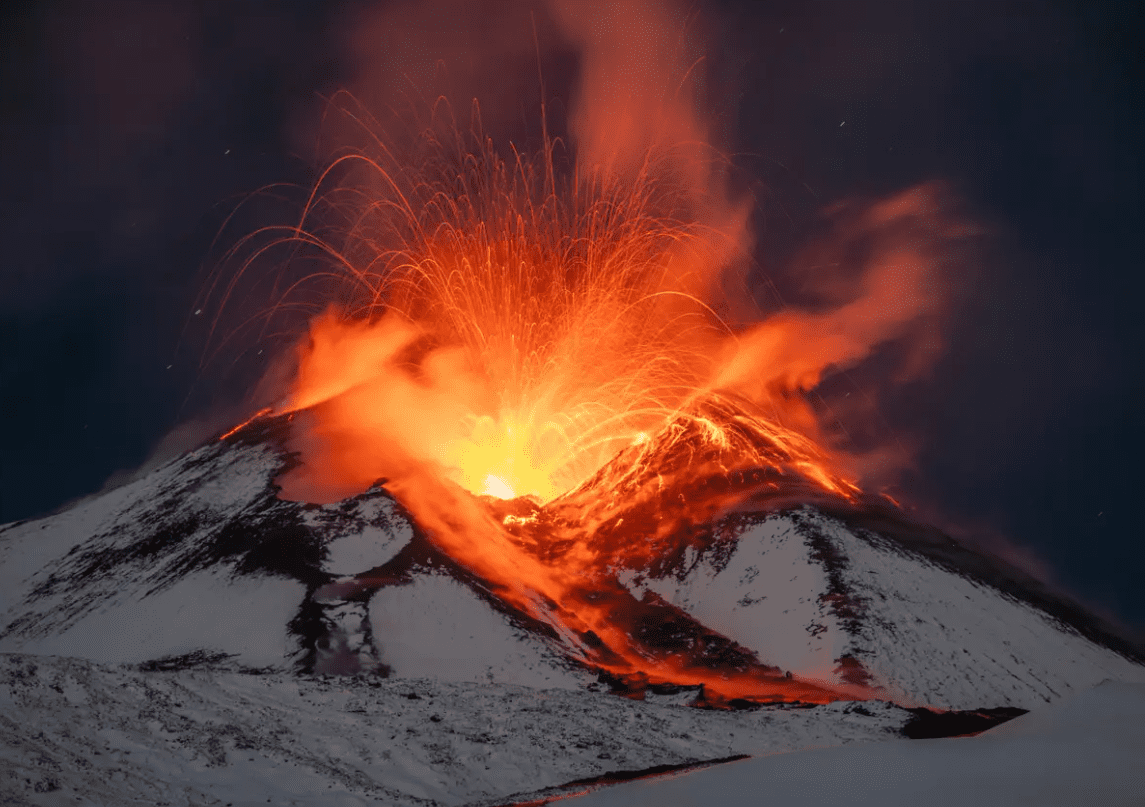
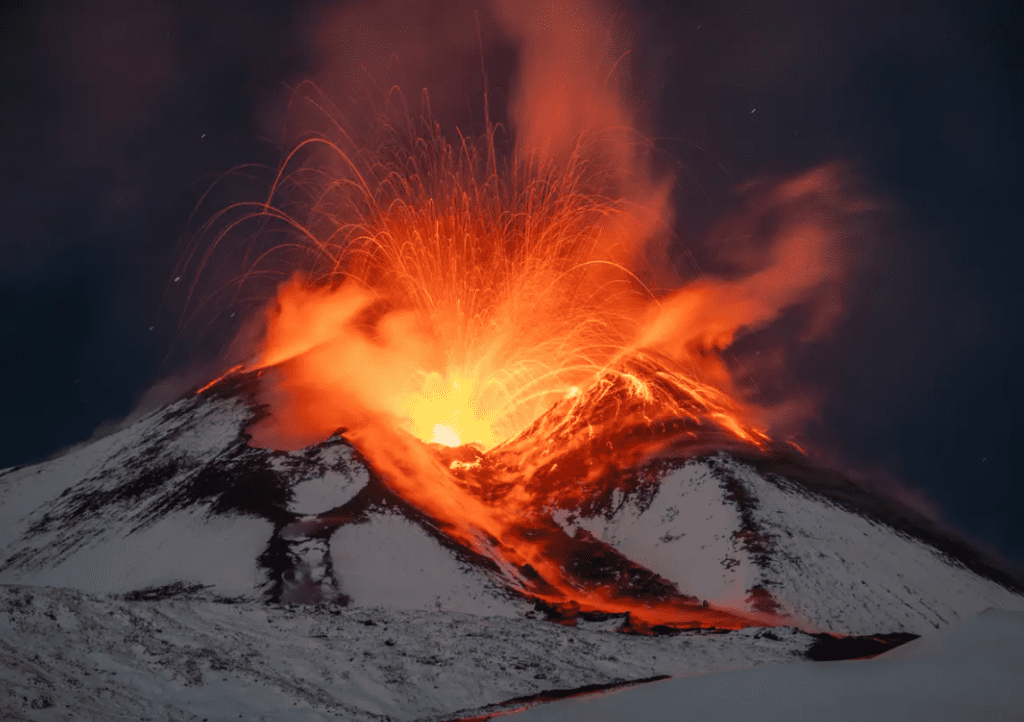
A dramatic Mount Etna eruption has stunned Europe after astonishing footage showed molten lava blasting more than 1000ft into the air. Europe’s most active volcano roared back to life on Sicily’s east coast, prompting a yellow alert and raising concerns about possible travel disruption for holiday flyers.
The eruption, confirmed by Italy’s National Institute of Geophysics and Volcanology, sent glowing lava fountains and towering ash clouds across eastern Sicily, creating scenes both breathtaking and alarming.
Mount Etna Eruption Triggers Yellow Alert Across Sicily
The latest Mount Etna eruption began on Boxing Day and continued into December 27 after several hours of calm. Volcanologists reported intense explosive activity from multiple craters near the summit.
A yellow aviation alert was quickly issued. This level signals heightened monitoring and information sharing, especially for air traffic. While airports remain open, travelers have been warned to expect potential delays.
Flights Monitored as Ash Cloud Drifts East
Authorities are closely watching conditions at Catania Fontanarossa Airport, Sicily’s busiest travel hub. Winds pushed the massive ash plume north east, reducing immediate risk to runways but increasing uncertainty for flight schedules.
So far, only minor delays have been reported. However, aviation officials remain on standby in case conditions worsen.
Lava Fountains and Ash Clouds Light Up the Sky
According to the INGV, jets of molten lava shot more than 1000ft into the air, while volcanic rock fragments were hurled several kilometres above the summit.
Footage captured an enormous ash column rising into the atmosphere as lava cascaded down the volcano’s flanks. In one striking scene, skiers continued descending Etna’s slopes as ash fell nearby.
Lava Flows Move Toward Valle del Bove
Lava from the eruption flowed roughly 2km east toward Valle del Bove, a natural basin known for containing Etna’s lava streams. Experts say this reduced the immediate threat to populated areas.
However, ash fall was reported on Piano Provenzana, a popular ski resort located on the volcano itself. Fine ash also reached the nearby town of Taormina.
Europe’s Most Active Volcano Strikes Again
Mount Etna stands at over 10,000ft tall and is one of the most closely monitored volcanoes on Earth. Its frequent eruptions make it both a scientific treasure and a constant natural risk.
The volcano last erupted in June, while earlier this year dramatic scenes showed tourists fleeing as ash clouds rapidly expanded.
A History of Disruption and Danger
Etna’s eruptions have repeatedly affected travel and safety in the region. In February 2021, volcanic activity forced temporary airport closures. In 2017, ten people were injured during an unexpected explosion, including members of a BBC news crew.
Despite safety bans, some visitors continue to approach the volcano during eruptions, drawn by its raw power and rare spectacle.
Why Yellow Alerts Matter for Travelers
A yellow alert does not mean immediate danger, but it signals that conditions can change quickly. Volcanic ash poses a serious risk to aircraft engines, even when eruptions appear visually distant.
Airlines rely on constant updates from volcanologists to adjust routes or ground flights if needed. Travelers flying to or from Sicily are advised to monitor airline announcements closely.
Mount Etna Eruption Captivates and Warns the World
The latest Mount Etna eruption is a reminder of nature’s immense force. While the visuals have captivated millions online, authorities stress that safety remains the priority.
With lava still flowing and ash clouds drifting across Sicily, scientists continue round the clock monitoring. For now, Etna remains active, unpredictable, and once again at the center of global attention.


















Comments are closed.