
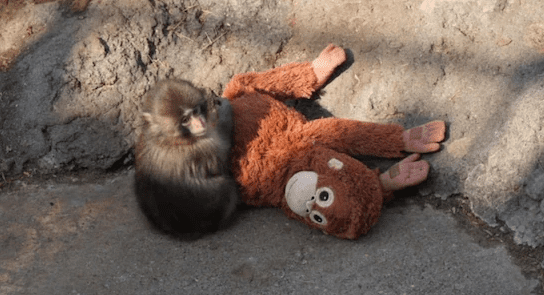
On July 26, 2025, at Ichikawa City Zoo near Tokyo, a tiny Japanese macaque named Punch entered the world—but his first moments of life were far from ordinary. Almost immediately after birth, Punch was rejected by his mother, leaving the newborn without the maternal care so crucial for a primate’s early development. The heartbreaking moment might have gone unnoticed if not for a series of viral videos showing Punch clinging to a stuffed orangutan toy, a makeshift substitute that would become his lifeline.
Zookeepers quickly intervened to ensure Punch’s survival. They provided him with a plush toy selected for its long hair and graspable limbs, mimicking the comforting feel of a real monkey. “The toy gives him something to cling to, helping build the physical strength and emotional comfort that a mother usually provides,” said zookeeper Kosuke Shikano. This early support has been critical, allowing Punch to begin the slow process of integrating into his troop while offering an unusual glimpse into the resilience of young primates.
Why Mothers Reject Their Infants
Infant rejection, while shocking, is not uncommon among primates. Studies have documented instances in which mothers abandon or even harm their young due to stress, first-time motherhood challenges, health issues, or past trauma. In Punch’s case, Shikano suggested that the intense summer heat during his birth might have played a role. First-time mothers often struggle to form an immediate bond, and environmental pressures such as extreme temperatures, excessive noise, or limited resources can increase the likelihood of neglect. Additionally, a mother’s compromised health or nutrition may force her to prioritize self-preservation over infant care.
A Plush Lifeline
Punch’s attachment to his orangutan toy has captivated audiences across the globe. Chosen for its monkey-like appearance, the stuffed companion has provided him both physical and emotional comfort during a period of intense vulnerability. The toy allows Punch to practice clinging, build strength, and experience a sense of security—critical elements that support eventual social integration with other macaques. “It was easy for him to grab,” Shikano explained. “Maybe he also liked that it looked like a monkey.”
Social media quickly picked up on Punch’s story, giving rise to a devoted fanbase using the hashtag #HangInTherePunch. Millions have watched clips of the baby macaque dragging his plush toy, attempting playful interactions, and gradually testing the boundaries of his new social environment. The videos struck a chord, highlighting both the fragility and resilience of life in the animal kingdom.
The Road to Social Integration
Initially, Punch was hesitant to approach other members of his troop. Over time, under careful supervision, he has started to learn the subtle cues and signals that guide macaque social life. Zookeepers report encouraging signs: Punch now playfully engages with his peers, occasionally gets scolded, and is beginning to assert his presence within the group. “While he sometimes gets disciplined by older monkeys, he shows mental strength and resilience,” said Shikano. “We’re confident that he will eventually outgrow his reliance on the toy and fully integrate into the troop.”
Fans Flock to See the Viral Sensation
The zoo has become a hub for Punch enthusiasts. On a recent Friday, over 100 visitors gathered at the macaque enclosure, eager to catch a glimpse of the young primate in action. Fans of all ages cheered as Punch cautiously interacted with his troop, shouting playful encouragement: “Hang in there, Punch!” Visitors traveled from across the region to witness his unique story firsthand. Sayaka Takimoto, 32, drove two hours with her husband to see Punch. “We rarely come to the zoo, but we had to see him,” she said. “He’s so adorable carrying his toy around.”
Other fans expressed mixed emotions. Some worried about his safety after videos circulated showing Punch being dragged by an adult monkey. The zoo reassured the public that Punch is not in danger and that these interactions are a normal part of his social development. They emphasized the importance of patience and support as Punch continues learning the complex dynamics of macaque life.
A Symbol of Resilience
Punch’s story is more than just a viral sensation—it is a testament to the adaptability of life and the power of care, even when unconventional. By relying on a stuffed toy in the absence of maternal affection, Punch has not only survived but begun to thrive, inspiring empathy and admiration worldwide. His journey underscores the delicate balance of nature, the influence of human intervention, and the unyielding spirit of a young life determined to persevere.
From forlorn newborn to a budding social star, Punch is teaching us all a lesson in resilience, hope, and the extraordinary ways animals adapt to challenges. As zookeepers continue guiding him toward full integration, fans remain captivated, following each playful step, each tentative interaction, and every moment Punch proves that even in the toughest beginnings, survival and joy are possible.












Comments are closed.