

In elite sport, true power shifts rarely announce themselves with noise. They arrive quietly — through consistency, composure, and control. That is exactly what unfolded on the Olympic ice as Japan asserted itself as figure skating’s new center of gravity, while Alysa Liu emerged as the unexpected counterweight: calm, unshaken, and resistant to a system built on pressure.
What played out was not simply a competition. It was a revealing moment in how global dominance in sport is evolving — and who is best prepared to survive it.
Japan’s Rise Is Strategic, Not Accidental
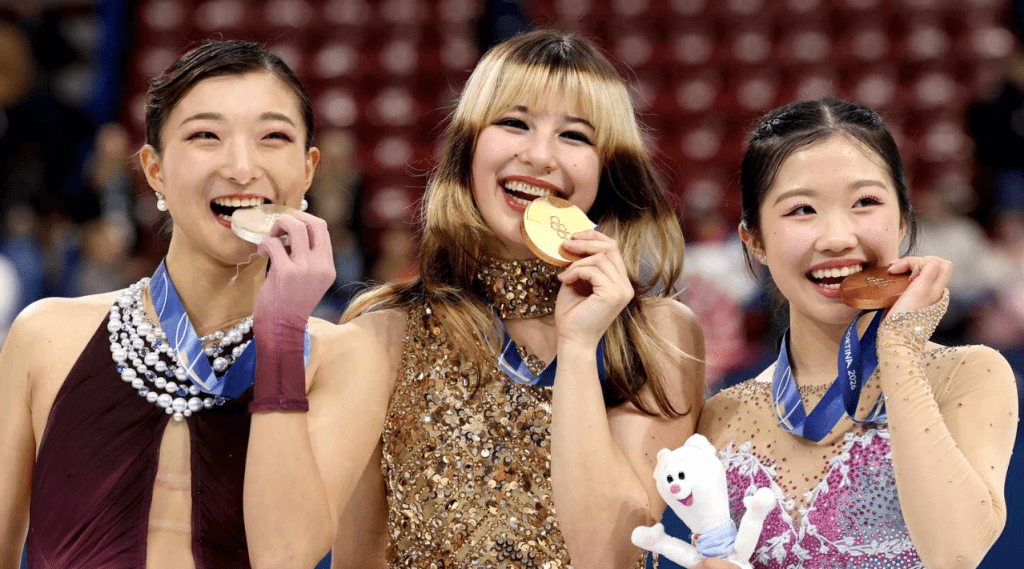
Japan’s dominance in women’s figure skating has been years in the making. Unlike federations that rely on isolated prodigies or short-term peaks, Japan has built depth. Multiple skaters capable of podium-level performances now emerge from a system that emphasizes precision, repeatability, and psychological control.
At recent Olympic and World Championship cycles, Japanese athletes have consistently occupied top positions, not through risk-heavy desperation but through structural reliability. Their performances signal something larger than athletic success: a national sporting philosophy focused on longevity rather than spectacle.
This approach has quietly but decisively shifted the balance of power on ice.
Alysa Liu: The Anomaly the System Didn’t Predict
Against this backdrop, Alysa Liu’s presence felt almost disruptive.
Liu does not fit the traditional Olympic narrative. She stepped away from the sport when expectations became suffocating, rejecting the idea that excellence must come through relentless pressure. Her return wasn’t fueled by unfinished business or external demands — but by personal readiness.
That distinction mattered.
While others skated as representatives of national systems, Liu skated as an individual. Her performances were defined not by visible anxiety or mechanical perfection, but by clarity. She didn’t chase excess difficulty. She didn’t unravel under scrutiny. She simply executed.
In a discipline often shaped by fear of failure, her calm became a competitive advantage.
Calm as a Competitive Weapon
Figure skating has long been haunted by burnout, controversy, and emotional collapse on the biggest stages. Over the past decade, the sport has seen how relentless pressure — especially on young athletes — can erode performance rather than elevate it.
Liu’s skating offered a counter-model.
Her programs demonstrated that control does not require domination, and confidence does not require aggression. While Japan’s skaters embodied system-wide excellence, Liu embodied something rarer: mental autonomy.
That difference exposed a new fault line in elite sport — one between centralized systems and athletes who refuse to be consumed by them.
Sport as Soft Power: Why This Moment Matters Beyond Ice
For Camel Move readers, the significance goes beyond medals.
Japan’s rise in figure skating reflects a broader global trend: nations investing in cultural and athletic soft power as a means of international influence. Success on the Olympic stage is no longer just about prestige — it signals organizational competence, long-term planning, and national stability.
At the same time, Liu’s success complicates that narrative. She proves that individual agency can still disrupt even the most efficient systems. Her victory suggests that the future of elite competition may not belong exclusively to institutions — but to athletes who manage to preserve psychological independence within them.
This tension mirrors wider global dynamics playing out across politics, economics, and culture.
A Sport at a Crossroads
Women’s figure skating now stands at a turning point.
Japan’s model appears sustainable and scalable. Liu’s path, however, raises uncomfortable questions for federations worldwide: Can athletes thrive without constant pressure? Is emotional well-being compatible with Olympic success? And what happens when competitors refuse to be treated as expendable assets?
The answers will shape the next generation of champions.
What Comes Next
Japan leaves this moment with momentum and structural confidence. Alysa Liu leaves it with something equally powerful: proof that calm can win in an age of chaos.
The ice has changed.
The balance has shifted.
And the future of figure skating will be decided not only by jumps — but by who controls the mental game.
















Comments are closed.