
Bad Bunny did more than headline the Super Bowl halftime show. He reframed what America means, on the biggest stage in entertainment, in front of a global audience of hundreds of millions.
His historic performance at Super Bowl 2026 became instantly polarizing, deeply symbolic, and impossible to ignore. Sung primarily in Spanish, rooted in Puerto Rican culture, and ending with a message of unity across the Americas, the show ignited political backlash, academic praise, and viral discussion across social media.
Yet at its core, Bad Bunny’s halftime show was not about provocation. It was about belonging.
A Super Bowl Finale That Changed the Conversation
To understand the significance of Bad Bunny’s performance, many experts say to look at how it ended.
After delivering a visually rich set grounded in Caribbean imagery and Latin rhythms, Bad Bunny paused. Then he spoke some of the few English words of the night.
“God bless America.”
Immediately after, he began listing countries across the Americas, including the United States and Canada. Behind him, a massive screen displayed a message that echoed his recent Grammy Awards speech.
“The only thing more powerful than hate is love.”
It was a clear statement. America, as Bad Bunny presented it, is not one country. It is a hemisphere.
Why Bad Bunny’s Super Bowl Halftime Show Became Political
The performance was politicized long before kickoff.
Critics labeled it un American. Others questioned why a predominantly Spanish language performance belonged on the Super Bowl stage. President Donald Trump went further, calling the show “a slap in the face to our country” and “an affront to the Greatness of America.”
Those reactions, scholars argue, reveal the very assumptions Bad Bunny was challenging.
Puerto Ricans are United States citizens. They have been since 1917. Yet their cultural visibility and political rights remain limited, especially for those living on the island.
Bad Bunny’s show confronted that contradiction directly, without a single campaign slogan.
A Visual Celebration of Puerto Rican Identity
Throughout the performance, Bad Bunny showcased Puerto Rican culture in unmistakable ways.
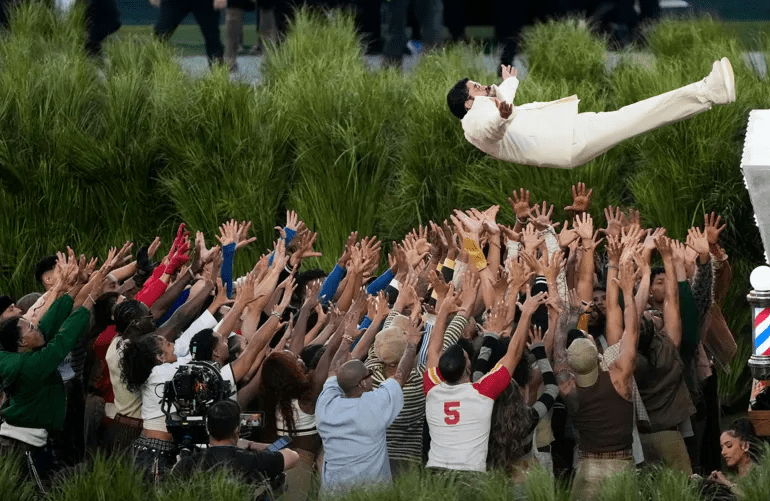
The stage design evoked sugar cane fields, a symbol tied to Caribbean history and labor. He walked past a piragua stand, a shaved ice staple across Puerto Rico. Traditional plena musicians joined him, representing a genre historically linked to community storytelling and protest.
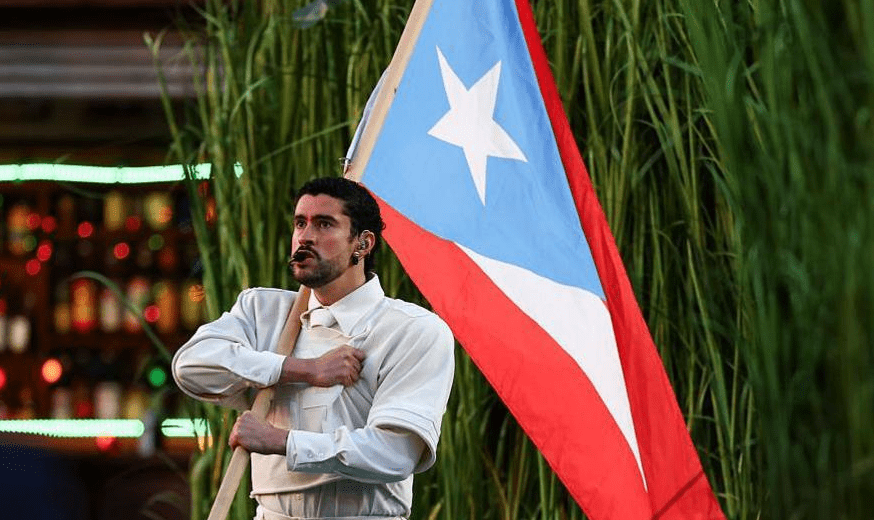
At one moment, Bad Bunny waved a Puerto Rican flag with a light blue triangle. That detail mattered.
The Meaning Behind the Flag
According to scholars, the light blue triangle references the original Puerto Rican flag used before the United States took control of the island in 1898. The color has since become associated with Puerto Rican independence.
By choosing that version of the flag, Bad Bunny layered his message. He celebrated Puerto Rican culture while also acknowledging its unresolved political status.
It was subtle. It was deliberate.
Together, We Are America
One of the most striking visuals came near the end of the show.
Bad Bunny stood surrounded by performers waving flags from across the Americas. Not just countries, but territories like Bonaire and the US Virgin Islands. He held a football emblazoned with a simple phrase.
“Together, we are America.”
For many viewers, it was the emotional peak of the night.
“This is a profound statement of Latino belonging in the United States,” said Petra Rivera Rideau, associate professor of American studies at Wellesley College. “He was not excluding anyone. He was inviting people in.”
Reframing America as a Hemispheric Identity
Music critics and cultural historians agree that Bad Bunny was doing something radical but deeply rooted in history.
“He is reframing America as a continent spanning identity,” said Reanna Cruz of Vox Media. “It is about community, joy, and shared humanity.”
That idea has long existed in Latin American music, from folk traditions to modern protest songs. What made Bad Bunny’s Super Bowl halftime show different was the platform.
Never before had that message reached such a massive, mainstream audience in the United States.
Why Language Was the Point
One of the most common criticisms centered on language. Some detractors claimed the Spanish lyrics excluded viewers.
Experts argue the opposite.
The performance demonstrated that inclusion does not require translation. Emotion, rhythm, and symbolism carried the message. English speakers were invited to experience another cultural world without it being altered for comfort.
That choice itself was political.
A Direct Contrast to Conservative Counter Programming
The backlash grew louder when a conservative counter event billed as an “all American halftime show” was announced elsewhere, headlined by Kid Rock.
Bad Bunny’s message stood in stark contrast.
“God bless America,” he said, but then redefined what America includes.
As Vanessa Díaz, associate professor of Chicano and Latino studies, explained, the performance was about unity while also staking a clear claim.
Latinos belong here. Immigrants belong here. Puerto Rico belongs in the conversation.
Joy as Resistance
Despite the weight of its themes, the performance never felt heavy.
There was dancing. There were fireworks. There was celebration.
Lady Gaga joined Bad Bunny for a salsa inspired moment. Ricky Martin appeared. A young boy was handed a Grammy onstage, a symbolic gesture toward future generations.
“Joy is resistance,” Cruz said. “Dancing is resistance.”
For many in the Latino community, the political message was unmistakable. For others, it was simply an unforgettable show.
Why Bad Bunny’s Super Bowl Halftime Show Will Be Remembered
Bad Bunny did not deliver a speech. He delivered a cultural moment.
He used music, imagery, and history to challenge narrow definitions of American identity. He reminded viewers that the United States exists within a larger Americas, shaped by migration, colonialism, and shared culture.
That is why the show sparked outrage. It is also why it resonated so deeply.
Bad Bunny did not ask for permission to belong. He claimed space. And he invited everyone else to join him.
Conclusion
Bad Bunny’s Super Bowl halftime show was not just historic because it was sung in Spanish or because it celebrated Puerto Rico. It was historic because it expanded the meaning of America on the world’s biggest stage.
In a deeply divided political moment, he chose unity without erasing difference. He chose joy without ignoring history.
And in doing so, he delivered one of the most talked about halftime shows of all time.











Comments are closed.